


Cambodia & History : Queen Soma, Founding Shadow of Cambodia

At the heart of the meanders of the great Mekong River, in the 1st century CE, the imperishable legend of Queen Soma is born. Daughter of a nāga king, these mythical Hindu serpent guardians of the waters, she reigns over Funan, the first Southeast Asian kingdom with Indian influence, and still irrigates the Khmer imagination.

Historians consider her a symbolic figure rather than a historical person; she embodies the early Indianization of the delta, corroborated by the Oc-Eo excavations and the Han Chinese chronicles.
Aquatic Origins of Funan
Around 50 CE, at the confluence of the Mekong and the Bassac, a trading Eden emerges that the Han and Wu annals describe through envoy Kang Tai in the 3rd century. These texts evoke rice fields irrigated by an ingenious network of canals, as well as ports buzzing with spices, ivory, and silks linking India to China.
The Weilüe (297 CE) sketches a multicultural society with stilted palaces, war elephants, and written laws, where local traditions flirt with emerging Hinduism.

The excavations by Louis Malleret for the École française d’Extrême-Orient at Oc-Eo, starting in 1944, reveal a crystal linga, Roman coins from Augustus, agate beads, and a millennial hydraulic system predating Angkor. These remains confirm a major urban center, a hub between Rome and Asia.
The Nāga Myth: Soma and Kaundinya
The daughter of the protector nāga king, Soma, holds the Funan shores under her reign. The Brahmin Kaundinya (Preah Thong, “Lord of the White Horse”), from Gujarat, lands around 50-100 CE, subdues the nāga, and marries the queen. Their lineage inaugurates the Kaundinien dynasty through the maternal line, engraved on the Thap-Muoi stelae.
This hybrid tale explains the omnipresent nāgas in Khmer art, from the balustrades of Angkor Wat to royal rites – Neang Neak in Khmer, Liǔyè in Chinese. UNESCO excavations at Oc-Eo (2020s) and Preah Vihear illuminate Viṣṇu cults and Funan seals, but they do not illuminate her biography: a myth perhaps forged to legitimize a millennial monarchy.
First King?
Jayavarman II (802-850) becomes the “first king” of Cambodia? On Mount Kulen, this cakravartin proclaims independence from Java and establishes the devarāja, a Shivaite cult deifying the sovereign, as attested by the Sdok Kak Thom inscription (1052). Yet, eight centuries earlier, Funan infuses its lineage into Chenla (Bhavavarman I, 580-600; Isanavarman I, 616-635).

Georges Cœdès sees it as the dynastic “zero point” (Les États hindouisés d’Indochine et d’Indonésie, 1948), while Claude Jacques nuances this view. The oceanic and multiethnic Funan foreshadows Angkor, venerated in the Reamker and the bas-reliefs under Suryavarman II (1113-1150).
Sources: From Stone to Chinese Annals
The Go Thap inscriptions (6th century) name the dynasty “Kaundinya”. Zhu Ying's reports (Wu, 250 CE) describe Fan-Man under Fan-Shun, with its tributes of sea turtles, elephants, and codified justice.
The École française d’Extrême-Orient confronts this data with Preah Vihear stelae and Chinese annals; dates remain flexible (50-225 CE), but filiation is assured.
The Oc-Eo excavations (2025) unearth Funan seals, thus linking the past to the present.
Unbroken Lineage to King Sihamoni
The dynasty endures from land and water Chenla to the Angkorian apex (Yasovarman I, 889-910; Rajendravarman II, 944-968; Suryavarman I, 1006-1050).
Jayavarman VII (1181-1218) builds the Bayon with its 216 faces and the Angkor Thom hospital. Decline occurs when Ponhea Yat flees Angkor in 1431 for Phnom Penh, harassed by Ayutthayan Thais; follow obscure kings and French colonization.
Sisowath reigns from 1904 to 1927, Monivong from 1927 to 1941. Norodom Sihanouk (king 1941-1955, then 1991-2004) traverses independence and war. In 2026, Norodom Sihamoni leads a constitutional monarchy.
Khmer Queens
Soma paves the way for emblematic female figures of the Khmer monarchy. Jayarajadewi (12th century), wife and advisor to Jayavarman VII, plays a decisive role in the empire's Mahāyāna Buddhist orientation, influencing the Bayon and the royal hospital.

In the 19th century, Ang Mey (1834-1841, then 1844-1847), enthroned by the Vietnamese amid Siamese-Vietnamese wars, embodies mortgaged sovereignty; she ends her days in exile and madness in 1874.
Other queens punctuate post-Angkorian history: Satya (c. 1550-1560), wife of Preah Mahānsak; Ang Pou Param (1628-1642?), unstable regent facing the Siamese; Ang Pen (19th century), sister of Ang Chan II, influential in Vietnamese vassalage.
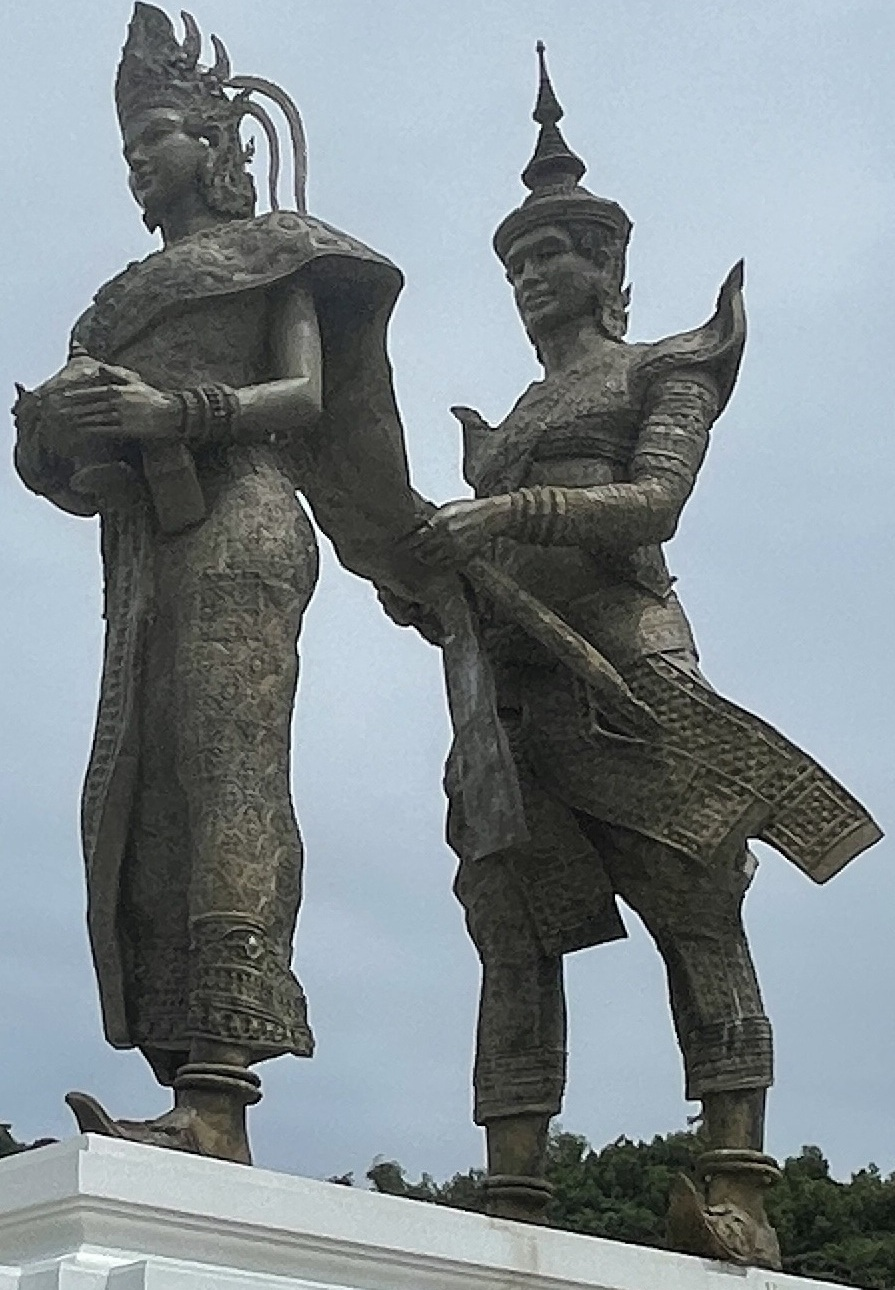
The Modern Guardian Queen Soma of Sihanoukville
It was only in 2019 that her myth took stone form in Sihanoukville. Sculpted by talented Cambodian artisans in a Phnom Penh workshop, the work measures nearly 10 meters high. Carved from reinforced concrete clad in gray stone, it depicts Soma standing, crown undulating like waves, facing the ocean.
Inaugurated in February 2019 during a lavish ceremony with apsara dances and Buddhist blessings, it was erected on a promontory overlooking the waters of the Gulf of Thailand.
The statue is more than a monument. During the COVID-19 pandemic, as casinos closed and tourists fled, Soma became a refuge. Locals prayed there for a return to normalcy, leaving offerings of flowers and incense. In 2022, with tourism resuming, it attracted thousands of visitors, immortalized in Instagram selfies, a symbol of post-crisis renewal.
Today, in 2026, it embodies the hope of a balance between rampant development and ancestral heritage, reminding fishermen, developers, and dreamers that true riches are born from the sea and memory.
In Phnom Penh, in February 2026, the Mekong whispers the name of Neang Neak during New Year; the Reamker sings her union. Soma unites the Khmers as a founding figure, from Funan rice fields to Angkor spires: a myth verified by archaeology, alive through culture.


Comments