


Yol Aularong, the Forgotten Rebel of 1970s Khmer Rock

Updated: Sep 8
He never got a statue, or a street named after him. Yet among vinyl collectors around the world, one name keeps resurfacing whenever the conversation turns to Cambodian rock of the 1960s and '70s: Yol Aularong. Far from the sentimental ballads that made stars of Sinn Sisamouth or Ros Serey Sothea, this fiery artist forged a style all his own — biting, ironic, almost punk before its time. His story, largely left in the shadows, deserves to be told.
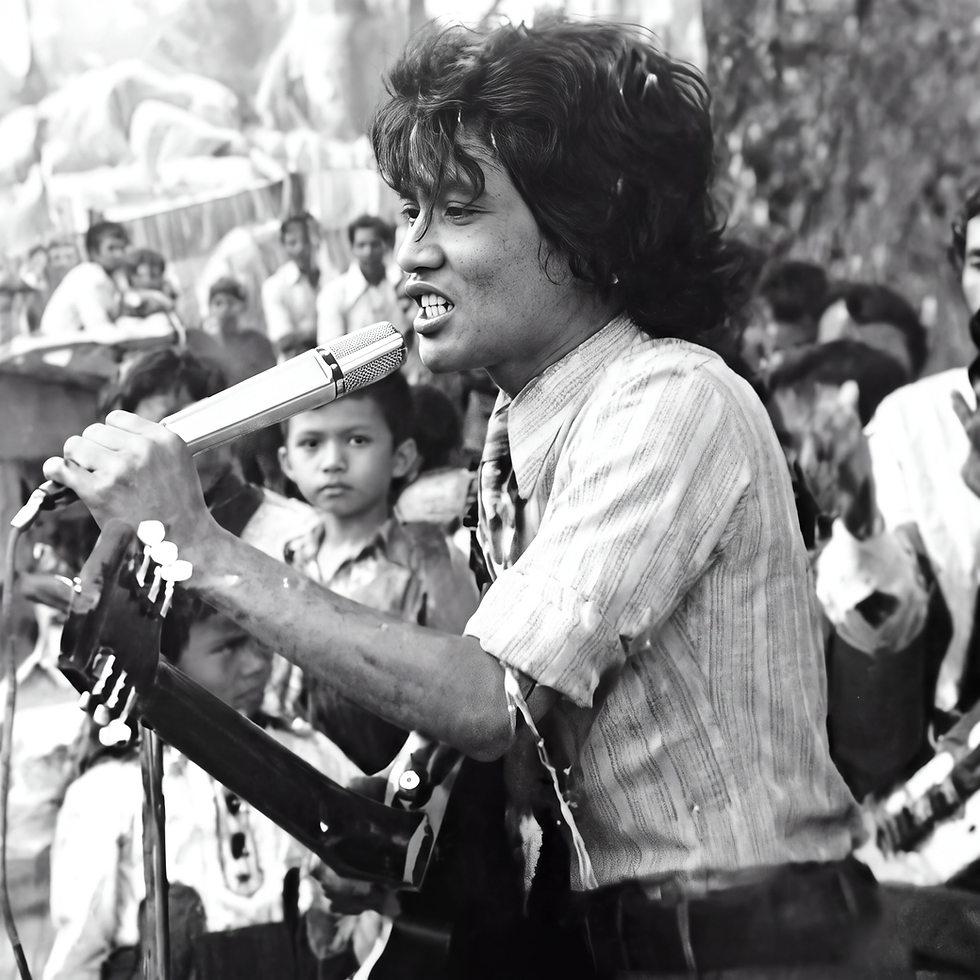
A musical heir who fell into garage rock
Born into a family where music ran deep, Yol Aularong — sometimes romanized as Yos Olarang — grew up surrounded by accomplished artists. His aunts, Sieng Vanthy and Sieng Dy, were well-known singers, while his uncle, Has Salan, was one of the most respected violinists and composers in Khmer classical music. His father held a position within Cambodia's diplomatic corps, which meant young Aularong spent part of his childhood in France.
That European interlude was far from a footnote. It goes a long way toward explaining the singularity of his sound: an electrifying blend of funk, soul, and Western psychedelic rock, grafted onto traditional Khmer vocal inflections and melodies. The result is a sound instantly recognizable — rooted in Cambodian culture, yet firmly tuned in to the Western counterculture of the era.
The bad boy who mocked the bourgeoisie
In a Phnom Penh where, throughout the 1960s and '70s, most artists sang of lost love and nostalgia, Yol Aularong stood out. He cultivated the image of a blunt, provocative bad boy. According to music historian LinDa Saphan, he was one of only two songwriters of his generation to genuinely practice social satire, alongside comedic singer Meas Samon. His songs skewered, with sharp irony, the conformism and rigid codes of Cambodia's bourgeois society at the time.
This defiance wasn't just a stage persona. A famous anecdote has him telling Prince Norodom Sirivudh a line that neatly sums up his outlook: that one being a prince and the other not made no real difference in the end, since everyone dies eventually — so they might as well share a drink together. The international press took notice: Britain's The Guardian called him a certifiable maniac, while The New York Times hailed him as a charismatic proto-punk who mocked the conformist society of his time.
A career cut short by Khmer Rouge tragedy
Like hundreds of Cambodian artists of his generation, Yol Aularong's trajectory was brutally cut short by the arrival of the Khmer Rouge. On April 17, 1975, the day Phnom Penh fell, he was last seen leaving the capital alongside his mother, swept up in the forced evacuation of the city.
In the documentary Don't Think I've Forgotten, which chronicles the lost golden age of Cambodian rock, his aunt shares her belief that he did not survive the regime. His profile as an openly Western-influenced, non-conformist musician made him an obvious target for a regime bent on erasing every trace of modernity and individuality.
A legacy revived by collectors
It wasn't until 1996, with the release of the cult compilation Cambodian Rocks — a bootleg assembled from surviving cassette tapes — that Yol Aularong's music found an audience again, this time an international one. His song Jeas Cyclo even found a second life on the New York stage, featured in playwright Lauren Yee's Cambodian Rock Band.
More than a simple wave of nostalgia, his name has become, according to The Huffington Post, a kind of generational password — a way for young Cambodians in the diaspora to reclaim their cultural identity and keep alive the memory of a musical golden age abruptly cut short.
Why his story deserves telling today
Fifty years after the fall of Phnom Penh, the memory of Cambodian rock continues to be written, piece by piece, through documentaries, vinyl reissues, and historians' research. Yol Aularong holds a place apart in that story: the free spirit, the satirist, the artist who dared to laugh in the face of an overly serious society, at the risk of his own life. Rediscovering his music today means giving justice to a singular voice that history's silence covered for far too long.


Comments