


Léonce Détroyat and Cambodia: a journalist against the Thomson convention

In 1886, a former naval officer published a book in Paris on Indochina. His name was Léonce Détroyat. He had seen Tourane in 1858, run a major newspaper and written the libretto of a Saint-Saëns opera. In one chapter, he attacks the convention forced on King Norodom in 1884, which he judged unworthy of France. Nothing suggests he ever set foot in Phnom Penh. His text remains a record of how Paris saw Cambodia, just as the kingdom was rising up.
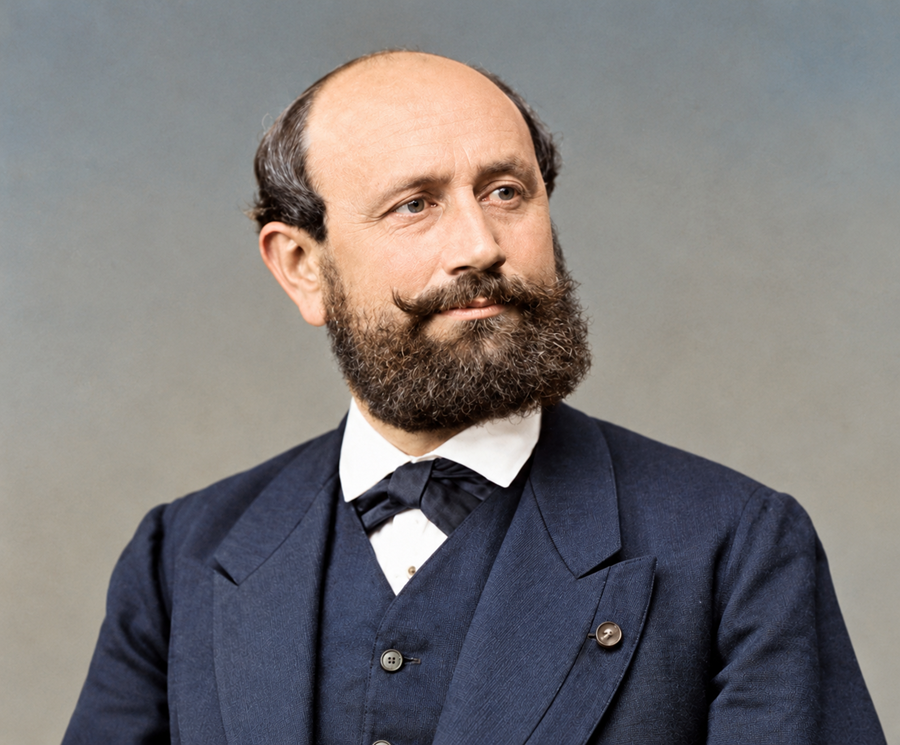
When La France dans l'Indo-Chine appeared in 1886, Cambodia had been a French protectorate for twenty-three years. It was also in open revolt. King Norodom had signed a convention on 17 June 1884 that stripped him of most of his power. His brother Si Votha had taken the lead of a rebellion.
Détroyat devotes a good part of chapter II, titled "Cochinchine – Cambodge – Siam", to the kingdom. He writes from Paris, as a reader of newspapers and treaties, not as a witness. He admits as much: for his work, he ran into "an almost total absence of official French documents".
His thesis is simple. Cochinchina, a French colony, feels smothered by Cambodia. It can only reach the north by crossing a kingdom he calls "badly administered", with abandoned roads and a border with Siam that has never been drawn. He wants France to organise the country in fiscal, commercial and military terms. A mere protectorate treaty is not enough for him.
1863, 1867: a protectorate negotiated with Bangkok
The Treaty of Oudong, of 11 August 1863, places Cambodia under French protection. But the kingdom had been paying tribute to Siam. To settle the matter, Paris signed a treaty with the King of Siam in July 1867.
Bangkok recognises the French protectorate and gives up all tribute. France promises not to incorporate Cambodia into Cochinchina. The provinces of Battambang and Angkor (Siem Reap) remain Siamese, and a commission is to fix the borders.
Détroyat calls this treaty "inept". In his eyes, the Siamese negotiator won recognition of a spoliation, committed at the end of the 18th century at the expense of Cambodia, the very country France meant to protect. The sovereigns of Phnom Penh protested one after another, Norodom included. France thus made itself "complicit" in this injustice. He says it must be repaired as soon as possible, and the "vague, undefined" situation ended.
He notes that Battambang and Angkor are the most fertile provinces in the region, with riches still to be exploited. He also reports that the King of Siam asked Governor Thomson, on 1 January 1885, to think about carrying out the treaty. Angkor would not return to Cambodia until 1907.
17 June 1884: the Thomson convention, according to Détroyat
Charles Thomson, governor of Cochinchina, signed the convention with Norodom in Phnom Penh. Paris approved it afterwards. Détroyat reproduces the full text.
The king must accept all the administrative, judicial, financial and commercial reforms that France deems useful. He "continues" to govern, but French residents are placed in the provinces, under a resident general. Taxes, customs and public works pass under French control. The king's civil list is set at 300,000 piastres, the princes' allowance at 25,000. Slavery is abolished. Land ceases to be the inalienable property of the crown. The city of Phnom Penh gets a municipal commission with French members, Cambodians, an Annamite, a Chinese and a Malay.
Détroyat's verdict is harsh. Telling a king that he will go on reigning while stripping him of the prerogatives of royalty is to inflict on him the humiliations of vassalage. He sees it as an act unworthy of France. He does not question Thomson's good faith, and describes him as driven by excellent intentions. But Thomson, he writes, was mistaken in forcing "old Norodom" to sign his own shame.
His criticism is no defence of the king. He would have preferred, a thousand times over, that France depose Norodom, ship him off to Poulo Condore and take "squarely" possession of Cambodia, even if that meant ignoring the 1867 treaty.
Filippini, Si Votha and the "pope of the bonzes"
Thomson is recalled. His successor, Ange Michel Filippini, is a former prefect of the Loire. Détroyat attributes the change to the influence of the deputy for Saigon, Blancsubé, whom he accuses of defending Norodom's interests. He gives no proof in the pages read.
Filippini arrives in Phnom Penh on 22 July 1886, "armed with full powers". He denounces the convention. Détroyat quotes at length a letter from a correspondent, published by Les Tablettes des Charentes. It describes a new agreement: France returns the administration of the kingdom to the king, except the opium monopoly and the customs. On 1 January 1887, only four French residencies will remain: Pursat, Kratié, Kompong Thom and Kampot. Norodom proclaims an amnesty. Princes and ministers set out to carry messages of peace, escorted by French soldiers, with 100 Gras rifles and 10,000 cartridges per mission. According to another correspondent, Cambodian militiamen are deserting to join the rebels.
For Détroyat, this is worse than the convention. He quotes La Liberté, the paper he ran until 1876: the concessions made to Norodom were taken for weakness. Supporters of the new policy argue that the convention served as a pretext for the revolt, so it is enough to denounce it. He does not believe it. He almost misses Thomson, who would have needed, he writes, an act of force from the mainland and three thousand men. Norodom would then have faced a choice: be locked up, or hand over Si Votha's agents.
For he accuses the king himself. Withdrawn in his palace, "dulled by opium", Norodom is said to be encouraging the insurrection led by his brother. Si Votha's weapons are supposed to come from Siam via Battambang, under the nose of the resident at Kompong Thom. These are his accusations, not established facts.
He also tells a scene from 1885. The "pope of the bonzes" of Cambodia, Si Votha's former tutor, is said to have gone to see him in the name of the governor and Norodom. He offered a pension if Si Votha stopped fighting. Si Votha supposedly made the offer known to his followers to build up his prestige, then swore to carry on. The monk even blessed the water of the oath. The rebel then entrusted him with a letter to the British consul in Bangkok, asking for money and arms. Détroyat cites no source. He draws a conclusion: such "treachery" would be found everywhere in the Far East.
The revolt ended under Filippini's governorship. He died in Saigon on 22 October 1887.
Mekong, Battambang, Angkor: Détroyat's map
Détroyat is interested in Cambodia as a trade corridor. He distinguishes two currents. To the west, the Menam, which crosses Siam and reaches the sea at Bangkok, where English influence dominates. To the east, the Mekong, 2,000 kilometres long, navigable almost everywhere, especially through Cambodia and Cochinchina. He writes that this river can become as French as the Menam is English.
Yet, he observes, the products of the countries north of Cambodia go to Bangkok along dreadful roads, rather than to the ports of Cochinchina. He describes Korat, in the heart of Siam, a vast warehouse where caravans trade their goods, with merchants who are almost all Chinese. Many travellers make a detour through Battambang to avoid the forest around the town. France, he says, has never thought of posting an agent there.
He recalls that a telegraph line once linked Bangkok to Phnom Penh, via Battambang and Pursat, thanks to Harmand, a former French chargé d'affaires in Bangkok. He has heard it was partly destroyed.
He also sees Siam as a player to be handled with care. The only independent kingdom in Indochina, it distrusts France, which English policy presents as aggressive. According to Détroyat, the 1884 convention seemed to prove Paris's enemies right, and the Tonkin expedition heightened Bangkok's fears.
Pavie, "a telegraph employee"
One detail will amuse Cambodge Mag readers. Détroyat pokes fun at the appointment, a few months earlier, of a vice-consul at Luang Prabang: "a very decent fellow", but a telegraph employee in Cambodia. That man is Auguste Pavie. The post was given to him, Détroyat writes, as a reward for a trip to Paris, where he accompanied young Cambodians sent to study.
Pavie has now been in Bangkok for months, waiting to set off. "Will he ever reach his destination?" the author asks. He adds that the telegraph can lead a long way, even to diplomacy.
Events proved him wrong. Pavie spent the following years exploring Laos and the Mekong basin, and his name remains tied to the entry of Laos into French Indochina. Cambodge Mag has traced his career.
A colonial gaze, to be read with distance
The book is of its time. Détroyat speaks of peoples "almost savage" and of "Asiatic perfidy". He reasons in terms of trade, prestige and rivalry with Britain. No Cambodian voice appears in the pages read. Norodom is sometimes an obstacle, sometimes a pawn. The Cambodians who fight are "rebels".
For the other side of the story, Cambodge Mag has told how Norodom I negotiated with French gunboats outside his palace, and how, in the 1860s, the monk Pou Kombo raised a kingdom against the crown and France.
Did Détroyat ever go to Cambodia?
None of the biographical notices consulted mentions a stay. His Indochina campaign took place in 1858–1860, around Tourane, five years before the protectorate. His book draws on the press, on the text of the treaties and on the report of the deputy de Lanessan. He cites the latter, while reproaching him for sticking to geography.
This article rests on the pages of chapter II devoted to Cambodia, roughly pages 57 to 80. Catalogues also attribute two pamphlets to him, Possessions françaises dans l'Indo-Chine (1887) and Notes sur l'organisation générale civile et militaire de l'Indo-Chine (1888). They were not consulted.
Who was Léonce Détroyat?
Born in Bayonne in 1829, died in Paris in 1898. A naval officer until 1867, then a newspaper director, an auxiliary general in 1870, and afterwards a librettist. The sections below follow these stages.
A Bayonne native at the naval school
Pierre Léonce Détroyat was born on 7 September 1829 in Bayonne, rue du Bourgneuf. His father, Jean Théodore, had been a saddler, then a mail-coach courier. He sat on the municipal council and would end as president of the chamber of commerce.
The family came from La Chatte, in the Dauphiné. An ancestor, Pierre, settled in Bayonne in 1774. His descendants went into banking, trade and military careers. Several attended the local Masonic lodge, La Zélée.
Léonce's mother, Marie Julie Passement, came from a more modest background. Her father was a tailor, in a working-class district. The Détroyats lived on the other side of the Nive, and in Bayonne the side of the river a family lived on showed its social rank. The family took time to accept the marriage. Births calmed things down: two boys, Léonce and Henri, and two girls, Caroline and Camille.
Léonce studied at Pons, in Charente-Inférieure, then at the Aumale school in Lorient, which prepared pupils for the naval school. He entered at Brest on 4 October 1845. Two years later, he left the training ship Le Borda as a 2nd-class midshipman.
Over the next fifteen years, he served on sailing ships, paddle steamers, then propeller ships. His career followed the shift to steam. It included three campaigns: the Crimea, Tourane, Mexico. His file says almost nothing of his role in the Crimea.
Tourane 1858: a naval ensign in Indochina
His first major expedition took him to Annam. An ensign, Détroyat left Brest on 4 March 1858 aboard the Saône, an old propeller ship carrying 600 troops and 22 officers. He shared a cramped battery with five other ensigns. He slept in a hammock.
The stopovers followed one another: Tenerife, Gorée, the Cape, then Île Bourbon, where Bayonne cousins, the Dousdèbès, welcomed him. The ship passed through the Strait of Malacca, Singapore, Hong Kong. Near Hainan, the expeditionary corps met the Spaniards who had come from the Philippines.
On 5 September, Détroyat commanded a battery aboard the corvette Primauguet, in the bay of Tourane, today's Da Nang. He took part in the engagements that led to the capture of the port. In letters to his mother and his brother Henri, he describes cruel fighting, on both sides. In 1859, a spear wound hit him during the taking of a fort. He was mentioned in the squadron's orders, made a knight of the Legion of Honour and received the Cross of St Ferdinand of Spain, reserved for acts of bravery on the battlefield. He often served under Commander Jauréguiberry, a fellow Bayonne man.
The Franco-Spanish expedition first meant to punish the court of Hué, accused of persecuting missionaries. Admiral Rigault de Genouilly had Tourane bombarded, then turned to Saigon, which fell on 17 February 1859. What was meant to be a punitive operation became a conquest, slow and difficult. In 1863, King Norodom signed the treaty that placed Cambodia under French protectorate. In 1887, France merged its possessions into the Indochinese Union.
The notices consulted report no stay by Détroyat in Cambodia. But he took part in the first act of the conquest of Indochina, and he would return to the subject in writing in 1886 (see above).
In January 1860, he commanded the merchant ship L'Asce, tasked with bringing wounded and convalescent men back to France. He was promoted to lieutenant on 11 July 1860.
Mexico: secretary to Emperor Maximilian
Two years later, the other side of the world. Napoleon III wanted to install a Catholic empire in Mexico, allied to France. On 10 July 1862, Détroyat was placed at the disposal of the vice-admiral commanding the naval forces of the Gulf of Mexico.
He was first stationed off Veracruz. Then he fought on land: the march on Jalapa, the fighting at Puebla in May 1863. In Mexico City, he became orderly officer to Generals Berthier and Douay, then joined Bazaine's staff. Mentioned in despatches on 20 February 1864 for the taking of Tocatische, he was made an officer of the Legion of Honour.
Archduke Maximilian of Austria, proclaimed emperor, landed at Veracruz on 28 May 1864. He took Détroyat into his cabinet, probably because the officer spoke fluent Spanish and a little German. On 25 November, on the emperor's orders, Bazaine seconded him to the Mexican Ministry of War as secretary of state for the Navy. In March 1866, Maximilian gave him his private secretariat as well, and the senior direction of military affairs. Détroyat then lived at court, in Chapultepec castle.
His position was uncomfortable. He acted as go-between for the emperor and Marshal Bazaine, whose despatches to Paris were far more optimistic than the situation. The American Civil War was over, and the United States were turning threatening. Détroyat quickly understood that Napoleon III would seek to withdraw. He tried to convince Maximilian.
Bazaine took it badly. On 22 March 1866, he asked that the officer be returned to the Navy's disposal. He judged his duties pointless and complained of rumours of palace intrigue. Some historians have wondered whether this meant ties with Empress Charlotte. The sources consulted do not confirm it.
On 7 May, Détroyat received the order to return. He begged Maximilian to abdicate. The emperor refused, but asked him to accompany Charlotte to Europe. They left Mexico City on 1 July 1866 and embarked on 10 July on the steamer L'Impératrice Eugénie. A month later, they landed at Saint-Nazaire.
Charlotte pleaded the cause of the Mexican empire in Paris. The reception was icy. She left for Belgium and would gradually lose her reason on learning what followed. Maximilian would be shot at Querétaro in June 1867.
In Paris, Détroyat denounced Bazaine's methods to Navy officials. No one believed him. Now under suspicion, he was no longer allowed to return to Mexico. In December 1866, he was assigned to the Navy's depot of maps and plans, to write reports on the war. He left the Navy in the spring of 1867.
From the Navy to La Liberté: a fighting journalist
On 20 December 1866, at the Madeleine church in Paris, he married Hélène Louise Garre. He was 38, she was 22. Her mother, Isaure, gave English lessons. Her grandmother, Sophie Gay, had run a salon frequented by the literary, artistic and political celebrities of the day. Her aunt, Delphine Gay, had married Émile de Girardin, the future "emperor of the press".
Girardin, a widower since 1855 and childless, was very attached to his niece. He would be godfather to their son Maurice, born in 1868.
This marriage decided what came next. Now Girardin's nephew, Détroyat turned to journalism and skipped the first fumbling steps. He began in La Liberté, a liberal paper of the Second Empire, under the pen name L. de Bourgneuf, a name recalling his birth street. He wrote on the Spanish question and on army reorganisation. On 31 May 1870, Girardin handed the paper over to him. He would run it until 1876.
He argued with courtesy and fire. Rochefort, whom he had taken on, answered with a pun on his name, which he conjugated like a verb.
1870: an auxiliary general
War broke out. Détroyat first stayed in Paris, then moved La Liberté to Bordeaux. Gambetta offered him the job of centralising the provincial generals' correspondence, with the title of secretary general of National Defence. He refused. On 6 December, he did accept command of the La Rochelle camp, with the rank of auxiliary general of division. He stayed there until the armistice.
In the elections of 8 February 1871, he stood in Indre-et-Loire. Bismarck opposed certain candidacies, his among them. A supporter of war to the bitter end, Détroyat had to leave Tours in haste, chased by the Prussian military authority.
With peace restored, he took up the pen again. He opposed the attempt at a monarchist restoration and backed the Bonapartists of the Appeal to the People. In 1877, he stood in Neuilly-sur-Seine. The sitting deputy won.
A series of newspapers
After La Liberté, he founded and ran other titles. Le Bon Sens soon merged with L'Estafette, where he became editor-in-chief. He made it a lively paper that stood out in Paris for the speed of its news. In 1885, he briefly ran Le Constitutionnel and turned it republican. In Madrid, he launched La Europa, which did not last.
He also published books and pamphlets: La Cour de Rome et l'empereur Maximilien and L'Intervention française au Mexique, both in 1868 according to the notice in Parcours de vies dans la Royale, then, among others, Du recrutement, de l'organisation et de l'instruction de l'armée française (1870) and La Liberté de l'enseignement et les projets de Jules Ferry (1879).
Henry VIII: the libretto for Saint-Saëns
Détroyat had always loved music. He became close to Gounod, Messager, Godard, Théodore Dubois, Camille Saint-Saëns. He became a librettist.
His best-known title is Henry VIII. He wrote the libretto with Armand Silvestre, from Calderón's play El cisma en Inglaterra, which tells of the king's passion for Anne Boleyn and the break with Rome. He first offered it to Gounod, who declined. Saint-Saëns accepted.
The opera premiered at the Paris Opera on 5 March 1883. It stayed in the house's repertoire until 1919. According to Grove, it is, after Samson and Delilah, Saint-Saëns's biggest opera success. It is still staged: La Monnaie in Brussels presented it in a production by Olivier Py, and the Bard SummerScape festival in the United States gave its first major American production in 2023.
Other works followed:
• Pedro de Zalamea, an opera by Benjamin Godard (1884), written with A. de Lauzières
• Aben-Hamet, an opera by Théodore Dubois, after Chateaubriand, whose libretto he wrote alone
• Djemmah, a Persian ballet by Francis Thomé (1886), with E. Pluque
He also wrote a comedy, Entre l'enclume et le marteau. He dreamed of founding a new lyric theatre for Paris. The project was announced with great fanfare in the press, then failed. For a few months, he ran the Théâtre de la Renaissance, where Messager's Madame Chrysanthème was staged.
Tchaikovsky and Sadia, the opera never written
In 1888, Détroyat and the librettist Louis Gallet, who carried weight in the press and at the Opera, tried to draw Tchaikovsky toward an opera in French, meant for Paris. Détroyat sent an outline, La Géorgienne. In a letter of 22 May 1888, the composer tactfully declined. In June, he also refused a subject taken from Musset.
Tchaikovsky then proposed a subject himself: Goethe's ballad The God and the Bayadere. To avoid comparison with Auber's 1830 opera-ballet, Détroyat turned the heroine, Sadia, into a singer. The work would be called Sadia, or The Courtesan.
The two men met in Paris on 3 April 1889. A week later, Tchaikovsky wrote to his nephew that it was settled: he would write this French opera. In July 1889, he received the libretto of the first act. He found it "very fine" and promised the score for the end of summer 1890.
It never came. Tchaikovsky piled up commissions from the Imperial Directorate: a ballet, then The Queen of Spades, premiered in the meantime in Saint Petersburg. Détroyat pressed him. He claimed to have found a Paris theatre ready to stage the work. Tchaikovsky handled him gently and promised the music for later. No sketch of Sadia is known. His brother Modest would note that the opera was never begun.
What remains is the correspondence: nine letters from Tchaikovsky to Détroyat, from 1888 to 1890, and fifteen letters from Détroyat to the composer, from 1888 to 1891, kept at the Klin museum.
The last years
After leaving La Liberté, Détroyat faded from view. He fell ill. He was seen, melancholy, around the Opera. Unlucky speculations cost him a good part of his fortune.
He died on 18 January 1898, aged 68, at his home in rue d'Isly, Paris, after a stroke a few weeks earlier. The funeral took place at the church of Saint-Louis-d'Antin. His son Maurice, a graduate of the École polytechnique, and his brother Henri led the mourners. An infantry company rendered military honours. He was buried at Père-Lachaise.
The Paris press ran obituaries. Jacques Rigaud, in Le Figaro, drew a portrait without indulgence. He granted him a great ability to absorb things, real kindness and no rancour. He reproached him for having touched everything without ever rising above an honest average, and for having left the Navy, where he could have gone very high. In his eyes, Détroyat was not a superior man but "an agitated man". Rigaud also paid tribute to Hélène, who stayed with him to the end.
Another Détroyat would make headlines in the next century: his cousin Michel (1905–1956), a test and aerobatic pilot nicknamed "the horseman of the sky".



Comments