


Shadows of the Khmer Rouge: Reconciliation in Veal Veng
- Youk Chhang

- Feb 23
- 4 min read
In the lush green hills of Veal Veng, in the Cardamom Mountains near the Thai border, the Khmer Rouge past lingers like a mist over the forest trails of Thmar Da and the streams of O’Plouk Damrei.
This remote district in Pursat Province, a former Khmer Rouge stronghold, now hosts the Veal Veng Reconciliation Center, a branch of the Documentation Center of Cambodia (DC-Cam), dedicated to collecting testimonies and educating about the genocide of Democratic Kampuchea (1975-1979).
Three former fighters share their stories: Long Thon, Bou Rina, and Oum Seng, once seen as enemies by many, have become farmers, grandparents, and neighbors, embodying the slow reconciliation of a fractured nation.
Long Thon’s Military Journey: From Phnom Penh to Rural Peace
Long Thon, 76 years old, now lives in Promoy commune, Veal Veng district. Originally from Kampong Chhnang, this young man joined the Khmer Rouge in 1972, in the wake of the 1970 coup against Prince Norodom Sihanouk. Initially in charge of propaganda and education, he rose through the ranks to become deputy battalion commander in Division 1, Southwest Zone (Kampot, Takeo, Kampong Speu). In April 1975, his unit advanced toward Phnom Penh from the northwest approaches, participating in the fall of the capital.

After the victory, Thon escorted Chinese technicians for the construction of Kampong Chhnang airport. The 1979 Vietnamese invasion forced his unit to flee: 300 men hid in the forests of Krakor and Phnom Kravanh, surviving on tubers and rice taken from fields.
In 1981, he reached the Thai border at Thmar Da – nicknamed “Phteah Pir” (the Two Houses) for its open-walled shelters from the Democratic Kampuchea era. Near O’Plouk Damrei (“stream where the elephant bathes”), littered with elephant bones, the site then housed up to 5,000 people: soldiers, transport units, doctors, and civilians, including the Division 2 hospital.
Wounded in 1982 by a B-40 rocket fragment during clashes against Vietnamese forces and the People’s Republic of Kampuchea (PRK), Thon recovered for two months in a field hospital, observing from a hill Thai villagers harvesting grass with sickles and occasionally talking with Khmer-ethnic Thai soldiers.
In 1985, the Vietnamese and PRK offensive swept through Thmar Da, pushing his unit to the Thai border's edge. The 1996 reintegration of Khmer Rouge, driven by the Cambodian government, saw him join Brigade 71 at Thmar Da, now part of the national army.
Demobilized in the early 2000s, he farms his land in Pursat, where forests once theaters of combat now rustle in silence. This district, created in 1996 after reintegration, includes five communes (Pramoy, Anlong Reap, O Ta Som, Kra Peu Pi, Thma Da) and over 13,800 inhabitants, more than half former Khmer Rouge cadres.
Bou Rina: A Childhood Stolen by Bombs and Death Marches
Bou Rina, 63 years old, a farmer in Anlong Reap commune, bears the scars of a war that struck her as a child. Born in Kandal, she saw her village razed by American B-52s in 1972.
A refugee in Phnom Penh's Boeng Trabek neighborhood, she returned to school until the forced evacuation of April 17, 1975: by ox cart to Kandal, a horrific sight along roads lined with soldiers' corpses.

Separated from her family at Chak Angre Krom, she joined a children's unit: morning study, then labor – guarding livestock, harvesting rice, gathering. Meals? Porridge, rice mixed with corn, beans, or cassava.
In 1978, she was assigned to a pigsty; her parents exiled to Koh Kong salt marshes left her in tears.
January 1979: fall of the Khmer Rouge regime. With her sister, she began a walking odyssey westward – Kampong Speu, Kampong Chhnang, Battambang – surviving on banana trunks and papaya stems, until Thailand.
At Thmar Da, in Transport Unit 50 under Roeun, she carried supplies and munitions from border posts to outposts, two to three trips daily on steep trails. During the 1984-1985 offensives, she transported munitions day and night to defend the Me Toek bridge; a Vietnamese mine tore her leg, sidelining her for months before resuming service.
In 1986, dismantling of Khmer Rouge divisions: she settled in Samlot (Battambang), married a nurse. In 2000, the couple moved to Krang Reng.
Oum Seng: From Teenage Guerrilla to Serene Grandfather
Oum Seng, 77 years old, alias Chhon, joined at 17 in 1968, leaving school in Kampong Chhnang for the maquis of Oral where embryonic networks of future Khmer Rouge leaders operated.
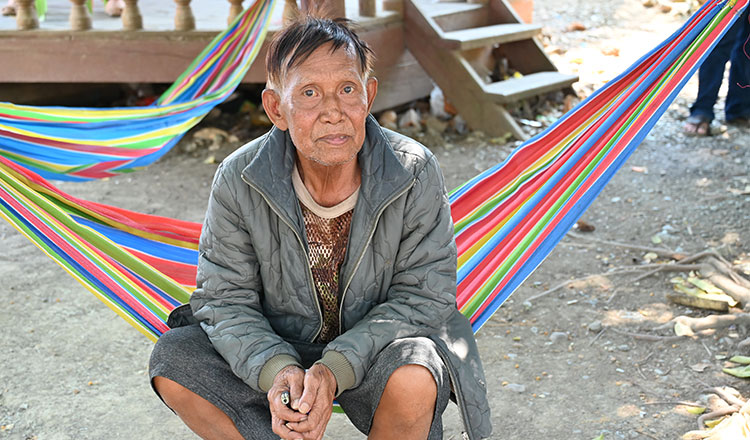
In 1969, he joined the “Vanguard Forces,” precursors to structured divisions. Leader of Regiment 52 then Division 919 on the northwest front (Kampong Chhnang, Kampong Speu), he witnessed post-1970 expansion.
Neighbor of Bou Rina in Anlong Reap, father of five granddaughters, he traded weapons for the hoe, ideology for village tranquility.
Veal Veng: From Red Bastion to Collective Memory
These lives – bush hospitals, border skirmishes, hunger, wounds, retreats – weave Cambodia’s turbulent history (1970-1990). Veal Veng, Sector 6 of the Northwest Zone under Democratic Kampuchea, showcase of deadly forced transfers (famine, overwork, executions), served as a post-1979 refuge for Khmer Rouge cadres fleeing to Thailand, harassing Vietnamese and PRK with Divisions 2 and 3.
The DC-Cam center promotes genocide education there: school forums, historical visits (O’Neary, Khmer Rouge railways), care for 220 survivors, support for Por disabled.
Without absolving or judging, these voices, recorded at the center, weave a complex legacy: ideology, survival, shifting alliances. Fifty years after the first shots, these battlefields forge reconciliation – not to reopen wounds, but to probe national resilience, where ruins may breed peace.


Comments