


Rescuing dogs and cats, and a café on the way: the Dirty Paws story

We met her at the Forum de rentrée of the French-speaking community, on Saturday 12 September, in the gardens of the French Institute in Phnom Penh. Marie Thach is 31. She is a content creator, a DJ and a former shop owner. For seven and a half years she has also been picking sick dogs off the streets of Cambodia. Severaol dozens of them now live with her, and she is opening a café for dogs and cats.

A shop at 18, then something else
Marie Thach is Cambodian and lives in Phnom Penh. She went to Zaman, the international school opened in the capital in 1997 by a Turkish education network and since renamed Paragon International School. She then started an English degree at university. “Two years, and that was it. I left school and started my own business.”
She was 18. She opened a clothing shop — not a label of her own, imported stock. She ran it for six years, then stopped. Singing followed, then acting, and a film. “I’ve tried a lot of things in my life.” These days she DJs: under the name Marie Thach she has played house and funk at the large mural festival backed by Tiger Beer in Phnom Penh, alongside singer Nikki Nikki.
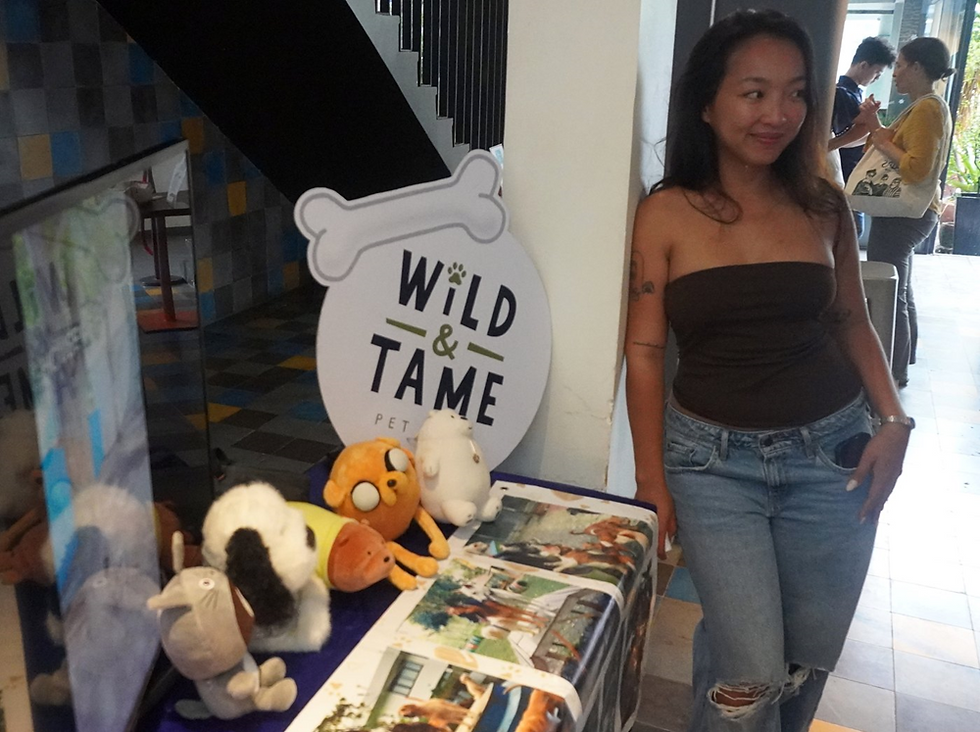
Dirty Paws, seven and a half years of picking up strays
The shelter is called Dirty Paws. It has no office and no shopfront: it is her home. Several dozens of dogs and cats, six to seven paid staff. No volunteers. “They are all employees.”
She does not take in every dog she comes across. “I don’t pick up everyone.” She targets injured animals and those that pose a risk to the rest. Her example is TVT, canine transmissible venereal tumour. It is one of the few contagious cancers known: the tumour cells pass from one animal to another, mainly during mating, and take hold in a new host. The standard treatment is vincristine, given in weekly injections, and the disease spreads all the more easily where street populations are neither treated nor sterilised. “If I save one, I stop ten or twenty from catching the same thing.”

“After Covid, everybody left”
The original model was the classic one: rescue, treat, rehome. It worked. It no longer does. “It was hard, but it worked. Now there is no adoption. There is nobody left. After Covid, everybody left.”
The sixty dogs are adults, many of them marked by their past. She has no illusions: nobody is coming for them. She will keep them to the end.
Marketing pays for the kibble
None of this is funded by donors. Marie Thach is a content creator: photography, video, marketing for restaurants and companies. That work pays for the food, the wages and the vet. “It brings in money. It’s hard right now, but I work a lot so I can take care of them.”
The shelter’s Instagram account, @dirtypawscambodia, followed by close to 6,000 people, serves as its window and its donation channel, with a bank account number posted in plain sight.
She puts it without any fuss. “I take a lot from the world. I use plastic, I eat. It’s a philosophical thing. This is my way of giving back.”
A café for dogs and cats
Her current project is an animal café, open to dogs as well as cats, in Kep, a stone’s throw from the Independence Monument. An old house she is renovating herself. On the day of the interview the building site was “one month and twelve days” old. She works on it every day.
The plot is roughly thirty metres by sixty. The café will occupy the front, with one or two dogs to greet visitors; the residents will be at the back. The idea is not purely commercial. “They are going to die one day or another. I want people to come, to know them while they are alive, to keep memories.”

The format already exists in the capital: Ministry of Cat, opened by an Australian-Spanish duo and supplied with residents by the charity Animal Rescue Cambodia, has served as a feline adoption café there for several years. Marie Thach is widening it to dogs.
Three million dogs a year
Her work takes place against a heavy backdrop. The Austrian organisation Four Paws estimates that two to three million dogs are killed every year in Cambodia for their meat. In July 2020 Siem Reap became the first province in the kingdom to ban the catching, buying, selling and slaughtering of dogs, with penalties of up to five years in prison and fines of 50 million riel.
The ban did not put an end to the trade: it pushed it out of sight. In May 2026 the NGO Animals of Our World, which runs the House of Strays sanctuary in Siem Reap, launched a campaign to extend the model nationwide. Its staff point out that Cambodia has one of the highest rabies death rates per capita in the world, and that most of the dogs roaming freely are not strays at all: they belong to someone. The ratio runs between one dog for every 2.8 people and one for every 4.8.
Marie Thach is not campaigning. She works at the scale of the animal in front of her.
And wildlife too
She also picks up wild animals from time to time and hands them over to CWC, Cambodia Wildlife Conservation. The organisation is recent. Among its people is Nick Marx, for years head of wildlife rescue and care at Wildlife Alliance and a familiar figure at the Phnom Tamao centre, now a biodiversity adviser to the APSARA Authority; CWC, headed by Try Sitheng, takes part in species reintroductions in the Angkor forest.
Marie Thach knows how hard it is. “Finding donations is very hard. Working with wildlife is hard.”
What she likes, what she doesn’t
One last question, the ritual one. What she likes most about Cambodia: “It’s authentic, it’s original, it’s real. I love the people here, and the architecture.” What she does not like: the rubbish and the politics. The traffic? “It’s fine. I’ve seen worse.”
She gives no opening date for the café. She goes back to the building site.


Comments