


Psar Kdam, the Crab Market of Kep: A Century of History Facing the Sea

At the end of a wooden pier battered by winds off the gulf, under sun-bleached parasols, a handful of families have kept up the same routine for a century: sorting, tying, cooking and selling Kep's blue crab. Psar Kdam, the “crab market,” is not simply a tasty stop on the road to Kampot. It is the living memory of a town that lost almost everything — except its bond with the sea.
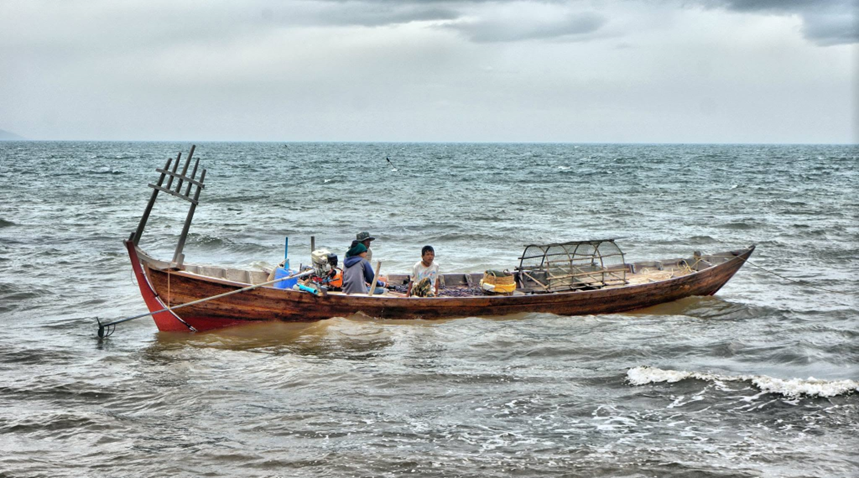
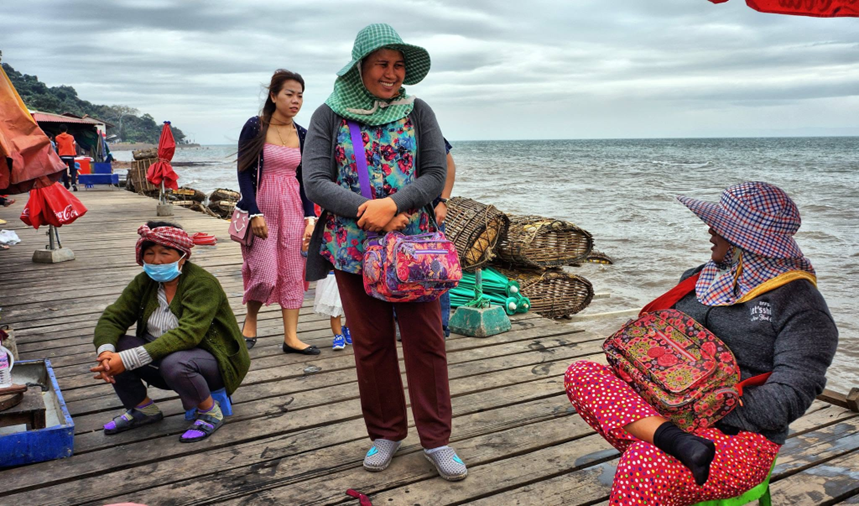
It is still early when the first boats come in, their hulls loaded with bamboo traps and wire-mesh crates. The sky hangs low, the colour of pewter, and the murky water of the gulf rolls ochre swells onto the sand. On the pier, the women are already waiting, bent over plastic tubs, ready to sort the day's catch. This is Kep, in southern Cambodia, where one of the country's most endearing rituals has played out for generations: the arrival of the blue crab.
A Town Built for Leisure, Destroyed by War
The market's story cannot be told without the story of the town that hosts it. Kep is no ancient city: it is a colonial invention, founded in 1908 under the French protectorate under the name Kep-sur-Mer. French administrators saw it as a coastal refuge for civil servants and for the Cambodian elite, fleeing the heat of Phnom Penh. Modernist villas rose on the hills, designed later, in the 1950s and 1960s, by young Khmer architects trained in France, blending Indochinese Art Deco with the clean lines of the modern movement. Kep became the kingdom's most fashionable resort, nicknamed by some the “Saint-Tropez of Asia,” favoured by the royal family as much as by Phnom Penh's bourgeoisie.
Then came the war. Under the Khmer Rouge, from 1975 onward, the town was emptied of its residents, its villas looted, dynamited or left to the weeds. For nearly three decades, Kep was little more than a landscape of ruins and rubble, a “town with nothing left,” as some travellers passing through in the early 2000s described it. But amid this field of scorched stone, one activity never stopped: fishing. And with it, on that very same strip of sand, the small market where the catch was sold.
Phsar Kdam, the Heart That Never Stopped Beating
The crab market — Phsar Kdam in Khmer — today occupies a covered area of roughly 1,600 square metres, separated from the sea by a long wooden pier where fishermen unload their catch directly. Its origins trace back to the interwar years, when the first seafood sellers set up to feed the wealthy holidaymakers of the young resort town. Most of today's stalls still belong to the same families who were already fishing these waters decades ago. After years of silence, the market truly came back to life around the turn of the 2000s, carried by the gradual return of visitors and the growing reputation of Kep crab, now the unofficial symbol of the entire province: a giant blue crab statue even welcomes visitors at the entrance to the bay.
It is still early when the first boats come in, their hulls loaded with bamboo traps and wire-mesh crates. The sky hangs low, the colour of pewter, and the murky water of the gulf rolls ochre swells onto the sand. On the pier, the women are already waiting, bent over plastic tubs, ready to sort the day's catch. This is Kep, in southern Cambodia, where one of the country's most endearing rituals has played out for generations: the arrival of the blue crab.
A Town Built for Leisure, Destroyed by War
The market's story cannot be told without the story of the town that hosts it. Kep is no ancient city: it is a colonial invention, founded in 1908 under the French protectorate under the name Kep-sur-Mer. French administrators saw it as a coastal refuge for civil servants and for the Cambodian elite, fleeing the heat of Phnom Penh. Modernist villas rose on the hills, designed later, in the 1950s and 1960s, by young Khmer architects trained in France, blending Indochinese Art Deco with the clean lines of the modern movement. Kep became the kingdom's most fashionable resort, nicknamed by some the “Saint-Tropez of Asia,” favoured by the royal family as much as by Phnom Penh's bourgeoisie.
Then came the war. Under the Khmer Rouge, from 1975 onward, the town was emptied of its residents, its villas looted, dynamited or left to the weeds. For nearly three decades, Kep was little more than a landscape of ruins and rubble, a “town with nothing left,” as some travellers passing through in the early 2000s described it. But amid this field of scorched stone, one activity never stopped: fishing. And with it, on that very same strip of sand, the small market where the catch was sold.
Phsar Kdam, the Heart That Never Stopped Beating
The crab market — Phsar Kdam in Khmer — today occupies a covered area of roughly 1,600 square metres, separated from the sea by a long wooden pier where fishermen unload their catch directly. Its origins trace back to the interwar years, when the first seafood sellers set up to feed the wealthy holidaymakers of the young resort town. Most of today's stalls still belong to the same families who were already fishing these waters decades ago. After years of silence, the market truly came back to life around the turn of the 2000s, carried by the gradual return of visitors and the growing reputation of Kep crab, now the unofficial symbol of the entire province: a giant blue crab statue even welcomes visitors at the entrance to the bay.
The Guardians of the Crab
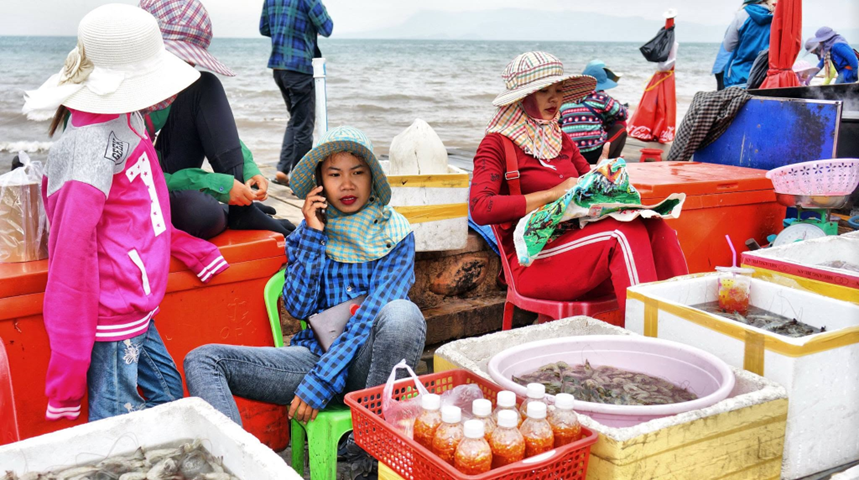
They are the ones who keep the market beating. Wearing wide-brimmed hats or checked krama scarves knotted against the wind, the vendors — many from the Cham Muslim minority, long settled on this coast — are hard at work from dawn. They separate fish from shellfish, tie the crabs' claws with strips of palm leaf or elastic bands, and fill baskets and tubs with seawater to keep the goods alive until sale. Between transactions, the haggling grows loud, the laughter louder still: bargaining at Psar Kdam has less to do with confrontation than with theatre, a ritual verbal joust in which everyone already knows, more or less, what the final price will be.
A little further along the pier, other women use a lull in trade to catch their breath: an e-cigarette, a scratch card, a phone call sheltered under an old, salt-worn Coca-Cola umbrella. The setting is modest, almost bare — chipped basins, mismatched plastic stools, makeshift coolers — but the atmosphere is immediately warm.
From Trap to Cooking Pot, in a Few Steps
What strikes visitors at Psar Kdam is how short the distance is between sea and plate. Bamboo traps are still bobbing just offshore when the first woks begin heating over wood-fired stoves. All along the pier, blackened pots and woks are constantly steaming: here, blue crab is seared with freshly crushed Kampot green pepper, the dish that made the town famous far beyond Cambodia's borders. Visitors lean over the braziers, watching the crabs plunge into boiling water under the amused eye of the cooks.

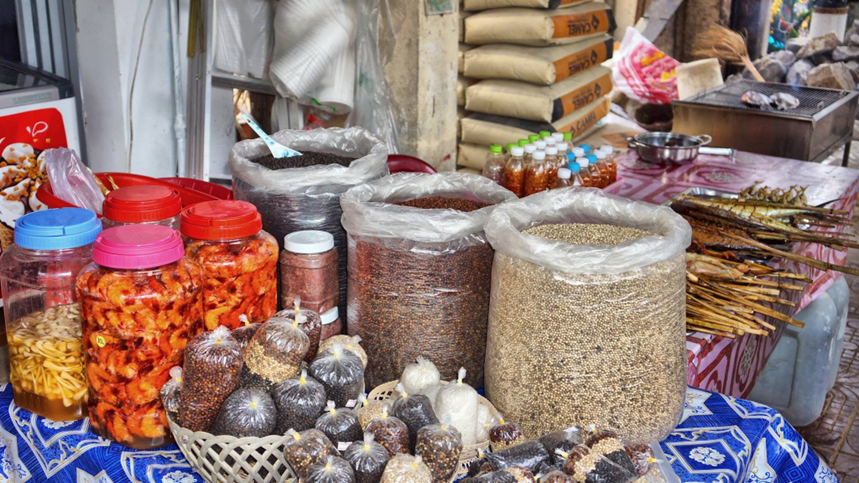
Around the market, the stalls also overflow with the products that accompany the crab: Kampot peppercorns, marinated dried shrimp, smoked fish threaded onto bamboo skewers. Together with the star crustacean, these flavours make up the culinary identity of the whole province.
A Family Economy, a Fragile Heritage
Behind the folklore, Psar Kdam remains, above all, a demanding place of work. Experienced vendors sell an average of several dozen kilograms of crab a day, more during peak tourist season, an activity that supports dozens of fishing families along Kep Bay. But the resource is not limitless: fishing pressure, combined with climate variability and the destination's growing popularity, regularly worries fishermen and local authorities about the preservation of the blue crab and its mangrove habitat. Kep crab has thus become, paradoxically, both the symbol of the town's revival and a reminder of the fragility of its coastal ecosystem.
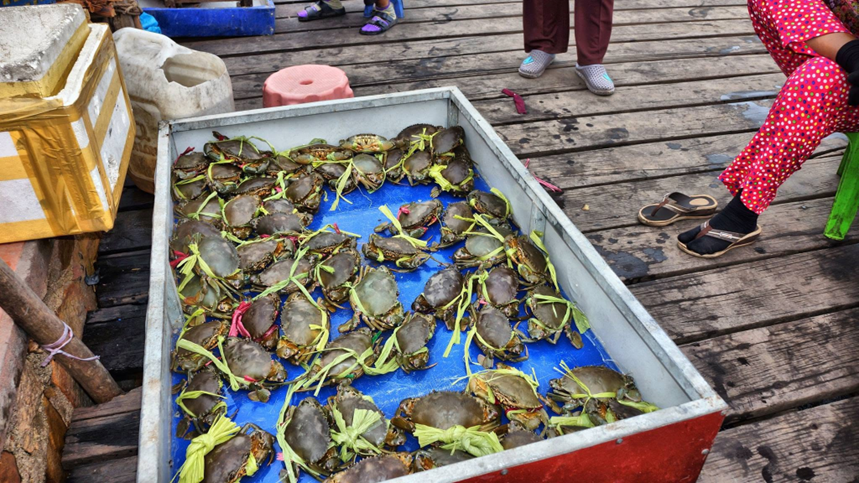
On the Water, the Same Gesture as Ever
Out on the water, the silhouettes of wooden boats continue to crisscross the bay, traps stacked aboard, engines barely louder than a murmur. Closer to shore, market gear — baskets, trays, drying racks — sometimes drifts in the waves between uses. This quiet, unchanging ballet unfolds just metres from the market's tables: rarely does a product travel such a short distance between where it is caught and where it is eaten.
Visiting Psar Kdam: What to Know
The crab market sits at the eastern end of Kep Bay, just minutes from the town centre and about 25 kilometres from Kampot. Activity runs all day, but it's liveliest in the late morning and early afternoon, when the fishing boats return. Crab can be eaten right on the spot, at one of the small restaurants lining the market, or bought raw to bring to one of the restaurants in the nearby town. A visit to Psar Kdam pairs easily with a walk through Kep National Park, a boat trip to Rabbit Island (Koh Tonsay), or a wander among the ruined colonial villas still scattered across the surrounding hills — all fragments of the same story, that of a town that learned to be reborn from the sea.


Comments