


Christophe Astolfi at Kep West: a Gypsy jazz heavyweight meets Enrique De Feo

Guitarist Christophe Astolfi, a respected name in European Gypsy jazz, is in Kep. On Saturday 31 October he shares the stage at The Wave with Argentine singer and guitarist Enrique De Feo, as part of the Art for Kep – Music City artistic programme.

Christophe Astolfi is not a name you often see on posters in Cambodia. In Europe, it is a different story. For more than twenty-five years, he has played with the people who matter in Gypsy jazz. His visit to Kep is no small thing.
From the Longwy coalfields to the Django tradition
An Italian national, Astolfi grew up in Hussigny-Godbrange, near Longwy in Lorraine, eastern France. It is mining country, shaped by Italian immigration in the 1960s.
He picked up the guitar at 12 and left school at 17. His best friend's father, a working accordionist, trained the two boys as accompanists: paso doble, cha-cha, rumba, waltz. He went on to play in accordion orchestras, then in rock and jazz bands. Local Gypsy and Italian guitarists, Tchavolo and Dorado Schmitt among them, introduced him to the music of Django Reinhardt. He never left it.
Brussels, Paris and the big names of Gypsy jazz
In 1998 he moved to Brussels. He stayed about ten years and became one of the faces of the Reinhardt tradition in Belgium, playing with Philip Catherine, Toots Thielemans, Koen De Cauter and Tcha Limberger.
Paris came next, from 2008, with David Reinhardt, Samy Daussat, Rodolphe Raffalli and Hugo Lippi. In 2010, filmmaker Tony Gatlif brought him into his Djangodrom project alongside Biréli Lagrène, Didier Lockwood and Stochelo Rosenberg. In 2015 and 2016 he recorded two albums with the brothers Boulou and Elios Ferré, including La Bande des Trois, on which he is the third guitarist.
A specialist of the Gypsy waltz
His album Christophe Astolfi et son trio jouent… des valses, recorded in 2013, has become a reference for Gypsy jazz guitarists. In 2016 he wrote the third volume of the Astuces de la guitare manouche series for Coup de Pouce, devoted to waltzes: eight standards, from Le Bal de la Marine to La Flambée montalbanaise. It is described as the first method dedicated to the Gypsy waltz.
In 2018 he came across unreleased compositions by Pierre "Baro" Ferré, father of Boulou and Elios, and recorded them with his quartet, Hammond organ included, on the album Plays the Music of Pierre Baro Ferré.
On stage he is first a solid rhythm player, the kind who holds a band together. He takes the solo when it is needed. He also gives concerts and masterclasses in France, across Europe and in the United States.
Listen: Indifférence, Tony Murena's waltz, played by Christophe Astolfi and his quartet, with Florent Gac on Hammond organ, Samuel Hubert on double bass and Stéphane Chandelier on drums (YouTube).
La rencontre avec Enrique De Feo
À Kep, il retrouve Enrique De Feo, chanteur et guitariste argentin. Un troubadour des Amériques, qui porte avec lui les chansons et le folklore d'Amérique latine.
Jazz manouche d'un côté, folklore sud-américain de l'autre. Les deux répertoires ont au moins un point commun : la valse, qu'on joue aussi bien dans les bals de Lorraine qu'à Buenos Aires ou à Lima.
La soirée est organisée dans le cadre du programme artistique Art for Kep – Music City.
Infos pratiques
Quand : samedi 31 octobre 2026, à partir de 18 h
Où : The Wave, Kep West, Kep
Réservation : kepwest.app
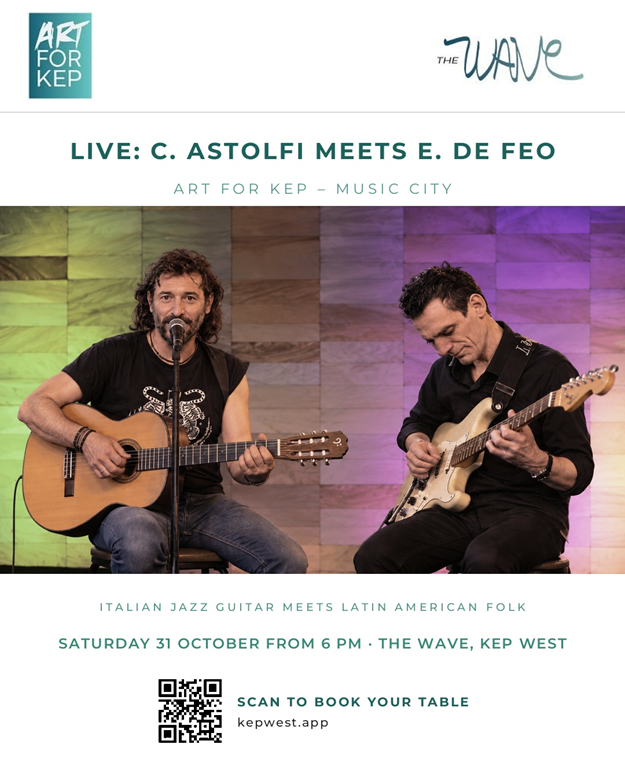
Meeting Enrique De Feo
In Kep he joins Enrique De Feo, an Argentine singer and guitarist. A troubadour of the Americas, he carries the songs and folklore of Latin America with him.
Gypsy jazz on one side, South American folk on the other. The two have at least one thing in common: the waltz, played in the dance halls of Lorraine as much as in Buenos Aires or Lima.
The evening is part of the Art for Kep – Music City artistic programme.
Practical information
When: Saturday 31 October 2026, from 6 PM
Where: The Wave, Kep West, Kep
Booking: kepwest.app


Comments