


Karim Belkacem Saadi: The gamble of a living theater at the heart of Cambodia

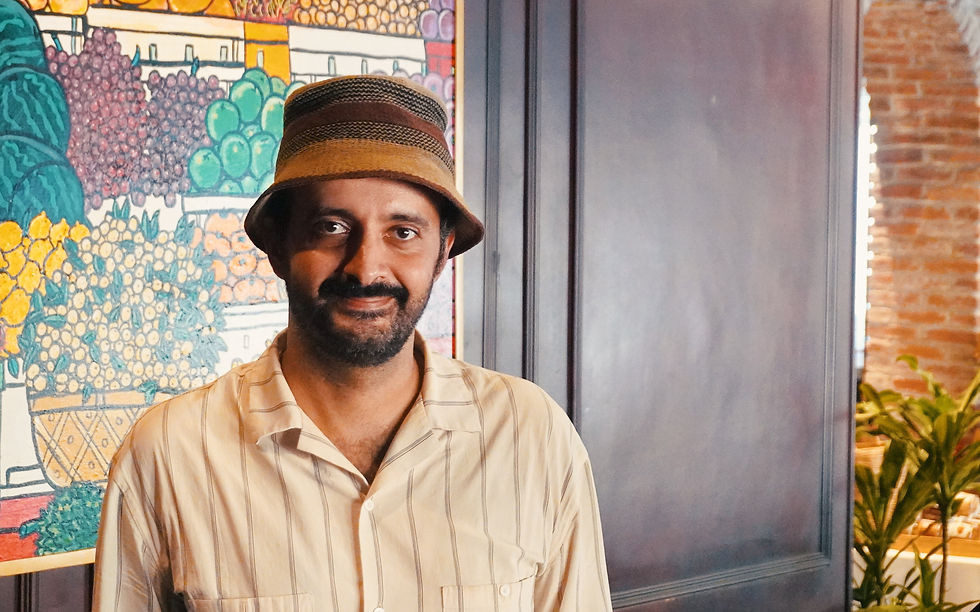
A stage director trained at the Geneva School of Fine Arts, Karim Belkacem Saadi chose Phnom Penh as the ground for an unusual artistic venture: founding a contemporary theater school, opening two performance venues, and training an entire generation of Cambodian actors—without public subsidies, without safety nets, driven solely by the conviction that live art can change how we see the world.

There are encounters that alter a trajectory. For Karim Belkacem Saadi, it was a three-day workshop at Cinehub, organized almost by chance upon his arrival in Phnom Penh in 2021, at the invitation of a teacher from the NGO Pour un Sourire d’Enfant. A few amateur actors, a makeshift space, and something unexpected: the clear evidence of a vast void. “There was no training school questioning art through a contemporary approach,” he recalls. From that realization, everything else followed—with almost relentless logic.
Born in Morocco and trained at the Geneva School of Fine Arts—with a bachelor’s in sculpture followed by a master’s degree titled “Art Action,” at the intersection of visual and performing arts—Karim Belkacem spent about ten years directing an independent company that toured European stages, from Belgium to France and Switzerland, before reaching Asia and South America.
He also co-created a feature film with Portuguese director Basil Da Cunha, O fim do mundo, presented at the Locarno Festival. In other words, when he set down his bags along the Mekong, he was not seeking exoticism, but a meaningful project.
A theater for Cambodians, not expatriates
With his partner Armelle Despeyroux, a Franco-Vietnamese reconnecting with her grandmother’s Asian roots in Cambodia, and Niyalic Khun, a young Cambodian educated at Lycée Descartes in Phnom Penh and Sciences Po in the Netherlands, Karim Belkacem founded the Acting Art Academy. The first venue, reclaimed along the Mekong riverside, was far from a cultural temple: it was a raw space to be shaped. But the artistic direction was clear from the outset.
“My observation came from what I knew in Morocco, where cultural venues linked to France often end up attracting very few Moroccans. I didn’t want to reproduce that pattern here.”
The Acting Art Academy established its foundations: performances would be in Khmer, with French and English surtitles. Works from the international repertoire would be translated—starting with Bernard-Marie Koltès, including four of his plays such as Roberto Zucco, Sallinger, and Black Battles with Dogs, followed by Tennessee Williams. Actors would not be selected for their looks, but for their sensitivity and understanding of the text. “Art is not the representation of beauty,” insists Karim Belkacem. “We are not training influencers.”
“There will be no lasting theater here if we don’t expand this bubble. We need a space that allows that.”
Koltès—whose plays have been translated into more than thirty-six languages and remain among the most performed worldwide since the legendary productions at Nanterre-Amandiers with Patrice Chéreau—offers ideal material for this project: a poetic and raw writing style that gives voice to marginalized characters and directly interrogates power relations. In Cambodia, where the arts are often rooted in representations of beauty and propriety, this is a deliberately subversive choice.
Chamber plays, or the legacy of a poetics of disturbance
To understand Karim’s approach, one must return to what defined his European company, Think Tank Théâtre, particularly when the collective turned toward cinema. Its hallmark: stage devices that blur the boundary between fiction and reality, placing the audience in an active, never passive, observational role.
The series of “chamber plays” is the most striking example: spectators sit around an enclosed scenography, separated from the actors by one-way mirrors, each equipped with headphones. The actors perform in a space the audience can see but not hear directly—sound spatialization, crafted with surgical precision, reconstructs a slightly shifted, anticipatory, and unsettling reality.
Presented notably at La Colline and Nanterre-Amandiers, these works—including an adaptation of Sarah Kane, another of Gulliver’s Travels, and a third of Shakespeare’s Measure for Measure—established the company on French national stages.
“What we worked on was the dissociation between sound and image. When a glass fell, we played the sound of it breaking a fraction of a second before impact. Spectators felt they could anticipate what would happen, without understanding why. We kept them in a constantly unsettled state of perception.”
This research—drawn from cinema and translated into live performance—continues to inform the work in Phnom Penh today. Even if the resources are incomparable, the philosophical project remains the same: to prevent the audience from settling into certainty.
Ten thousand spectators at Riverside—and a theater to invent
During the first years at Riverside, the Acting Art Academy opened its space every two months for public scene presentations—OTA (Opening to Audience). The audience came. And it was Cambodian, nearly 80 percent.
“At first, people told us Koltès wasn’t necessarily for a Cambodian audience. In fact, we regularly hosted 80 people, sometimes more. We calculated that we’ve already had 10,000 attendees.”
This relative success—real but limited—pushed the team to take the next step. The Riverside building was transformed: a mezzanine was built, capacity increased to 74 seats, and a stage platform installed. The new venue was given a name that sounds like a manifesto: The Last Stage. “The last stage. Almost a provocation: there is no stage in Cambodia, so it’s the last—but it’s also the first.” Since opening in February 2024, something has been performed here every Friday, Saturday, and Sunday. The program changes monthly.
The play Part of Us, staged with academy students, ran for twenty-one sold-out performances. At the end, they were still turning away around twenty spectators each night. “What made it possible was word of mouth. And word of mouth happens when people sense real work behind it. Professionals from London or the Netherlands said they never imagined seeing this in Cambodia.”
“The greatest directors you see in Europe all started rehearsing for a year for free, in a basement, without heating. Everyone starts like that.”
Last Stage Aquation: integrating into a regional network
The project did not stop at Riverside. In 2025, Karim Belkacem opened a second venue: Last Stage Aquation, on Koh Pich island, in collaboration with entrepreneur Alexis de Suremain. The goal went beyond increasing capacity. It was about equipping Phnom Penh with a technically credible space in the eyes of regional partners—a stage whose dimensions and lighting rig meet the standards of a European municipal theater or venues in Bangkok and Ho Chi Minh City.
The modular stage can reach nine by twelve meters. The technical installation benefited from the voluntary support of Éric Soyer, a French scenographer and lighting designer nominated several times for the Molière Awards.
“For there to be a professional stage in Cambodia one day, we need co-productions. And for co-productions, we need a stage that meets the criteria foreign partners expect.”
The logic is one of pragmatic survival: inviting a company from Belgium is out of reach, but paying for a flight from Bangkok for a workshop with a Royal Shakespeare Company director is feasible.
The financial model remains fragile, Karim acknowledges openly. No public subsidies, actors paid through cross-monthly arrangements across projects, and authors’ rights sometimes granted free of charge—such as those from Compagnie Louis Brouillard for a Khmer adaptation of Joël Pommerat’s Amour. Services sold to institutions and companies help balance the budget. “Renting the venue also indirectly supports a cultural space.”
The Golden (r)age Festival: a bet on the Cambodian public
In June 2026, The Golden (r)age Festival—led by the Acting Art Academy—reached full scale: thirteen productions, twenty-six performances across seven venues in the capital, including The Last Stage Riverside, Last Stage Aquation, Chenla Theatre, the French Institute of Cambodia, and the SOSORO Museum. The result: 80 percent of performances sold out, with 130 to 140 spectators per night and a majority Cambodian audience—including for $10 tickets, once deemed unsellable.
“The theater’s name had to be on the building. Not something we apologize for existing—asserting it in public and media space: there is a contemporary creation theater in Phnom Penh.”
The festival is coordinated by three former academy students, now fully responsible professionals. This may be the clearest sign of the project’s success: Cambodians have learned to manage a venue, communicate, fill theaters—and they are doing it.
A school without indulgence, a vision without compromise
Eighteen hours of classes per week, no more than three absences per semester, fines for lateness—even for students whose training is nearly free ($40 per month for administrative fees). Karim Belkacem has little sympathy for workshops as a substitute for structured training. “Training through workshops can work when you already have a solid foundation. But starting with that leads nowhere. I’ve never believed in it.”
The academy also deliberately rejects the use of artificial intelligence in its creative processes. Posters, visual identity, festival communication: everything is created manually by the students themselves.
“If you were not involved in the decisions that led to these outcomes, you cannot question them.” In a context where generative tools are proliferating, this stance stands out—not as nostalgic purism, but as a deliberate pedagogical choice.
An actress from the academy was selected at Cannes this year in a film produced by Anti-Archive. International directors are now making the trip—Frédéric Fisbach for a production based on texts by Antoine d’Agata, and Compagnie Louis Brouillard for a series of exchanges and workshops.
What may look like recognition is, in Karim’s view, only the beginning of long-term work. “The audience, for me, is at least ten times larger than what we reach today. There are still universities, educated Cambodians, returning diaspora communities. We have only touched one layer.”
Acting Art Academy / The Last Stage — Phnom Penh · http://actingartacademy.com
Chakto Festival II — June 2026, seven venues, thirteen productions


Comments