


History : Alix Aymé, a French Painter on the Roads of Indochina

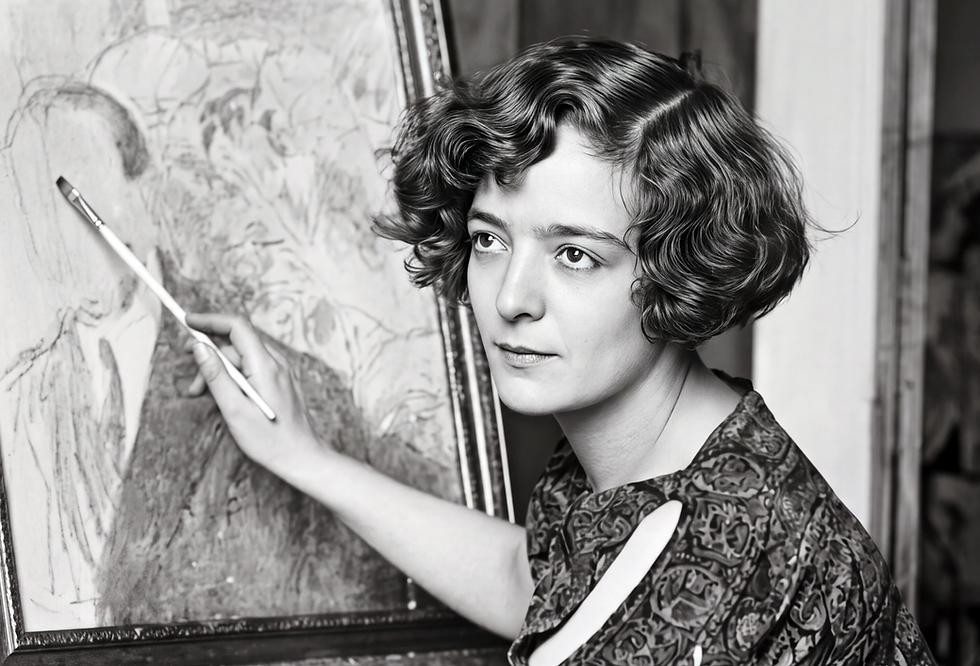
Born in Marseille in 1894 and died in Paris in 1989, Alix Aymé spent more than twenty years in Asia. She taught at the École des Beaux-Arts in Hanoi, revived the art of Vietnamese lacquer and decorated the Royal Palace in Luang Prabang. Between the Mekong and the temples of Angkor, she also painted Cambodia. Her work now hangs in the Louvre.
From Marseille to Asia
Alix Angèle Marguerite Hava was born in Marseille in 1894. She trained first in music, then turned to drawing. In Paris she joined the Académie de la Grande Chaumière and the Ateliers d'art sacré. There she became a pupil of Maurice Denis, the theorist of the Nabis group. Denis remained her teacher and her correspondent to the end.
In 1920 she married Paul de Fautereau-Vassel. The French government sent him to China. The couple left for Shanghai, then Hanoi. Alix discovered Asia, and would not leave it for good until 1945.
Vietnamese lacquer
Vietnam became her base. She taught drawing there, first in the French lycées, then at the École des Beaux-Arts de l'Indochine in Hanoi. That is where she left her most lasting mark. With Joseph Inguimberty, she revived lacquer, a local technique the school did not teach. She was the only French teacher who practised it. From 1934 to 1939 she passed it on to her students. Some, such as Nguyen Gia Tri and Le Pho, would become major figures of modern Vietnamese painting.

Laos and its kings
In 1929 Alix Aymé received her first major official commission: a mission to Laos to prepare for the 1931 Colonial Exhibition. She designed the Laotian pavilion for the Paris show. Above all, she grew attached to Luang Prabang. She became close to the household of King Sisavang Vong. For the reception hall of the Royal Palace she painted nineteen large canvases. They are still there.
In 1931 she married again, this time to Georges Aymé, an officer in the French army in Indochina and brother of the novelist Marcel Aymé.
The Cambodian passage
Cambodia holds a quieter place in her story, but a real one. From 1929 she travelled and painted in the country. She sketched the temples of Angkor, like other travelling artists of her time. Her notebooks keep the trace of these journeys, between the river, the forest and the Khmer monuments. Aymé did not settle in Cambodia as she had in Vietnam or Laos. She passed through it, watched it, painted it.

A long-forgotten body of work
Alix Aymé left Indochina in 1945 and returned to France. She kept painting until her death in 1989. For years her name stayed little known to the general public. Museums and the art market have since rediscovered her. Her drawings are held in the Cabinet des Dessins of the Louvre. Her work is also found at the Musée des Années Trente in Boulogne-Billancourt, the Musée des Beaux-Arts in La Rochelle, the Royal Palace in Luang Prabang and the Evergreen Museum at Johns Hopkins University in the United States. An Association des amis d'Alix Aymé, founded in 2012, watches over her memory.


Comments