


From Flooded Plains to Forgotten Empires: Southeast Asia's Ancient States

From the Flooded Plains of Cambodia to the Straits of Malacca, civilizations of unsuspected grandeur built the first states of Southeast Asia—and changed the course of human history forever.

SOUTHEAST ASIA · FROM ORIGINS TO THE FIRST STATES
Long before Marco Polo ever heard of it, long before Portuguese ships sailed eastward, kingdoms existed here that rivaled Rome or Chang'an in magnificence. The first state civilizations of Southeast Asia represent one of the great enigmas—and one of the most beautiful revelations—of world archaeology. This panorama, long ignored by major historical syntheses, now stands as one of the most fascinating chapters in the human adventure.
From the Mekong Valley to the volcanoes of Java, from the misty coasts of the Malay Peninsula to the alluvial plains of the Irrawaddy Delta, a mosaic of early states forms, transforms, collapses, and is reborn according to rhythms unique to each geographic space.
Angkor: the city of gods in the midst of the forest
Nowhere else in Southeast Asia does the grandeur of the early states express itself with such force as in the plains of Cambodia. Between the 9th and 15th centuries, the Khmer Empire builds the largest preindustrial agglomeration the Earth has ever known. At its peak in the 12th century, the greater Angkor region houses perhaps a million inhabitants—more than contemporary London or Paris. It spans over 1,000 square kilometers, interwoven with a hydraulic network of stunning sophistication: hundreds of barays (artificial reservoirs), thousands of irrigation canals, and dikes capable of storing and redistributing millions of cubic meters of water between seasons.

Angkor Wat, the temple-mountain dedicated to Vishnu by Sūryavarman II in the 12th century, is the largest religious monument ever built by humankind. Its central tower rises to 65 meters. Its galleries extend nearly 800 meters on each side. Its bas-reliefs narrate in stone the epics of the Mahābhārata and Rāmāyana across kilometers of sculpted walls with an expressiveness never surpassed. But Angkor is not just an aesthetic marvel: it is a political and economic machine of remarkable efficiency.
TECHNOLOGY · THE LIDAR REVOLUTION
Data from aerial LIDAR—a laser scanner capable of "seeing" through the forest canopy—has revolutionized our understanding of Angkor over the past decade. Dozens of secondary cities, forgotten temples, paved roads, and dried-up canals have emerged. What we called "the Cambodian forest" was in reality a fully anthropized landscape, shaped by human hands for centuries.
Jayavarman VII: the king-builder
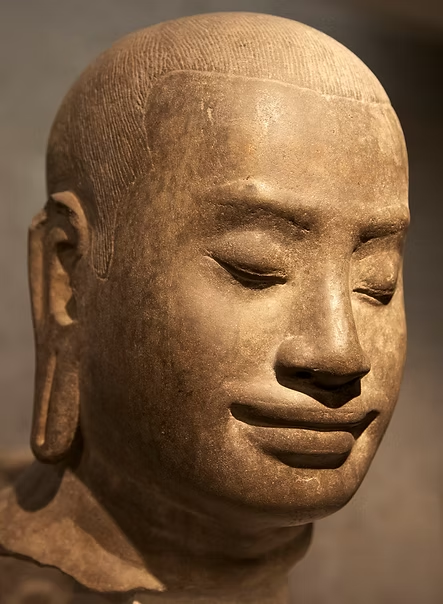
If Sūryavarman II founded Angkor's architectural splendor, it is Jayavarman VII, at the turn of the 12th and 13th centuries, who brings the Khmer Empire to its maximum extent. Under his reign, the empire stretches from the Malay Peninsula to the north of present-day Laos. Jayavarman VII adopts Mahayana Buddhism as the state religion, breaking with the Shaivite tradition. The magnificent city of Angkor Thom, with its Bayon crowned by hundreds of smiling faces, remains the most striking testimony to this transformation.
The key to the Khmer system is hydraulic. In a land subject to the whims of an irregular monsoon, those who master water master life. Khmer engineers developed over centuries a network of remarkable topographic precision, enabling agricultural yields unmatched by any other continental Asian society of the era.
The fall of Angkor, begun as early as the 14th century, illustrates a universal truth: a civilization's very grandeur makes it vulnerable. Recent research converges on a multi-factor scenario—climate change, saturation of the hydraulic system, deforestation, military pressures from Thai kingdoms. All these elements combine to lead to the progressive abandonment of the capital.
"Angkor is not only the world's largest religious monument: it is living proof that an agrarian society can achieve levels of organizational complexity rivaling any city of the classical ancient world."
II — DEEP ORIGINS
Before the kings: stateless societies
To understand the birth of the first states, one must first imagine what preceded them. For millennia, the peoples of Southeast Asia lived in relatively egalitarian communities based on hunting, gathering, and nascent agriculture. Archaeologists have found traces of these populations in caves adorned with rock paintings in Borneo dating back over 40,000 years—among the oldest known artistic representations in the world—in the megalithic jar cemeteries of the Plain of Jars in Laos, or in the terraced rice fields that have sculpted the hills of Luzon for at least 2,000 years.
The mastery of cultivated rice, the domestication of the water buffalo, inter-island navigation, and bronze working form the cornerstones of the transformation to follow. But the keystone may lie in the trade networks that weave, from the second millennium BCE, a web of economic interdependence among peoples separated by thousands of kilometers of sea and forest.

Excavations at Ban Don Ta Phet in Thailand illustrate this early integration: gold and silver jewelry, Indian-imported bronzes, glass beads from the Mediterranean. This single site, dated to the 4th century BCE, testifies to central Thailand's insertion into Indian Ocean trade networks well before any state formation. Exchanges precede states; trade engenders hierarchy.
The Straits of Malacca and Sunda, natural bottlenecks between the two great oceans, are the strategic crossroads of this vast network. Spices from the Moluccas, resins from Borneo, tin from the Malay Peninsula, gold from Sumatra's mountains—these goods circulate along routes that we are only now reconstructing thanks to isotopic analyses and recently discovered shipwrecks. Those who control the straits control the world.
III — THE IDEOLOGICAL TRANSFORMATION
When India reshaped a continent
At the turn of the Christian era, a cultural phenomenon of immense scope transforms Southeast Asia: what historians call "Indianization." Merchants, Brahmins, and Buddhist monks from the subcontinent venture eastward. They bring not only goods, but ideas: Hindu and Buddhist cosmology, Sanskrit as the language of power and the sacred, techniques of monumental stone architecture.
Local elites quickly grasp the utility of these borrowings. A royal ideology based on the devarāja model—the god-king—legitimizes and consolidates power in ways local traditions did not always allow. The king is no longer merely a war leader or redistributor of wealth: he becomes the cosmic pivot of his kingdom, the guarantor of universal order. This transformation is inseparable from the formation of the first states.
IV — THE GREAT CIVILIZATIONS
Portrait of four lost worlds
1ST–5TH CENTURIES
Funan
Mekong Delta · Vietnam & Cambodia
The region's first great state, Funan prospers through control of routes between India and China. Its ports welcome ships from the Roman Empire and Sri Lanka. Its elites adopt Sanskrit and Brahmanism as tools of legitimation.
9TH–15TH CENTURIES
Khmer Empire
Cambodia · Indochinese Peninsula
At its peak under Sūryavarman II and Jayavarman VII, the Empire governs most of the continent. Angkor Wat, a world masterpiece, testifies to unmatched hydraulic mastery and social organization.
7TH–13TH CENTURIES
Śrīvijaya
Sumatra · Straits of Malacca
A legendary thalassocracy, Śrīvijaya controls the straits for six centuries. A major center of Vajrayana Buddhism, it attracts pilgrims and merchants from across Asia, from Arabia to Tang China.
6TH–11TH CENTURIES
Dvāravatī
Central Thailand · Chao Phraya Plain
The first hub of Theravada Buddhism in continental Southeast Asia. Its stone Dharma wheels and moat-encircled cities define an original urban model, precursor to Thai kingdoms.
These four examples illustrate the diversity of trajectories taken by Southeast Asian societies in their transition to statehood. There is no single model. Some kingdoms arise from control of maritime routes, others from mastery of continental hydraulics. But all share fundamental traits: an aristocracy capable of mobilizing agricultural surplus, a religious ideology that sacralizes political order, and the ability to forge long-distance alliance networks.
V — THE FIRST FORGOTTEN EMPIRE
Funan: at the sources of continental civilization
In the Mekong Delta emerges between the 1st and 6th centuries a political entity that Chinese sources call Funan. This kingdom long remained ghostly. Excavations at Óc Eo have revealed a stunning archaeological reality: 2nd-century Roman coins, Indian gems, Han-style bronzes, extraordinarily sophisticated gold jewelry.

This commercial cosmopolitanism is no accident—it is the very foundation of Funanese power. The city is drained by an impressive network of canals, capable of irrigating rice fields and supplying a considerable urban population. A hydraulic network that directly prefigures that of Angkor, six centuries later.
VI — EMPIRES OF THE SEA
Śrīvijaya and the thalassocracy of the straits
If the Khmer Empire embodies the grandeur of continental civilizations, Śrīvijaya represents the opposite archetype: a sea empire, without fixed territory, founded on control of maritime routes. Based in Palembang in present-day southern Sumatra, this thalassocracy extends its influence from the 7th to 13th centuries across Southeast Asia to Sri Lanka.
What strikes most about Śrīvijaya is the extraordinary discretion of its material traces. For a long time, historians doubted its very existence: no spectacular temples, no monumental capital identifiable with certainty. Śrīvijayan power resided not in stone, but in movement—in fleets patrolling the straits, in tax networks on trade. When Arab, Indian, or Chinese merchants mention "Zabaj," "Sanfoqi," or "Sribuza," they all refer to the same invisible empire.

In the Javanese archipelago, the Borobudur temple—a nine-level Buddhist stūpa covered with 2,500 bas-relief panels and 504 Buddha statues—perhaps represents the absolute pinnacle of insular architectural art. Built in the 9th century by the Śailendra dynasty, it is a cosmological representation of the path to enlightenment, a stone mandala that pilgrims traversed level by level.
A 9th-century shipwreck discovered off Oman carried alone more than 60,000 Tang ceramic pieces and over two tons of gold and silver ingots—eloquent testimony to the intensity of trade linking Śrīvijaya to western Asia.
"The first states of Southeast Asia were not born of military conquests, but of the extraordinary ability of certain elites to control the trade flows that irrigated an entire world—and to equip themselves with ideological tools to perpetuate their domination."
VII — TIMELINE
Four millennia in perspective
4TH C. BCE
First archaeologically documented long-distance exchanges. Integration of the Indochinese Peninsula into Indian Ocean networks. Gold jewelry and imported bronzes in elite burials at Ban Don Ta Phet.
1ST–2ND CENTURIES
Emergence of the Funan kingdom. First Sanskrit inscriptions. Spread of Brahmanism and Buddhism in the royal courts of the Mekong Delta.
5TH–6TH CENTURIES
Peak of Funan. Progressive collapse in favor of Chenla. Expansion of Theravada Buddhism. Formation of the first Dvāravatī cities in central Thailand.
7TH CENTURY
Foundation of Śrīvijaya in Palembang. Unification of the Malay Peninsula. Construction of Borobudur in Java. Beginning of maritime straits domination.
9TH–10TH CENTURIES
Foundation of Angkor by Jayavarman II. Start of Khmer expansion. Erection of the first temple-mountains. Development of the great hydraulic network of the Tonlé Sap plain.
12TH CENTURY
Construction of Angkor Wat by Sūryavarman II. The Khmer Empire reaches its maximum extent under Jayavarman VII. Angkor becomes the world's largest preindustrial city.
13TH–15TH CENTURIES
Progressive decline of Angkor under climatic and military pressures. Collapse of Śrīvijaya. Rise of Thai kingdoms and Islam in the archipelago. End of the classical period of the first states.
◆ ◇ ◆
VIII — THE PERMANENCE OF TRACES
Living heritage of vanished empires
To speak of the "fall" of these civilizations would be deeply reductive. Khmer irrigation systems still feed much of Cambodia today. The Malay language, spread by Śrīvijaya's trade networks over centuries, becomes the lingua franca of the archipelago and gives birth to modern Indonesian and Malaysian—two of the world's ten most spoken languages. Theravada Buddhism, propagated by the kingdoms of Dvāravatī and their successors, remains the dominant religion in Thailand, Cambodia, Laos, and Burma.
Archaeology of ancient Southeast Asia has never been as dynamic as today. Stable isotope analyses reconstruct ancient populations' diets and geographic origins from a single bone fragment. Ancient genomics begins to lift the veil on the great migrations that populated the archipelago. Network analyses applied to archaeological data reconstruct trade flows between sites thousands of kilometers apart.
The theory of "Indianization" imposed from outside gives way to a more nuanced view: local elites play an active role in selecting and adapting Indian models. The idea of strongly centralized states is replaced by that of more flexible political formations, where power circulates according to logics of prestige and patronage rather than direct territorial control.
Ancient Southeast Asia, long seen as a periphery squeezed between the "great civilizations" of India and China, now asserts itself as a major laboratory of world history. A space where humanity, with remarkable creativity, adapted external influences, invented original solutions to the challenges of power, and built monuments that still speak to the imagination of all humankind. These empires finally deserve our full attention.
"One does not 'visit' Angkor or Borobudur like a museum. One enters them as one enters a still-living civilization, whose resonances continue to shape hundreds of millions of contemporary lives."


Comments