


Echoes of Border Reclamation: Siam's 1946 Retreat from Khmer Lands

Nearly 80 years ago, amid the turmoil of the post-war period, Thailand – then Siam – buckled under diplomatic and military pressure to return territories conquered at the expense of Cambodia and French Indochina.
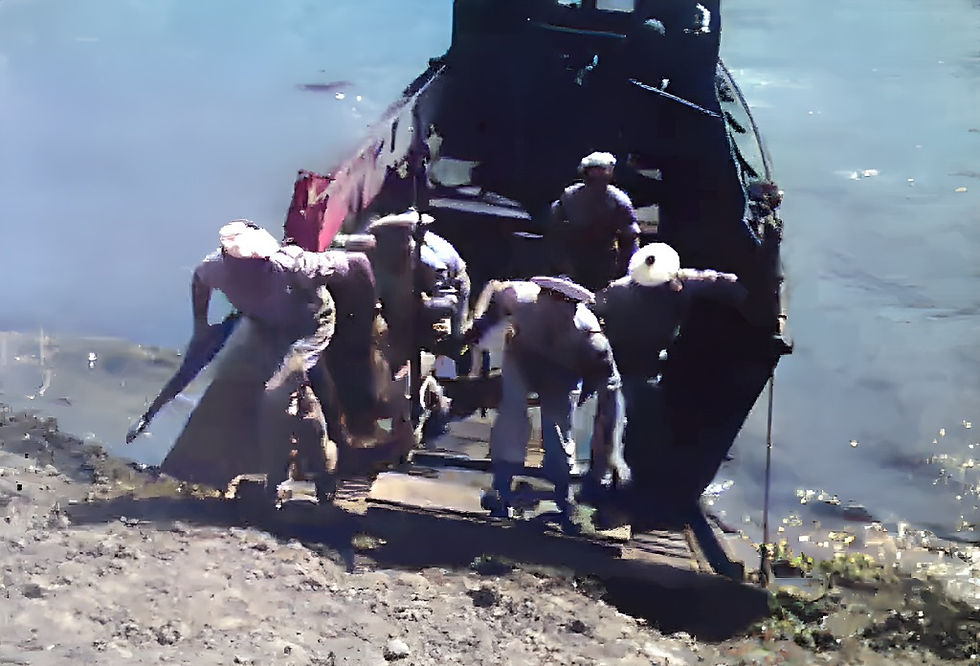
These archival images, frozen in a silent short film, are not mere relics: they resonate like a warning, a prologue to the border tensions still stirring the region today. Youk Chhang, director of the Documentation Center of Cambodia (DC-Cam), invites us to dive into this forgotten page of Khmer history.
Video emblematic, these black-and-white shots, from the archives of the Établissement de Communication et de Production Audiovisuelle de la Défense (ECPAD), capture the essence of a precise and symbolic military operation. Filmed on December 8, 1946, the film shows the first French units crossing the Siamese border, under the command of Colonel Simon.
A border marker, planted in the village of Svay Dan Keo, marks the old limit imposed by Siam. But the Prek-Te bridge, strategically sabotaged by the Khmer Issarak – these Khmer nationalists fighting against Thai occupation –, forces the troops to a halt. 15-CWT trucks line up on the roadside, waiting for repairs.
Further on, General de Jonquière, a key figure in the reconquest, signs the official act of territorial restitution in the presence of the Siamese governor. On the banks of Battambang, LCI (Landing Craft Infantry) landing craft dock, securing the city's approaches. These silent but eloquent scenes bear witness to a diplomatic victory wrested by force: Battambang, a fertile province annexed by Siam in 1941 during the Franco-Thai crisis, finally returned to the French and Cambodian fold.
Context: The Franco-Thai War and Its Aftermath
To grasp the scale of these events, let's go back to 1940-1941. Taking advantage of France's debacle against Nazi Germany, Phibun Songkhram's Siam launched an offensive against Indochina, seizing Battambang, Siem Reap, and other Khmer provinces. France, weakened by Vichy, ceded these territories via the Tokyo Treaty (January 17, 1941), but revenge came with the Allied liberation.
In 1945, Thailand, an ally of Japan, was forced by the Washington Accords (1946) to return the conquests – a humiliation for Bangkok, under pressure from the United States and France.
December 8, 1946, marked the climax: 2,000 French soldiers, supported by armored vehicles and aviation, entered Battambang without major resistance, thanks to British mediation and Sino-American negotiations. As historian Pierre Brocheux recounts in Histoire de l'Indochine contemporaine (PUF, 1998), this operation was not just military; it reaffirmed French sovereignty over its protectorates against Thai nationalism and Khmer dissidence.
The Khmer Issarak: Shadows of Resistance
The sabotage of the Prek-Te bridge is no coincidence. The Khmer Issarak, an anti-French and anti-Siamese independentist faction, embody the identity struggles of post-colonial Cambodia. According to the archives of the Service Historique de la Défense (SHD, Vincennes), these guerrillas delayed the French advance by several hours, symbolizing a resistance that foreshadowed the Indochina War (1946-1954).
Youk Chhang, at DC-Cam, sees an echo of current disputes: "These images whisper the possibilities of tomorrow, in a country and region where borders remain alive."
Today, February 12, 2026, these archives resurface as Phnom Penh and Bangkok reignite border disputes – Preah Vihear foremost. Battambang, the Khmer agricultural jewel, remains an economic and memorial stake.
Sources
ECPAD – Original Video (© ECPAD, French Ministry of the Armed Forces).
Brocheux, Pierre. Histoire de l'Indochine contemporaine (PUF, 1998).
Osborne, Milton. The French Presence in Cochinchina and Cambodia (Cornell University Press, 1969).
Washington Treaties (November 17, 1945) and Franco-Thai agreements (1946), French diplomatic archives (La Courneuve).
SHD reports, GR 8 H 1234 (Indochina operations 1946).
Youk Chhang
Director, Documentation Center of Cambodia (DC-Cam)



Comments