


Dynamite Doug: How a British Antiquities Dealer Plundered the Soul of the Khmer Kingdom

For nearly six decades, he was the quietest and most powerful name in the Asian art trade. Douglas Latchford — self-taught collector, published scholar, a familiar face in Phnom Penh's diplomatic circles — was, for his Western clients, the ultimate guarantee of legitimacy when it came to acquiring a Khmer sculpture. Prestigious museums, New York auction houses, wealthy private collectors: they all trusted him. They were wrong.
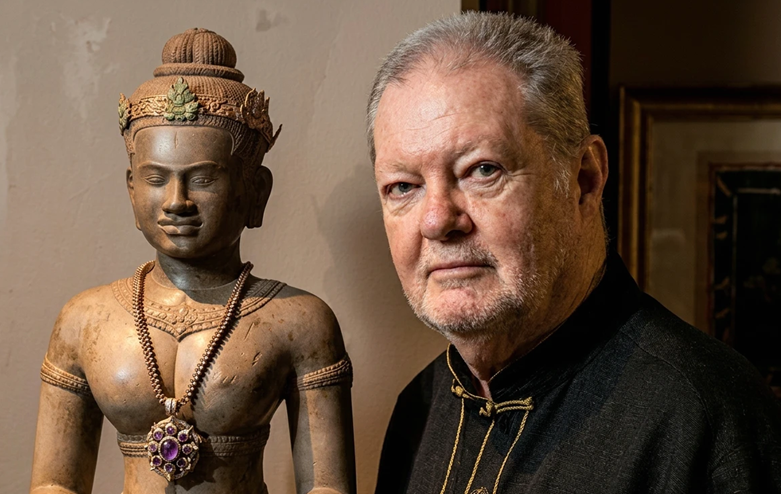
Latchford died in 2020 before he could stand trial. Today, a scathing new book by Canadian journalist Matthew Campbell, The Man Who Stole the Gods, portrays him as the architect of looting on a scale that is almost impossible to grasp — the man behind a massive trafficking operation in Cambodian antiquities that ran for decades before his death.
An empire built on the ruins of Angkor
The story begins in the 1960s, when this British expatriate settled in Bangkok develops a passion for Khmer art. He sets out exploring Cambodian temples and making buying trips to archaeological sites across the old Khmer empire, drawn by the growing appetite of Western museums and collectors for Asian art. In a field still largely ignored by international academia, he also spots a chance to establish himself as an intellectual authority — despite having no formal training in art history whatsoever.
But behind the façade of the gentleman-scholar lies a much darker reality. For decades, as the country descends into civil war and then the horror of the Khmer Rouge regime, sites such as Angkor Wat and Koh Ker are left almost entirely unprotected. Small bands of local looters, sometimes assisted by soldiers, tear friezes, statues of Hindu deities and Buddhas from the ruins using picks, chisels and even dynamite — the origin of the nickname that would stick to Latchford, "Dynamite Doug." The pieces, often still caked in dirt or missing their feet, are hauled by oxcart to the Thai border before entering the dealer's network, where falsified paperwork launders them onto the global market.
Books as sales catalogues
One of the most striking threads in Campbell's investigation concerns the scholarly volumes Latchford co-published with American researcher Emma Bunker. Presented as serious academic works, they in fact served to manufacture a credible paper trail for stolen pieces — glossy catalogues disguised as scholarship, designed to reassure buyers who assumed that a handsome, well-bound book was proof enough of legitimacy.
The trap would eventually snap shut on him: those same books, by documenting the sculptures in such detail, later allowed investigators to match stolen statues with the empty pedestals still standing on Cambodian sites.
A name that turned toxic
Indicted by prosecutors in New York in 2019, Latchford died the following year without ever facing a courtroom. But the fallout from his career has kept spreading. His name is now so radioactive that any object linked to him has effectively become unsellable. The Metropolitan Museum of Art, the Denver Art Museum and the National Gallery of Australia have all since returned pieces tied to his network to Cambodia.
According to Matthew Campbell, the scandal has essentially killed off the market for Khmer art: major auction houses such as Sotheby's can no longer put a significant Khmer statue up for sale in New York. A piece once worth millions on the open market is today, for practical purposes, worthless — no buyer is willing to risk bringing it into the light.
The long road home
Much of the credit for tracking down and returning these objects goes to lawyer Bradley Gordon, who has spent years building a database of thousands of missing artifacts — compiled, ironically, largely from the very photographs Latchford published in his own books. In February 2026, 74 pieces were returned from the United Kingdom under an agreement reached with the late dealer's family; in June, two further Khmer antiquities left the Metropolitan Museum of Art after being seized by the Manhattan District Attorney's office.
For Cambodia's Minister of Culture and Fine Arts, Phoeurng Sackona, these returns are about far more than heritage administration. These statues, she has said, are not simply blocks of stone or wood: to many Cambodians, they are inhabited, alive, carrying a spirit of their own. Each return closes, piece by piece, a wound opened a century ago by colonialism, war and organized plunder.
"The Man Who Stole the Gods" by Matthew Campbell is published by Portfolio/Penguin.


The overall experience feels very fluid and well-optimized. Moving from one section to another is smooth, and the design keeps everything visually appealing.
After browsing around for a bit, I found the interface surprisingly engaging. It’s simple enough for easy use while still looking modern and polished.
I genuinely like how organized everything feels here. The clean design combined with smooth functionality creates a very positive first impression.
The interface has a very refined and professional touch to it. Navigation feels effortless, and the overall design makes spending time on the platform enjoyable.
https://www.servicedapartmentinbangalore.com/