


Cambodia: growth holds, households take the hit

Exports are breaking records. Foreign investment keeps flowing in. Public debt stays low. But tourism has collapsed, inflation has quintupled in three months, and millions of households are sinking deeper into debt. Two economies coexist in Cambodia. Here's why.

KEY FIGURES 2026 growth: revised from 4.3% (World Bank, January) to 2.5% (Mekong Strategic Capital, July). Exports: $17.09bn in H1 2026, +19.5% year-on-year (GDCE). Inflation: from 1.3% in January to 5.8% in April 2026 (National Bank of Cambodia). Tourism: -47.8% in international arrivals over five months (Ministry of Tourism). Private debt: over 180% of GDP, against public debt of 26-30% (IMF). |
A growth forecast revised downward, again and again
In January 2026, the World Bank was still projecting 4.3% growth for the year. The number didn't hold.
In July, at the close of its Article IV mission, the International Monetary Fund cut its own estimate to 3%. The reasons: energy, tourism, real estate.
Mekong Strategic Capital went further still. Its worst-case scenario, published the same month: 2.5%. That would be the kingdom's weakest growth in nearly twenty years. The firm puts the possible impact of the oil shock linked to the Middle East conflict, on its own, at 1.5 to 2 percentage points.
Facing that shock, the Asian Development Bank moved fast. In late July, it announced $450 million for Cambodia and Sri Lanka. Cambodia receives $250 million of it, as a loan for a program called RISE — "Rapid Intervention for Stabilization of the Economy" — meant to support more than a million vulnerable households. The Asian Infrastructure Investment Bank and the Japan International Cooperation Agency round out the financing, with up to $250 million and $188 million respectively.
Exports, meanwhile, hold firm
Here's the paradox. While growth forecasts keep deteriorating, foreign trade is in rude health.
According to the General Department of Customs and Excise, Cambodia exported $17.09 billion worth of goods in the first six months of 2026. A 19.5% year-on-year rise that hasn't let up since January. The United States remains by far the top destination, buying $7.17 billion worth — more than 42% of the total — ahead of Vietnam, China, Japan and Canada.
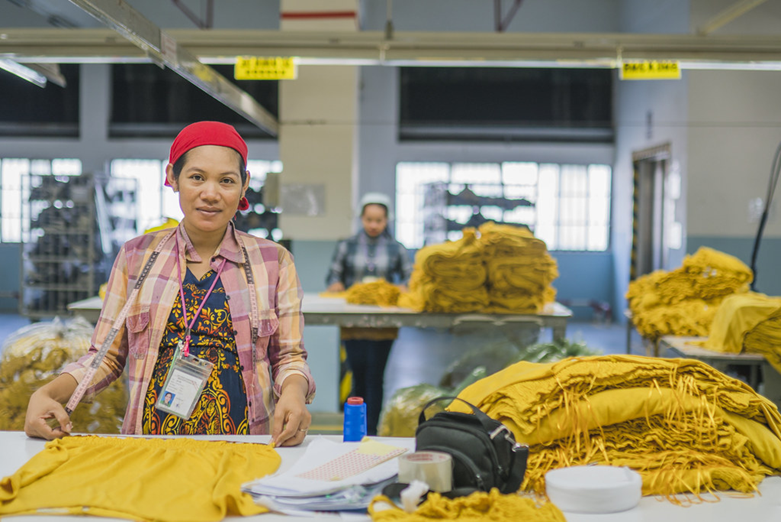
Garments, footwear and travel goods still carry close to half of all exports on their own. But diversification is gaining ground: rubber exports jumped more than 60% in the first quarter, and cashew nuts crossed the symbolic billion-dollar mark for the first time in 2025.
According to the US Trade Representative, goods trade between the two countries reached $15.7 billion in 2025 — US imports from Cambodia jumped 21%, to $15.3 billion.
The saga of US tariffs
Briefly threatened with a tariff of up to 49% on its clothing exports, Cambodia negotiated a cut to 19% in the summer of 2025. In exchange: scrapping its own tariffs on American goods.
That rate didn't last long. In February 2026, the US Supreme Court struck down the legal framework underpinning those "reciprocal" tariffs. The result: a floor rate of 10% now applies to Cambodian exports. A dependency on a single market — more than two exports in five — that Phnom Penh's chambers of commerce still see as a structural vulnerability.
Inflation that quintupled in three months
This is probably the indicator that speaks loudest to households. According to the National Bank of Cambodia, annual inflation stood at just 1.3% in January 2026. By March, it had already reached 5.6%. By April, 5.8%.
AMRO, the ASEAN+3 macroeconomic research office, has since raised its annual forecast to 5.1% for 2026 — placing Cambodia among the Southeast Asian countries hit hardest by rising energy and food prices.
Housing, water, electricity, gas and transport recorded the sharpest increases, a direct echo of the global oil shock. An inflation surge that hits all the harder because it falls first on food — 45% of an average Cambodian household's spending basket.
Tourism, a historic pillar in free fall
If one sector sums up the gap between macroeconomic indicators and lived reality, it's tourism.
According to the Ministry of Tourism, after a record 5.57 million international visitors in 2025 — $3.87 billion in revenue — arrivals fell 47.8% over the first five months of 2026. 1.54 million visitors, against 2.95 million a year earlier.
The rupture with Thailand explains much of the shock: Thai arrivals collapsed by more than 96%, accounting on their own for close to 60% of the total decline. But the slump also touches China, Vietnam and the United States. Even stripping out Thai visitors from the count, international arrivals still fall by roughly 28%.
Industry professionals point to another, more diffuse factor: the kingdom's international image, tarnished by heavy media coverage of the online scam centers operating on its soil. A factor said to weigh on investor confidence as much as on traveller confidence.
A "two-speed" economy
The firm Mekong Strategic Capital coined a phrase that has stuck in Phnom Penh: a "two-speed economy."
On one side, goods exports and part of the manufacturing sector show a resilience almost disconnected from the regional context. On the other, tourism, real estate and large parts of domestic demand remain under pressure.
This split explains why GDP growth — carried almost entirely by export-oriented garment factories and agribusiness — doesn't translate into a perceptible improvement in living standards. A large share of the population depends first on tourism, local trade, construction, or the informal economy.
The household debt time bomb
This may be the starkest contradiction between the big macroeconomic aggregates and lived reality. Public debt stays contained, around 26 to 30% of GDP. Private debt, by contrast, has reached staggering levels.
According to the IMF, private-sector debt exceeds 180% of GDP. Up to 87% of that debt is thought to be denominated in US dollars — a currency mismatch for borrowers who earn in riel.
Cambodia now holds the world record for microfinance debt per capita: 3.8 million households, more than three million loans, $18 billion in cumulative outstanding balance. A 2025 Human Rights Watch study documents how this system, meant to fight poverty, has led in several rural and Indigenous communities to land seizures, families going without food, children pulled out of school, and several debt-related suicides.
According to AMRO, non-performing loans climbed to roughly $4.7 billion by mid-2025 — 8.1% of total lending, the highest level in years. On the small-business side, Credit Bureau Cambodia puts outstanding credit at $37.44 billion at the end of March 2026, with loans overdue by more than 90 days at 7.7%, up from 7.1% the previous quarter.
The border's knock-on effect
The border crisis with Thailand has also weakened another quiet pillar of household income: remittances sent home by Cambodians working abroad, chiefly in Thailand.
According to AMRO, Cambodia's current account swung from a deficit of 3.6% of GDP in 2025 to a projected deficit of 8.5% in 2026. The causes: higher energy imports, falling tourism revenue, and a sharp drop in remittances tied to migrant workers returning from Thailand.
Yet, according to the World Bank, more than 70% of available job openings sit in manufacturing. Only 4 to 5% of returning workers have relevant experience in that field. The result: a retreat into the informal economy, and its low pay — small trade, subsistence farming, domestic services.
What this says about Cambodia in 2026
Taken in isolation, each of these indicators can be read as reassuring or alarming, depending on the angle. Put together, they sketch an economy where the aggregate strength of foreign trade and the concrete fragility of households are moving in opposite directions.
In June, the World Bank called for targeted, time-bound cash transfers to cushion the most vulnerable households against the combined shock of fuel prices, the border crisis and the slowdown. The Ministry of Economy and Finance, for its part, unveiled a 2026 budget of $10.2 billion, up 7%, a substantial share of it financed through $3.1 billion in borrowing.
Phnom Penh is betting on public spending, support from multilateral lenders and a tourism rebound to close the gap between its economy's two speeds — before the country's scheduled graduation from least-developed-country status in 2029 reshuffles the deck once again.


Comments