


Cambodia & Dossier : Garment Minimum Wage — $212, Unions Say It Falls Short

The 2027 round closed on Wednesday: $212 a month, two dollars above 2026 — exactly the same rise as last year, despite unions asking for $250.66. For the roughly 900,000 workers in the sector, the gap with the cost of living hasn't moved
2027: two dollars more, same as last year
The 2027 round closed on Wednesday, 30 September. At the National Council for Minimum Wage's final meeting, the 51 members voted between two figures: $210, backed by employers, and $225, proposed by part of the union side. The former won, 47 votes to 3, with one abstention. Prime Minister Hun Manet then added $2 on his own initiative, setting the 2027 minimum wage at $212 a month from 1 January, and kept the temporary $2.50 transport and housing allowance agreed in June. With allowances, total pay will range from $229 to $240. Independent unions, who had asked for $250.66, called the rise insufficient; Cambodian Alliance of Trade Unions president Yang Sophorn said she disagreed with the outcome, arguing it would not let workers improve their standard of living.
The employers' case
On the employer side, the argument stayed the same across the fourteen meetings of the 2027 round. Employer representatives pointed to a wage already higher than several regional competitors, falling exports, rising international shipping costs, and the uncertainty created by US tariffs, cut to 19 percent in August after passing through 36 and briefly 49 percent. Nang Sothy, vice president of the Federation of Employers and Business Associations of Cambodia, argued the base wage is only part of the real cost of a worker once overtime and allowances are counted. For Arnaud Darc, an employer representative at the International Business Chamber, the logic is a trade-off: restraining wages hurts purchasing power now, but setting a level the sector cannot sustain puts jobs at risk later.
Yiang Det, 22, in Takeo
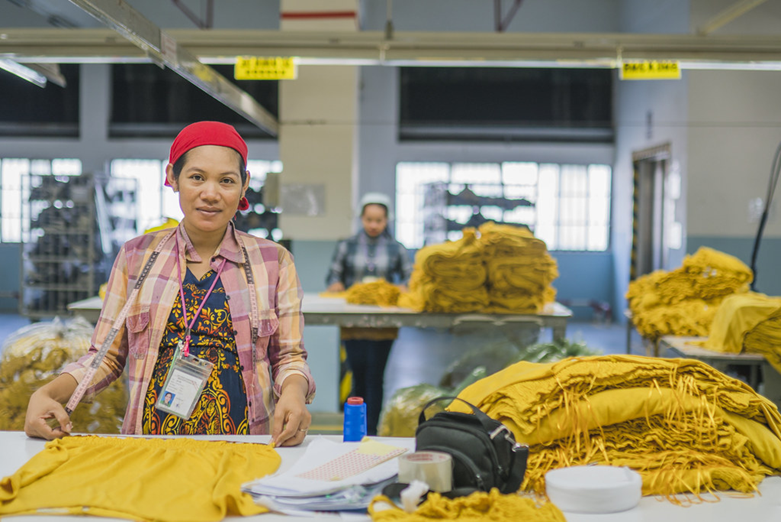
The case of Yiang Det, 22, a garment worker in Takeo province, puts a face on that figure. Before the 2027 round even concluded, she was already saying the price of goods and fuel eats away at everything, creating pressure that is as much psychological as economic. The extra two dollars agreed in September do not change that calculation. A 2024 Asia Floor Wage Alliance survey put average monthly spending on food and essentials for textile workers at around $408, against typical income, overtime included, of roughly $250 — a gap that pushes 91 percent of them to take out at least one loan, with average debt climbing from $5,000 to $6,000 between 2023 and 2024.
A familiar pattern
The pattern isn't new. The 2026 round followed the same path: $208 proposed by employers, $232 demanded by unions, and it was already Hun Manet who made the final call, adding two dollars to set the wage at $210 from 1 January 2026. Since 2018, the minimum wage has climbed from $170 to $212, in increments of two to six dollars — and for the second year running, it was a two-dollar intervention from the top that closed the debate.
What the law requires of employers
The law also governs the mechanics of pay: monthly payment with a Khmer-language payslip, hours capped at 8 a day and 48 a week, overtime at a 50 percent premium by day and 100 percent at night or on the weekly rest day. Employers contribute to the National Social Security Fund at roughly 5.4 percent of salary, including 2 percent for a pension scheme made compulsory in 2022 and due to rise to 8 percent in 2027. Underpaying the minimum wage means repaying the shortfall with interest, and risking a fine of 61 to 90 days of the base daily wage, or imprisonment of six days to one month.
For Yiang Det and the roughly 900,000 workers in the sector, those two dollars help a little, without closing the gap with the cost of living. The same question will likely return, largely unchanged, at the next round.


Comments