


Brushes Against Bombs: The Chromatic Chant of 70 Artists in Phnom Penh
While the echoes of war still resonate at the Kingdom's borders, the capital becomes the sanctuary of a new kind of resistance. Facing the Botum Vattey pagoda, a monumental fresco 35 meters long and 5 meters high was completed on March 3, uniting 70 Cambodian artists in a peaceful response to Thailand's military aggression.

The March sun beats down hard on the canvases stretched in Wat Botum Park, but the heat does not diminish the painters' determination. The "Art of Peace" project, after a memorable first installment in Siem Reap last December, now occupies the political and spiritual heart of Phnom Penh.
Carried by Tan Kimsour's vision and supported by the Union of Cambodian Youth Federations (UYFC), this collective work of 175 square meters goes beyond mere artistic performance. It is a historical document, painted proof of a people's resilience in the face of territorial violation.
A Fresco-Mirror of the Border Tragedy
The official narrative of the exhibition leaves no room for ambiguity: art here is a weapon of testimony. The fresco unfolds like a long ribbon of immediate memory, capturing scenes of desolation from Oddar Meanchey and Preah Vihear provinces, among others. The symbolism is omnipresent and heart-wrenching.

The Temple of Preah Vihear in Peril: At the center of the work, the majestic silhouette of the temple, a UNESCO World Heritage site, appears partially chipped by artillery impacts. This motif symbolizes not only physical aggression but also an attack on the Khmer's millennial identity. Seeing this sacred monument under fire reminds the world that the destruction of heritage is a crime against universal culture.
Exodus and Mourning: Feminine figures, draped in the dignity of their grief, clutch portraits of missing soldiers. Beside them, lines of children fleeing combat zones illustrate the drama of the 500,000 civilians displaced in December. Their gazes are not turned toward vengeance, but toward the spectator, challenging them on the real human cost of foreign incursion.
The Scarred Land: Broken bridges and ruined schools dot the composition. These elements underscore a deliberate intent to paralyze civilian life and sabotage the country's future development.
Artists' Voices: Three for a Nation
Polystyrene F-16 fighter jet model above Cambodian border conflict mural
It was impossible to interview all 70 artists, and difficult to choose among them, so here are three testimonies from major figures in Cambodian art today.
Nou Daro: The Weeping Earth
Specialist in "Naturality," known for works integrating organic elements, Nou Daro sees this aggression as a wound inflicted on the nurturing earth. For him, war is the antithesis of creation.

"My art has always sought harmony between man and his environment. Today, I paint the brutal rupture of this balance. Seeing our forests burned by explosions and our ancestral lands trampled by foreign soldiers is a physical pain that I try to exorcise on canvas."
Monisilong Riem: The Fragility of Strength
Master of recovery art, Monisilong Riem (Selong Vat) brings a sculptural and satirical dimension to the project. On the sidelines of the fresco, he installed a piece that had already struck minds in Siem Reap: a meticulously sculpted F-16 fighter model made from recycled polystyrene.

"By transforming this symbol of destruction into a small, fragile object made from waste, I want to show that brute force is an aberration that always ends in debris. Reducing the fighter jet to a 'recycled toy' is my way of desecrating the weapon to better magnify civilian life and the peace it threatens."
Vutha Tor: The Brush as a Bulwark
Co-founder of Phare Ponleu Selpak and leading figure in Battambang's art scene, Vutha Tor carries the memory of past trials to protect the future. "We do not use cannons to respond to aggression, but the naked truth of our brushes."

"Having lived through the darkest hours of our history, I refuse to remain silent. I paint so that the youth of 2026 never again hears the whistle of shells. It is our duty as witnesses and guardians of peace."
Tan Kimsour's "Brush Diplomacy"
At the heart of the project, Tan Kimsour coordinates this peaceful army of 70 artists. Between work sessions, he shares his vision of a project that transcends traditional artistic boundaries.

Witness Rather Than Weapon: For Tan Kimsour, the urgency is to document. "What we are doing here is visual archiving. Social networks fade, speeches are forgotten, but a fresco of this scale is a historical witness. We transform border realities into a truth no one can ignore."
A Universal Response: The choice of art is also a global communication strategy. "We do not respond to force with force, but with clarity. The pain of a mother or the shadow of a chipped millennial temple are symbols understood everywhere, from New York to Tokyo. This is our way of appealing to international opinion."
Building Nation Through Unity: He emphasizes the collective: "This project belongs to every artist, from the recognized master to the volunteer student. By working side by side, we show that national unity is not an abstract concept, but a concrete action."
Awakening of an Engaged Youth
Artists painting large 'Art of Peace' mural at Wat Botum Park with scaffolding and AKP logo
Beyond the masters, "Art of Peace" has become a catalyst for Cambodian youth. Under the UYFC's auspices, many art students and young volunteers took turns preparing supports and assisting painters. For this generation, the border conflict is an identity baptism by fire. Visitors see more than a work: they discover a method of resistance through unity. The massive attendance since the project's start in Phnom Penh testifies to a need to appropriate the national narrative through visual and poetic emotion—the beauty of art responds to the ugliness of bullets and bombs.

The Inauguration: A Night of Light and Unity
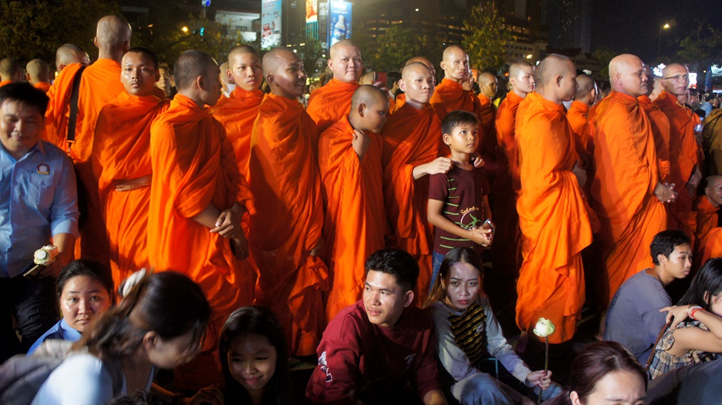
On the evening of March 3, Wat Botum's esplanade transformed for the grand official inauguration. In a powerful yet intimate staging, covered by all national media, the work was celebrated with traditional dance performances, theater, and a sound-and-light show.

The event took place in the presence of Vice-Premier Minister Hun Mani, a central figure in the project whose impetus and unwavering support made this fresco possible. His presence alongside the artists sealed the link between artistic creation and national commitment, turning this ceremony into a major act of cultural diplomacy.
Conclusion
Can a tube of paint stop a tank? At first glance, the "Art of Peace" approach might seem derisory against the firepower deployed at the borders. Yet history teaches us that while weapons occupy the terrain, it is narratives that win hearts and international legitimacy.

By choosing Wat Botum Park for this second stage, Cambodian artists send a powerful message: the Kingdom stands tall, united, and its response will not be one of barbarity. Where some seek to erase borders or chip away at millennial temples, the brushes of Nou Daro, Monisilong Riem, and Vutha Tor rebuild, testify, and immortalize.
Riem's polystyrene F-16 model is perhaps the most eloquent symbol of this exhibition. It reminds us that the power to destroy is ephemeral and polluting, while the power to create is permanent. On March 3, 2026, Phnom Penh affirms its cultural sovereignty.

Cambodia proves it knows how to transform its pain into a light so brilliant that no military shadow can extinguish it. The art of peace is, more than ever, the highest form of courage.
Article: Emmanuel Pezard
Photographs: Emmanuel Pezard and Vannak Khun


Comments