


Where Ghosts Keep Watch: Rithy Panh’s Night at S-21

In the stifling humidity of Phnom Penh, Rithy Panh settles one evening at the foot of the washed-out walls of S-21, that cursed school where the Khmer Rouge forged their machine for crushing souls.
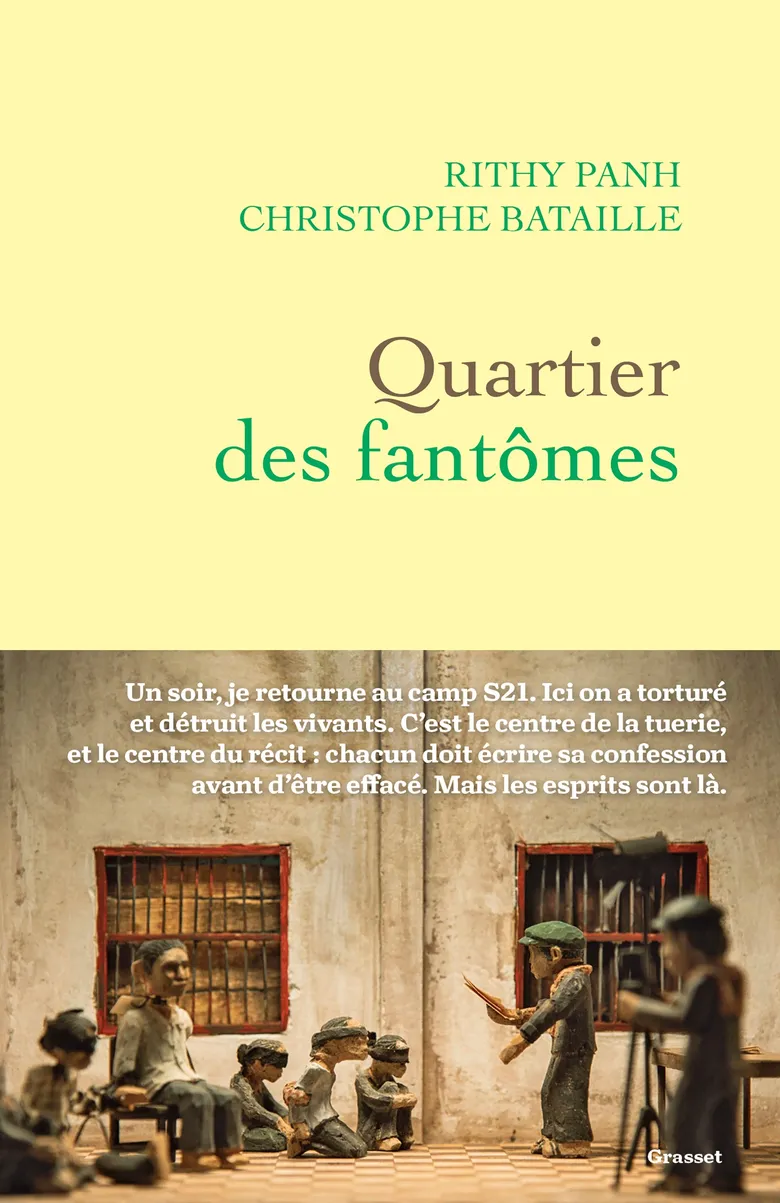
Quartier des fantômes (District of Ghosts), born of his pen and that of Christophe Bataille and published by Grasset in early 2026, is not a simple narrative: it is an intimate wandering, a feverish vigil for shadows that refuse to fall silent. Few pages—just 128—are enough for this book to carve a deep furrow, blending raw poetry with an unflinching reminder of a genocide that swallowed a quarter of the Cambodian people.
Echoes Trapped in Stone
Picture it: flaking blue shutters, yellowed paint blistering under tropical rain, and a silence that weighs like a threat. Panh fixes his gaze here, where 14,000 prisoners were tortured into confessions torn out by electricity, melted plastic, or ripped fingernails.
No survivors from this building as such; only ghosts, and identity photographs lined up like so many scars. This is not the first time the filmmaker has confronted these walls: his 2003 film S-21: The Khmer Rouge Killing Machine had already captured them raw, forcing executioner and victim into a chilling face-to-face. Here, writing takes over—starker, more obsessive still.
You feel the man on the edge of vertigo, scanning the darkness to detect not theatrical specters, but traces of a denied humanity. Insects stridulate, night advances, and with it the questions: how do you capture the invisible? How do you write what defies words? Panh, who mastered the art of molding clay to animate the absent in The Missing Picture, extends that same alchemy into literature.
The Odyssey of a Survivor
Rithy Panh is no armchair author. Born in 1964 into a family of teachers in Phnom Penh, he was thirteen when the Angkar tore him from his world: deportation, hunger, and the gradual disappearance of his father, his mother, his sisters in the camps. 1979: flight to Thailand, then exile in France. At La Fémis, he forged his weapon: cinema. Site 2 in 1989 opened the breach; followed by The People of the Rice Field, Paper Cannot Wrap Fire, all the way to The Missing Picture (2013), nominated for the Oscars and awarded the Golden Eye for Best Documentary at Cannes. Locarno and Venice crowned him.
With Christophe Bataille, his accomplice on The Elimination, he delivers a chiselled prose in which each sentence carries the weight of a muffled scream. The inserted images—cast shadows, architectural details—echo his visual art, rendering the text almost cinematic.
Duch, the Shadow at the Center of the Vortex
At the heart of this night stands Duch, alias Kaing Guek Eav, the mathematics teacher recycled into head of S-21. A zealous paranoiac, he demanded from prisoners tales of betrayal as fictitious as they were interminable, logged into statistical tables for the Angkar. Electrocutions, drownings—anything went to “produce” confessions.
Tried in 2010 by the international tribunal, sentenced to life; dead in 2020, without true penitence. Panh dissects him without gratuitous hatred: he embodies that banality of evil that turned teachers into monsters. But facing him emerge the discreet resisters: Vann Nath, the painter whose accusatory canvases still haunt the walls; Bophana, who would give her name to the cultural and audiovisual archives center founded by the filmmaker.
Beyond Testimony: A Meditation
This book is not merely a return to S-21. It is a reflection on writing after horror—after Tuol Sleng, after the killing fields. How does a people of 1.7 million ghosts rebuild its history? Panh rejects the forgetting advocated by some repentant voices.
His Phnom Penh night, rustling with memories, questions our own capacity to stare into the abyss without looking away. Poetry and investigation intertwine into a timeless elegy, strikingly relevant in 2026, as Cambodia—passed from hand to hand in power—oscillates between economic boom and open wounds.
Why Read Quartier des fantômes?
For anyone interested in the genocides of the twentieth century, in the silences of History, or simply in prose that lingers. Grasset (ISBN 9782246845300) delivers a carefully crafted edition, worthy of any demanding library.
Rithy Panh does not forgive; he illuminates. And long after the final page, the walls of S-21 are still whispering.


mình có lần lướt đọc mấy trao đổi trên mạng شيخ روحاني thì thấy nhắc nên cũng tò mò mở ra xem thử cho biết. mình không tìm hiểu sâu chỉ xem qua trong thời gian ngắn để quan sát bố cục cách sắp xếp جلب الحبيب các mục và trình bày nội جلب الحبيب dung tổng thể. cảm giác là các phần được trình bày khá gọn, các hurentest berlin mục rõ ràng Huren Berlin nên đọc lướt cũng không bị rối với mình như vậy là đủ để nắm tin cơ bản rồi. جلب الحبيب
👍
Los artículos sobre lotería nacional presentan información interesante y bien explicada. El contenido utiliza un lenguaje accesible, mantiene una excelente organización y facilita comprender diferentes aspectos relacionados con este tema. Es una página con un enfoque educativo que merece ser recomendada.
In geometry dash meltdown, there is no slow introduction or extended tutorial. Players are immediately placed into fast-moving levels filled with sharp obstacles and tight spaces. The character never stops moving forward, which means hesitation is not an option. Players must adapt quickly, learning the game’s logic through experience rather than instruction.