


Warehouses, expressways, free zones: Cambodia's industrial gamble

Between brand-new expressways, sprawling special economic zones and an airport barely out of the ground, the Cambodian kingdom is accelerating its industrial transformation. A report published this year by realestate.com.kh paints the picture of a still-young market that is nonetheless ready to take off — provided it comes to terms with some well-identified structural weaknesses.

Ten years ago, talk of a Cambodian "logistics corridor" would have raised a smile. Today, the country is quietly but genuinely establishing itself as one of the relay points of Asia's industrial relocation. That is what the latest industrial and logistics market overview, published by property platform realestate.com.kh and compiling data from Cambodia's General Department of Customs and Excise (GDCE), the Council for the Development of Cambodia (CDC) and the Ministry of Commerce, sets out to demonstrate, figures in hand.
The "China+1" playbook
The diagnosis boils down to a well-worn but still effective formula: Cambodia is a direct beneficiary of the "China+1" strategy, the reshuffling of global supply chains pushing manufacturers to diversify their production bases beyond China. Add to that operating costs that remain competitive against regional peers, preferential access to European and Asian markets through the EBA (Everything But Arms) and RCEP trade regimes, and a growing domestic consumer market that is in turn fuelling demand for warehousing and last-mile logistics around Phnom Penh.
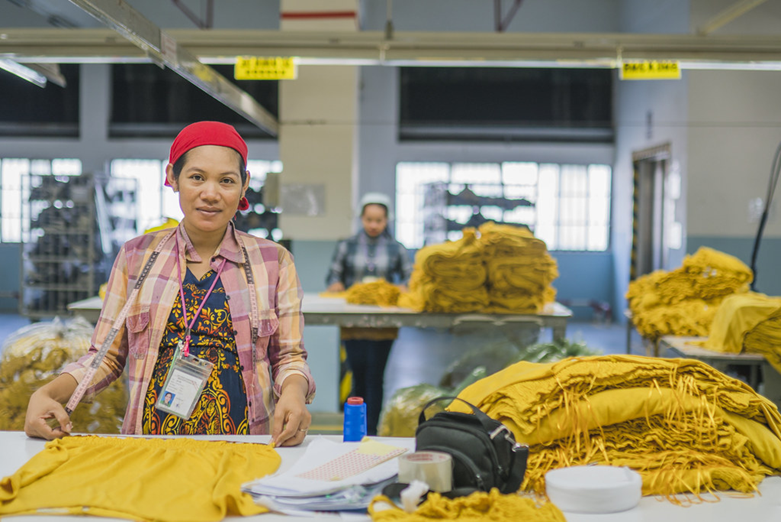
Garments and apparel remain the historic backbone of the manufacturing base, but the report points to the rise of more diversified sectors: electronics, automotive components, bicycle manufacturing, agri-processing and furniture and wood products now round out an industrial fabric that is far less mono-sector than it was a decade ago.
The great infrastructure push
The real shift, however, is playing out on asphalt and rail. The Phnom Penh–Sihanoukville Expressway, completed in 2023, cut the journey to the deep-water port to under two hours, turning the entire National Road 4 corridor into the country's industrial backbone in the process. The new Techo International Airport, 24 km south of the capital, is meanwhile expected to anchor demand for air freight and cold-chain facilities along National Road 2.
Other projects are still under way: the Phnom Penh–Bavet Expressway is set to open up the eastern industrial corridor toward the Vietnamese border, the expansion of Sihanoukville Port is meant to absorb growing export volumes from the special economic zones, and the southern rail line linking the capital to the coast is being upgraded for freight capacity. The most spectacular project remains the Funan Techo Canal, a 180 km inland waterway designed to link Phnom Penh to the sea and free bulk cargo routes from having to pass through Vietnam — with commissioning targeted for 2028.
Phnom Penh, Kandal, Sihanoukville: mapping the opportunities
Within the capital itself, the report identifies eight hotspots, from the historic National Road 4 corridor — home to the Phnom Penh Special Economic Zone and the country's largest concentration of factories — to the emerging logistics hub of Khan Sen Sok in the north, popular with FMCG distributors and third-party logistics (3PL) operators.
Beyond the capital's administrative boundaries, Kandal province stands out as the natural overflow corridor for urban growth, with land costs 20 to 40% lower than Phnom Penh's core for access to the same labour pool. Sihanoukville, the country's only deep-water port, hosts a cluster of special economic zones dominated by Chinese and regional manufacturers, where demand for cold storage is, according to the report, "severely undersupplied" in 2026. Bavet, on the Vietnamese border, plays the card of integration with Ho Chi Minh City's supply chains 170 km away, drawing Taiwanese, Korean and Chinese investors. Poipet, the historic crossing point with Thailand, remains less developed but offers, in the report's words, a first-mover advantage for anyone looking to position themselves in bonded warehousing — though the border crossing was closed as of 22 June 2026.
Fifty-six zones, $13.7 billion
The special economic zone figures give a sense of the momentum under way: 56 zones on the books, 33 of them operational, run by 28 developers and operators, for a total of 1,062 investment projects representing $13.7 billion in committed capital and 245,000 direct jobs. The data, compiled by the CDC for the 2024–2025 period, lists notable occupiers including Adidas, Nike, Puma, Coca-Cola, Toyota, Ford, Denso, Yazaki and Chinese carmaker BYD — a roster that reflects the sector diversification mentioned above, spanning garments, automotive and agri-food.
These zones offer investors a fairly standard package of incentives for the region: corporate income tax holidays of up to nine years, import duty exemptions on production inputs and equipment, ready-built infrastructure, on-site customs offices and bonded warehousing, and one-stop-shop approval procedures.
On the trade front, the country remains heavily oriented toward the United States, which absorbs 40.8% of Cambodian exports according to the customs statistics cited in the report, well ahead of Vietnam (16.6%), Japan (5.5%) and China (5.4%). That concentration mechanically exposes the kingdom to swings in the US-China trade relationship.
The blind spots not to underestimate
The report, however, stops short of euphoria. It identifies five risks, at contrasting levels of severity. At the top of the list, rated high: the infrastructure gap — with power reliability and road quality remaining uneven outside the major special economic zones — and land title and legal issues, since foreign entities still cannot directly own land in Cambodia, even though the recent passage of a trust law is beginning to offer an alternative to the traditional long-term lease.
The report also flags, at a medium risk level, macroeconomic uncertainty tied to US-China trade tensions — notwithstanding the stability offered by a largely dollarised economy — as well as the partial withdrawal of certain EU trade preferences, which is already said to be affecting some export sectors. Finally, the shortage of internationally standard logistics parks — with clear ceiling heights still mostly in the 6 to 9 metre range, when e-commerce and racked storage call for 10 metres and above — remains a constraint for the most demanding occupiers, even as supply improves.
A market "early but accelerating"
That is the phrase the report's authors use to sum up the state of the sector: a market at an early but accelerating stage, driven by infrastructure investment, the expansion of special economic zones and genuine occupier demand. Enough, they conclude, to make a compelling medium-term case for developers and occupiers prepared to navigate the market's current limitations with the right local guidance.
Whether Cambodia can turn this acceleration into a lasting position on Southeast Asia's industrial map remains to be seen — up against neighbours, Vietnam chief among them, playing the same hand with a considerable head start.
Source: "Cambodia Industrial & Logistics Snapshot 2026," realestate.com.kh, based on data from Cambodia's GDCE, CDC and Ministry of Commerce.

Comments