


The Phnom Penh Customs Museum: A Journey Through Cambodia’s Fiscal and Maritime History

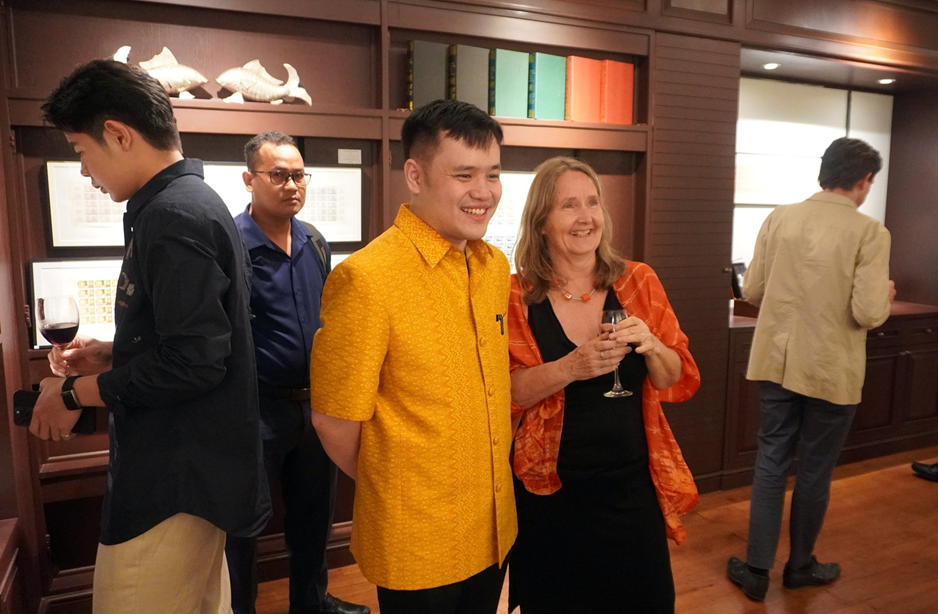
During the opening of the Santepheap Foodcourt, we had the opportunity to visit the Phnom Penh Customs Museum, located in the former building of the General Department of Customs and Excise. Although this project is still recent and continues to evolve, the site offers an informative tour of the customs history of the Kingdom — featuring historical documents, books, photographs, models, uniforms, and investigative methods.

It is, however, difficult to find records and testimonies concerning the establishment of Cambodia’s first customs services, since in the 19th century these were centralized under the French Indochina regime and operated mainly along waterways, largely due to the many pirates and smugglers then using boats.
Beginnings
Cambodia’s customs administration was created by Norodom Sihanouk during the Sangkum Reastr Niyum period, thus separating it from the Indochina Union of the French colonial era through Royal Decree No. 661 dated June 29, 1951.
During the French colonial period, Cambodia’s customs administration operated as a sub-directorate in Phnom Penh, responsible for overseeing customs administration in Cambodia and southern Laos, along with three other sub-directorates across Indochina. These four entities were under the main administration of the French Governor-General of Indochina based in Hanoi.

The functioning of Cambodia’s Customs Administration was suspended from 1975 to 1979 under the Khmer Rouge regime. The administration resumed operations on July 13, 1979 under the supervision of the Ministry of Commerce, later transferring to the Ministry of Economy and Finance by Sub-Decree No. 06 of March 11, 1988 under the name Department of Customs and Excise. It was later restructured as the General Department of Customs and Excise of Cambodia (GDCE) through Sub-Decree No. 134 of September 15, 2008. The GDCE became the 155th member of the World Customs Organization (WCO) on April 3, 2001.
History of the Customs and Excise Administrative Building
In 1884, there was no dedicated customs administration building, only a warehouse belonging to the Sub-Customs Administration. This brick-built structure, located in central Phnom Penh, was severely damaged by a fire in May 1884.

The ground floor and first floor were used for administrative purposes, while the second floor served as offices and housing for the Customs and Excise Director and staff. The building had three exterior facades: the east side featured the main entrance along the Sisowath Quay, the west side bordered Preah Ang Eng Street, and the north side ran along Preah Ang Nun Street, which led toward Wat Phnom. The south side adjoined the Phnom Penh Autonomous Port authority.
This building was demolished in 1965, and an hotel named “Chhné Tonle” (meaning riverside) was later constructed on the site — now occupied by the Tribe Phnom Penh Hotel.
After 1965, the Customs and Excise administrative office relocated to No. 13 Norodom Boulevard, now numbered 6–8 Norodom Boulevard.

This single-story colonial-style structure once served as an administrative office for the Ministry of Finance and now houses the museum.
On July 23, 2001, during the commemoration of the 50th anniversary of Cambodia’s Customs and Excise Administration, a U-shaped building was constructed on the same premises behind the colonial structure and inaugurated by Samdech Techo Hun Sen. The project was carried out under the direction of H.E. Dr. Pen Siman, Delegate of the Royal Government of Cambodia and then Director General of the Department.

Under the leadership of H.E. Dr. Kun Nhem, Minister attached to the Prime Minister and Director General of the GDCE, a new Customs and Excise administrative building was later constructed on the site of the former U-shaped building.

Construction of the new building began in February 2017 and was officially completed by the end of 2019. This modern 35-story structure covers 44,423 m² and includes eight floors of parking space.
Riverine History
Serge Rinkel, a former French customs coast guard and expert on cross-border crime in Africa — working notably with the World Border Organization (BORDERPOL) and the European Commission — authored an insightful document about the Indochina flotilla and the origins of the Indochinese Customs Union.
The Indochinese Customs Union
Starting on October 17, 1887, a single customs regime applied to Cochinchina, Annam, Tonkin, and Cambodia, countries then under the French-controlled Indochinese Customs Union. A Directorate for Cochinchina and Cambodia was established in Saigon, while another for Annam and Tonkin was based in Hanoi. In 1897, both were merged to form the Indochina Customs and Excise Authority, overseen by a single Director initially based in Hanoi, later in Saigon. The General Customs Directorate centralized revenue collection under the French Governor-General’s command.
At that time, the colony’s budget relied heavily on indirect taxation, mainly from customs duties and three state monopolies (régies): salt (1897), opium (1899), and rice alcohol (1902). This system proved highly effective — Indochina soon became self-sufficient and even generated financial surpluses large enough to issue public works and railway bonds on the French market from 1898, backed by Indochina’s own budget.
While profitable, the régime’s penalties were extremely harsh — particularly for sailors or barge owners transporting goods without permits. For example, moving salt without a pass could result in confiscation of the goods, a fine of 100 to 2,000 francs, imprisonment from one month to two years, and seizure of the vessel in case of repeat offenses.
Development of the Flotilla
Given the strong customs revenue, suppressing maritime and river smuggling became a key priority for the colonial governor, who fostered the growth of a customs fleet. By 1890 in Phnom Penh, a small flotilla comprised the steam launches “Cambodge”, “Siam”, “Laos”, “No. 2”, and “No. 1”, later joined by “Khmer” in 1894. By 1895, the entire Indochina Customs fleet included eight steamships and thirty-six other boats. Three vessels — “Ninh Binh” (in service since 1887), “Hanoi”, and “Nam Dinh” — served as effective patrol boats, each with ten days’ autonomy and coal bunkers of fifty tons, though only the last two carried revolver cannon armament.
Download and read the full document here
The museum is open to visitors. For inquiries, call +855 23 722 767.


Comments