


The Khmer Enigma: The Lost Autochromes of Jules Gervais-Courtellemont

In September 1928, National Geographic published twenty-seven color photographs of a Cambodia almost unknown to the Western world. Signed by a French adventurer-photographer, a convert to Islam, companion of Pierre Loti, and pioneer of autochrome—these images resurface today with undiminished power. A dive into the lens of a forgotten visionary.

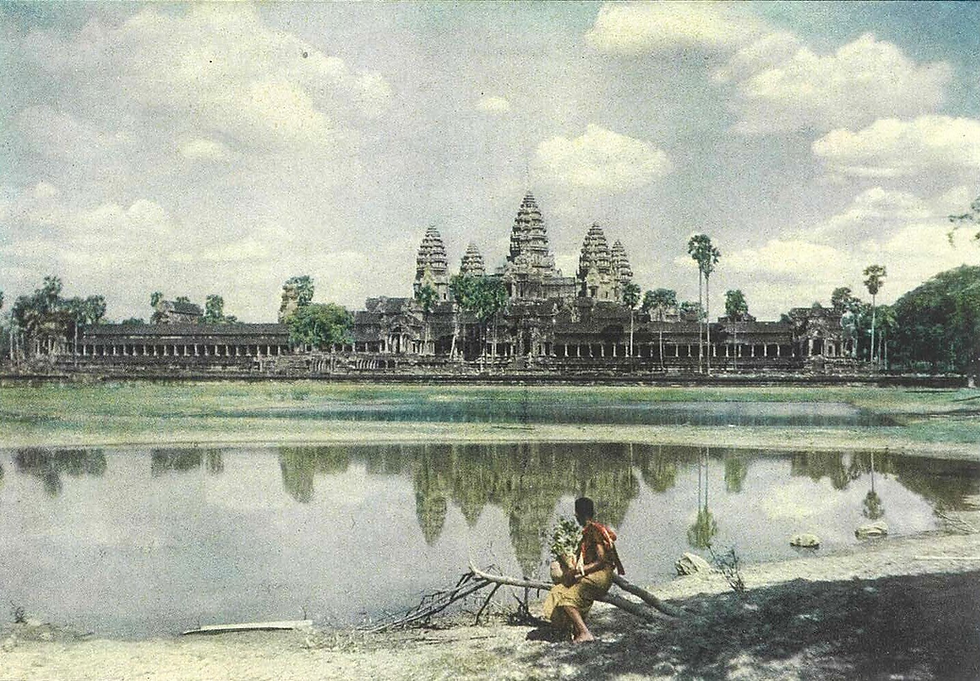
September 1928. On the tables of National Geographic Magazine subscribers, an issue suddenly feels like an open window onto another world. Among pages devoted to French Indochina, twenty-seven color photographs break away from the usual gray of illustrated press: royal dancers at the edge of Angkor’s golden stones, a saffron-robed monk lost in contemplation of ruins, pagoda facades drenched in tropical light. This is the golden age of autochrome, and its master is present: Jules Gervais-Courtellemont—explorer, convert to Islam, photographer of empires, friend of Pierre Loti—and a largely unrecognized witness of colonial Cambodia.
Nearly a century later, these autochromes re-emerge in full resolution thanks to the Angkor Database, which digitized an original copy of the magazine. For the first time since 1928, it is possible to view these images as American readers once did, in the vibrancy of their warm and melancholic tones, between sunlit sepia and twilight blue.
A Man at the Crossroads of Worlds

Jules Gervais-Courtellemont was born in 1863 in Avon, Seine-et-Marne. His trajectory would be ordinary if, at just fourteen, he had not found himself alone managing a farm in Algeria, abandoned by parents forced to return to France for health reasons. This forced immersion in Arab and Berber worlds shaped him into a bridge between civilizations. In 1888, he opened a photography studio in Algiers and became editor of the journal L’Algérie artistique et pittoresque. His fate shifted in 1894: converted to Islam, he performed the Hajj and became one of the first Westerners to photograph Mecca—an audacity that could have cost him his life.
His career then became a living atlas: Spain, Syria, Egypt, Palestine, China, Yunnan, Tibet—and Indochina, which he explored between 1900 and 1903 with his wife Hélène, also a photographer and daughter of Islamologist Charles Lallemand. Their joint exhibition in Hanoi in 1902 earned him the Gold Medal of the French Geographical Society. Gervais-Courtellemont was not a luxury tourist; he was an eye, a sensitivity, a way of seeing the world without the usual arrogance of the colonizer.
“He sees Cambodia not as a terra incognita to conquer, but as a civilization to understand—a nuance the French press of the time, absorbed in its ‘civilizing mission,’ was incapable of imagining.” — Angkor Database, editorial note, 2025
Autochrome, or Color Wrested from Time
To grasp the importance of these images, one must understand what autochrome is. Developed by Auguste and Louis Lumière from 1904 and commercialized in 1907, this process remained for nearly thirty years the only accessible color photography technique. Its principle is almost magical in its simplicity: a glass plate is covered with millions of potato starch grains—about four million per square centimeter—dyed red, green, and violet. Light, passing through these microscopic filters, exposes a panchromatic emulsion and reproduces the full range of colors of the subject.
The manufacturing process is extremely complex. The grains are sorted to the micron, dyed in three separate baths, mixed with clockwork precision, spread onto a varnished plate, then subjected to pressure of five tons per square centimeter. The result is a positive transparency of often stunning beauty—warm, slightly grainy, and irresistibly poetic.
Gervais-Courtellemont was one of the great masters of this technique. It was after seeing his autochromes in a 1909 projection that philanthropist Albert Kahn was struck by revelation: he immediately entrusted this method to his monumental project, the Archives of the Planet, sending dozens of photographers around the world to create the first global color photographic memory of humanity.
Angkor Seen Through an American Lens
Journalist Robert J. Casey authored the text accompanying the autochromes in the September 1928 National Geographic. His article, titled “Four Faces of Siva: The Mystery of Angkor,” is both literary and informative. Yet the photographic series attached to it under the title “The Enigma of Cambodia”—twenty-seven color images by Gervais-Courtellemont—goes far beyond mere illustration.
What stands out is the notably balanced perspective American editors bring to the French Protectorate. While French press of the time glorified the “civilizing mission,” National Geographic focuses on Khmer distinctiveness: royal classical dance, pagoda life, monks in meditation.
The selection does not avoid politically sensitive subjects: one photograph shows the Phnom Penh courthouse, where Cambodian and French magistrates sit side by side in visible discomfort. Another documents the Cambodian School of Arts—founded in 1917 by George Groslier—which American captions awkwardly call an “industrial school,” mistaking the preservation of ancient craftsmanship for technical training.
American editors also discreetly point out errors by French scholars. Structures at Angkor Wat labeled “libraries” by EFEO archaeologists? The magazine notes simply: “They have been called libraries, but were probably chapels.” A small remark with significant implications.
The Silver Pagoda and Its Lost Frescoes

Among the twenty-seven autochromes, one draws particular attention from art historians. Catalogued as G-C (A) 10, it shows the interior of the Silver Pagoda in Phnom Penh with exceptional clarity. On the walls appear vast frescoes of remarkable refinement—narrative cycles inspired by the Reamker, the Khmer version of the Ramayana.
These murals were partially destroyed during restoration work in the 1960s and later suffered under the Khmer Rouge era. Gervais-Courtellemont’s autochrome is now one of the most precise records ever made of these lost works—a photograph that, in 1928, was just one image among others, but has since become an art historical treasure. Photographic plates reproducing these murals, recently rediscovered, were exhibited at the Sosoro Museum in Phnom Penh in October 2025.
REFERENCE · KHMER ROYAL DANCE IN PARIS IN 1906 Long before his journey to Cambodia, Gervais-Courtellemont had already encountered Khmer classical dance elsewhere. In June 1906, King Sisowath made a historic visit to France. Dancers from his royal ballet performed at the Théâtre de Verdure in the Bois de Boulogne, Paris. The performance captivated the French press, and Auguste Rodin himself attended and was deeply moved. Among the witnesses was Gervais-Courtellemont, who produced a striking photographic report for L’Illustration in June 1906. This image, long misattributed, is now correctly credited to him by the Angkor Database, confirming his lasting interest in this ancient art. |
The Enigma, the Marie Celeste, and the Jungle
To conclude his National Geographic article, Robert Casey uses a bold metaphor. He quotes a French engineer met at the Angkor Inn—“Monsieur Pierre Dupont of roads”—who compares the abandoned site to the Marie Celeste, the Canadian brigantine found drifting in 1872 with sails set, table laid, fires still burning, but no crew aboard. The comparison is exaggerated—civilizations are not “abandoned” like ships—but it captures the emotion Angkor evoked in Western visitors of 1928: an overwhelming silence, a mystery only partially uncovered by EFEO excavations.
This sense of enigma—enhanced by the unreal light of autochromes—may explain the enduring power of these images. They capture not just architecture, people, or a moment, but an atmosphere: filtered light through moss-covered stones of Angkor Thom, the orange stillness of a Buddhist sermon at the Silver Pagoda, the suspended grace of royal dancers preparing among ruins.

A Singular Perspective in a Colonial Context
It would be anachronistic to portray Jules Gervais-Courtellemont as an early anti-colonial activist. His work fits within the Orientalist gaze of his era: he published works praising the French colonial empire and photographed colonial troops during World War I. Yet something in his personal journey—a man who converted to Islam, lived among Algerian peasants, and traveled in disguise to reach Mecca—shaped his perspective toward genuine curiosity rather than condescension.
Where his contemporaries saw Cambodian scenes as illustrations of France’s protective role, Gervais-Courtellemont photographed a praying monk, a bride in ceremonial dress, women weaving silk, children playing at the foot of Angkor Wat’s naga balustrades. He documented a living people, not an exotic backdrop.
When he died in Paris on October 31, 1931—just weeks after the publication of his final major color report in National Geographic—he left behind a considerable body of work, scattered between the Albert Kahn Museum archives in Boulogne-Billancourt and collections in Washington, D.C. A body of work that has waited nearly a century for a gaze worthy of it.
“These autochromes are not ruins. Like Angkor itself, they still turn the waters: solid, intact, mysterious. They simply await being seen.”
Digital Resurrection
The Angkor Database, a social responsibility project hosted by the Templation Angkor Resort, undertook high-resolution digitization of an original September 1928 issue of National Geographic. This marks the first time since publication that all twenty-seven autochromes can be viewed in quality faithful to their original state.
The entire series is now available online (https://angkordatabase.asia/photos/visions-of-cambodia-by-j-gervais-courtellemont), accompanied by rigorous scholarly apparatus: location identification, historical context, and corrections of occasionally inaccurate original captions.
This work highlights a frequently overlooked truth: photographic archives from the colonial world are an inexhaustible source of history—not as tools of nostalgia, but as material for inquiry. What Gervais-Courtellemont’s lens captured in 1927 inside the Silver Pagoda cannot be reconstructed by any historian. Here, photography is not ornament—it is evidence.
SOURCES
Jules Gervais-Courtellemont, “The Enigma of Cambodia (27 Natural-Color Photographs)”, in Robert J. Casey, “Four Faces of Siva: The Mystery of Angkor”, National Geographic, vol. LIV, n°3, septembre 1928, p. 302–332. Numérisation et notes critiques : Angkor Database (angkordatabase.asia).
Béatrice De Paste & Emmanuelle Devos, Les couleurs du voyage : L’œuvre photographique de Jules Gervais-Courtellemont, Paris Musées / Phileas Fogg, Paris, 2002.
National Science and Media Museum, “History of the Autochrome: The Dawn of Colour Photography”, 5 juin 2009.


Comments