


Silent Cancer of War: A Journey to Cambodia's Forgotten Frontier
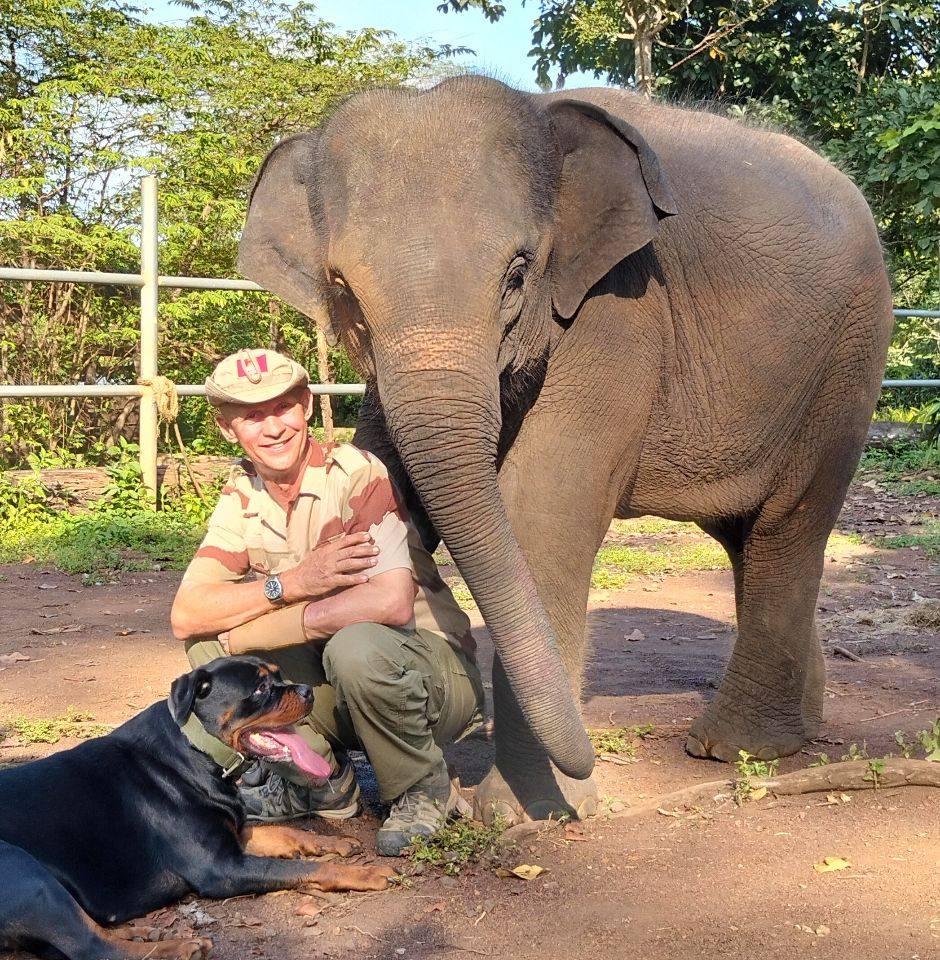
In this article, the author Pierre-Yves Clais delivers a poignant and unflinching testimony of a recent trip to the Cambodian border. Between the duty of remembrance, compassion for war victims, and denunciation of Thai arrogance, he crafts a "geopolitical" narrative doubled with an intimate reflection on the resilience of a people being humiliated and dispossessed.

Through scenes of life, encounters, and historical analyses, Clais reminds us that war, like cancer, never truly disappears.
A Journey to the Heart of Remembrance
A few days ago, we returned from yet another family stay at the Thai border.
This trip, always difficult, through regions devastated by Siamese bombs, has become for us much more than a journey. It is a path of friendship, fidelity, and gratitude, almost a duty. For those at the border are a part of ourselves, a part of Cambodia. They watch, they protect. And yet, they are too often forgotten as soon as the clamor of battle fades a little.
War, That Silent Cancer
But war is like cancer. It doesn't disappear just because we decide not to think about it anymore. It remains there, lurking, smoldering in the shadows, metastasizing slowly and preparing dark tomorrows. Like everyone, we too would like to move on, but we cannot.

For this war is not an abstraction. It has faces, those of flesh-and-blood men we have met many times. It evokes smiles, embraces, jokes exchanged over a meal, a small gift offered to soldiers, some of whom are no longer here today. These men live tied to the border like to a cruel and hungry lover, one who has already swallowed several of their own and whom they know promises them even more suffering.
And then, in these places where everything is scarce, the humblest attentions take on profound value for those who receive them...
Precious Aid for the Eleven Widows of Ta Krobey
This time, in addition to our usual pickup truck filled with assorted supplies for the soldiers, a kind French soul had entrusted us with cash donations for the eleven war widows of Ta Krobey, left in the wake of the last Siamese offensive. This aid, significant for poor women weakened by their new status, was handed over to them at the Samrong barracks during a ceremony organized by the military hierarchy.

Once again, the profound changes in the Cambodian army move us: the kindness, compassion, and courtesy of the officers toward those who have lost everything warm the heart! With the cohesion meals shared with the soldiers and this heartbreaking visit to a primary school in Preah Vihear where most of the dads are at the front, it is undoubtedly the only luminous moment of this trip. For the rest, we can only measure the extent of the losses and destructions suffered by Cambodia since the last attack.
Thai Arrogance and Permanent Provocation
And then there is Thai arrogance. Now, they hold all the heights, often deep inside Cambodian territory, which they dominate and sweep with crossed sniper positions. Their flags planted on the ridges seem to taunt the Khmers: they are there to stay, and everything indicates they seek to provoke an incident.

International Law, a Chimera
These invaders know full well that the world has changed... The 2008 and 2011 border clashes were just trial runs. At the time, Thailand tested both its military power and the international community's reaction. Under pressure, it eventually accepted the arbitration of the International Court of Justice, which once again ruled against it.
But since 2014, the major conflicts shaking the planet have relegated international law to the status of a chimera. Russia, Israel, the United States... and, on their scale, Thailand: each now acts according to its own will to power.
In this global turmoil, little Cambodia disappears from the radar. All the more so since it has weakened itself on the international stage by allowing the infamous "scam centers" to prosper on its soil, whose sordid reputation has tarnished its image.
And Our Allies in All This?
So, who will dare intervene for Cambodia? ASEAN, true to its tradition, looks the other way. Interference is not in its DNA: what interests it above all is trade. And the great, formidable Chinese ally? Alas, it does far more business with Thailand than with Cambodia and was at the pool during the last three attacks...
And what is France doing? Has it forgotten the history that binds it to Cambodia? Has it forgotten that in 1907 it restored to this country nearly a third of its current territory, including the provinces of Siem Reap and Battambang, occupied by Siam since 1795? Will it prefer today to continue, cynically, selling CAESAR cannons to Thailand, those fearsome weapons that pulverize both Cambodian soldiers and international law? Doesn't a diplomacy that constantly tries to spare the goat and the cabbage end up debasing itself to a pitiful posture of a rug merchant? The France of the Third Republic did not act by chance: at a time when Cambodia was threatened with disappearance, pressed by Siam to the west and north and by Vietnam to the east, it allowed it to survive as a state. Over a thousand soldiers from the Marine Troops and the Legion lost their lives there so that justice could be done.
Not taking sides is always and everywhere condemning the weak! Time is pressing, however, because tensions are rising again...
Venerable Lah Sokunthy, Buddhist Watchman
Tireless defender of the poor of Sraèm and the Khmer nation, Venerable Lah Sokunthy tirelessly roams Preah Vihear province at the wheel of his sturdy 4x4. Everywhere he goes, he brings the compassion of the Buddha to each, but also very concrete aid allowing the most destitute to survive in these times of military occupation of the country by Thailand.

At the end of the Holy Day ceremonies, he confides to us that the Thais have already obtained the essentials of what they coveted: Ta Krobey, Prasat Knah, Ta Moan Thom. All that remains for them now is the crown jewel: Preah Vihear, devastated in the last attack.
No fewer than 562 artillery impacts were recorded on the temple; irreparable damage, to the point that the Minister of Culture wept... The modern pagoda at the foot of the mountain was completely razed by the bombings. That morning, seized by a premonition, the Venerable had providentially evacuated the monks. Without this saving intuition, they would all have perished under the shells.
Preah Vihear: A Jewel Under the Bombs
This barbaric relentlessness of the Thais has nothing to envy in the destruction of Palmyra by the Islamic State or the dynamiting of the Bamiyan Buddhas by the Taliban. At this degree of savagery, such destructive fury cannot be taken lightly: it reveals a deliberate will to annihilate even the memory and history of Cambodia itself.
Siamese military positions have advanced strongly, and new armaments have been deployed there. According to the Venerable, it would take them little time to seize the temple and push the few surviving Cambodian soldiers toward the cliff.
Exactly, he recalls, as during the Dangrêk massacre, which occurred in that same place on June 8, 1979, when the 45,000 refugees from the Nong Chan camp were hurled toward the escarpment, 7,000 of them disappearing in atrocious conditions.
This is truly a policy and strategy long matured.

When History Lies: Siamese Propaganda
Visiting the Siam Museum in Bangkok about fifteen years ago, a painting caught my eye and shocked me deeply, to the point of photographing it. It shows Naresuan, king of Ayutthaya, enthroned as master on a raised platform while the water soiled by the washing of his feet is poured over the head of the Khmer king Phra Satha, presented as a captive promised to execution. This image is not a simple "work of art": it is assumed historical propaganda.
King Satha I was never captured or killed during the capture of Longvek in 1593; he fled and died in exile in Laos. Yet the lie persists, glorifying the ritual humiliation of the Cambodian sovereign and transforming the sack of his capital into a moral triumph.
Displayed at the heart of a museum whose official mission is to explore and make understood the central concept of "Thainess" (ความเป็นไทย — Kwam Pen Thai), that is, "what does it mean to be Thai?", through the history, culture, and anthropology of the Thai people, this painting sums up Thai policy for centuries: deny the reality of facts, humiliate Cambodia, and justify, even today, territorial claims and a sense of superiority toward a neighbor deemed eternally inferior.
The Unapologetic Racism of "Thainess"
Currently, the Thais have come to sincerely believe their own lies. They feel in their absolute right, as confirmed daily by comments on Thai social networks: insulting, contemptuous, often openly racist toward Cambodians. They call the Khmers "Khmens" or "Kamens," a term loaded with derision and assumed contempt.
They openly mock the destruction of Ta Krobey and Preah Vihear, convinced that it was all justified by the mere presence of a few soldiers and three old rifles. They make a joke of it, turning the brutal erasure of Khmer history and presence into a legitimate and amusing victory.
Thus, one could recently read on a Thai Facebook page: "The Khmer country was a Siam colony for 432 years... This country was only founded 73 years ago... They were slaves for almost 1000 years and today they are still slaves of Hun Sen. The Khmers copy everything that is Thai."
This type of discourse, mixing denial of Cambodian history, rewriting of the past, and assumed contempt, is unfortunately not marginal. It reflects a view widely held in certain Thai nationalist circles: that of a Cambodia supposedly without its own history, whose culture would be only a late imitation of Siamese civilization.
This unapologetic racism is no accident: it is the natural extension of a national identity (this "Thainess") built on symbolic domination and the systematic rewriting of Cambodia's past.
To assert this domination, what could be more effective than seizing, even destroying, the Khmer temples on the border?

Sacred Temples Turned Lines of Fracture
The presence of these sanctuaries on the Dangrêk ridge is actually no coincidence. It responds to a logic that is both religious, political, and strategic. In Hindu cosmology, the mountain symbolizes Mount Meru, center of the universe. Khmer kings thus built their temples on the heights to materialize this sacred mountain and guide the pilgrim in an ascent toward the divine, as at the Preah Vihear temple.
But these sanctuaries were also markers of sovereignty. The Dangrêk chain formed the natural limit between the Cambodian plain and the Khorat plateau, and the temples lining it affirmed Khmer imperial presence while controlling the roads linking Angkor to the northern territories. They thus constituted a true sacred and strategic line.
When modern borders were drawn during the Protectorate era, cartographers often followed the mountain ridge line. Yet several temples had been built on the southern slope of this ridge, with historical access from the north. This misalignment created the territorial ambiguities that still fuel disputes today around sites like Preah Vihear, whose belonging to Cambodia has been repeatedly confirmed by the ICJ.
Thus, architectural and spiritual choices made nearly a millennium ago have become major geopolitical friction points!

Containers and Barbed Wire: De Facto Annexation
The Thai army claims that the barriers of containers and barbed wire it has erected along the border comply with the "Cambodia-Thailand ceasefire agreement." Yet the official text of this agreement explicitly provides for the return of civilians "without obstruction," prohibits any new military infrastructure, and specifies that the ceasefire must in no way alter territorial sovereignty.
The situation on the ground contradicts these commitments. The installed barriers, the advance of military positions, and restrictions on the return of displaced populations create a new territorial reality. What is presented as a temporary security measure increasingly resembles a de facto annexation of significant portions of Cambodian territory.
A ceasefire cannot serve to redraw a border. Preventing inhabitants from returning and consolidating military positions is transforming an occupation into pure and simple annexation.
Preventive Threat as Pretext
And yet that is still not enough for them... Thai military authorities and intelligence services have been claiming for months to be deeply concerned by Cambodia's acquisition of modern anti-aircraft systems. In February 2026, security officials in Bangkok thus declared that these systems aimed to neutralize Thai air superiority, particularly that of their F-16 and Gripen fighters, even mentioning the possibility of preventive strikes.
By presenting defensive capabilities as an offensive threat, Bangkok seeks to legitimize a potential new armed intervention to complete a process of annexation already underway on the ground.

A People That Remembers
Thus, today, in the almost complete indifference of the world, an ancient drama is playing out: that of a small country believed to be able to be nibbled away little by little, hill after hill, temple after temple. Yet Cambodia's history is full of moments when its disappearance seemed inevitable. It never was...
For beyond maps, treaties, and official speeches, there is a deeper reality: a people that remembers. Destroyed by heavy artillery, the stones of Preah Vihear and Ta Krobey become the symbol of Thai barbarity that violently denies a millennial sovereignty and a civilization that, long before modern borders, had already inscribed its mark on these mountains.
One can try to erase this presence, plant flags on the ridges, erect barriers, and rewrite history. One can even, for a time, impose the fait accompli, but history never allows itself to be confiscated indefinitely.
Those who think they can turn force into right would do well to remember one simple thing: borders imposed by violence always end up, sooner or later, becoming lines of fracture again. And when that moment comes, it is not the peoples who have defended their land who are judged by History. It is those who wanted to take it.


Comments