


Phsar Thmey, Phnom Penh's Golden Memory

For nearly a century, an ochre Art Deco dome has watched over Phnom Penh and over one of the most photographed markets in Southeast Asia — born from a drained swamp, scarred by bombs, and saved just in time by a French-Cambodian renovation.

Just as the Cambodian sun begins to bite into the asphalt, Phsar Thmey's dome is the first thing to catch fire with light. Its ochre skin, unlike anything else in the capital's skyline, gathers the light before the city has fully woken up, and its four wings, stretched out diagonally, cast a star-shaped shadow over the surrounding sidewalks. You can spot this faintly extraterrestrial Art Deco silhouette from a distance, wedged between boulevards inherited from the French protectorate and the glass towers rising all around it. But it's inside that Phsar Thmey shows its true face: under light filtered through golden lattices, amid the mingled smells of fresh fish, incense, and hot metal, thousands of lives cross paths every day, among jewelry displays, stacked mountains of fabric, and fruit stalls — much as they have, almost without interruption, since 1937.
Why was a market built on a swamp?
The site's location was no architectural accident, even if it caused headaches for years. Before the 1930s, the spot was nothing but a marshy area that collected runoff during the monsoon, right in the middle of what was then Phnom Penh's Chinese quarter. With the capital's population nearing 90,000 by the late 1920s, the French protectorate's administration judged the site too central to remain a bog and decided to drain it to build a market worthy of its urban ambitions. The 1929 economic crisis delayed the project by several years; construction finally began in 1935.
A project built by names that mattered
The design was entrusted to Jean Desbois, Phnom Penh's city architect from 1931 to 1937, with Louis Chauchon as supervising architect-engineer and Wladimir Kandaouroff at his side, backed by the engineering firm Daydé & Pillé. The market opened in September 1937, under the gaze of King Sisowath Monivong. At the time, it was billed as the largest market in Asia: a central dome rising 26 meters, then one of the largest on the continent, from which four immense halls radiated out, capable of housing hundreds of stalls.

A dome built for the heat, not just for looks
What still strikes visitors today isn't so much the building's size as its climatic ingenuity. The geometric lattices pierced along the walls let light in while creating a chimney effect that naturally draws hot air out — a form of passive cooling devised long before the age of the split-unit air conditioner. The interplay of beams and golden openings rising toward the top of the dome remains, to this day, one of the architectural sights most sought out by photographers passing through Phnom Penh.
A bomb, a war, years of neglect
The market's history has been anything but smooth sailing. In 1940-1941, during the Franco-Thai War, Thai aircraft bombing seriously damaged the structure, forcing a temporary closure. It took until the end of World War II for Phsar Thmey to be rebuilt and reopened. The following decades were hardly kinder: the civil war, and then the years of Democratic Kampuchea, left the building neglected, much like most of the capital's architectural heritage during that period.
The renovation that saved Phsar Thmey
It wasn't until 2009 that a major renovation project got underway, funded to the tune of $4.2 million by the French Development Agency (AFD). The roof, drainage system, and load-bearing structure were all overhauled, along with hygiene and safety conditions for vendors. The market reopened on May 25, 2011, its famous yellow hue restored. A four-faced clock, installed in 2012 to replace the original 1930s piece which was beyond repair, now sits at the center of the dome — a nod, some residents say, to Phnom Penh's nickname, the "city of four arms," a reference to the confluence of the Mekong, Tonlé Sap, and Bassac rivers at the very origin of the city.
What you'll find under the dome
Each wing of Phsar Thmey has ended up specializing, almost without anyone planning it. In the textile aisles, towels and krama scarves stack up in multicolored pyramids, rising almost to the ceiling of the stalls.
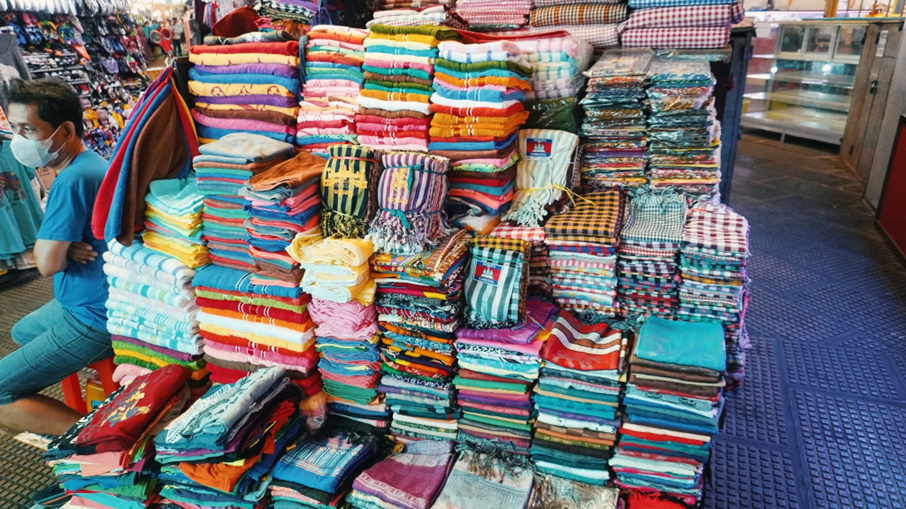

Sunglasses, meanwhile, are counted by the dozen on rotating display racks, somewhere between more or less convincing knockoffs of major brands and cheap polarized models.

Around the outer edge, the rougher trades take over: butchers cut meat assembly-line style, carcasses hanging from hooks, while entire aisles of ready-to-wear clothing stretch the length of a wing, mannequins dressed in floral dresses and denim jackets lined up like an honor guard.

This constant mix of luxury and counterfeit, tradition and cheap imports, may be what best captures the spirit of the place: a market that has never had to choose between its different lives — kept running, day after day, by the vendors who bring it to life.
How to visit Phnom Penh's Central Market
Phsar Thmey sits in the Daun Penh district, a few streets from the river, not far from the Royal Palace and the Russian Market — an almost obligatory stop on any visit to Phnom Penh. The building is most photogenic early in the morning, when light streams through the dome's lattices, or in the late afternoon, once the midday heat has passed. As in most Cambodian markets, it's worth haggling over prices, especially in the aisles devoted to souvenirs, textiles, and jewelry.


There are times when life can be stressful, and all it takes to significantly improve your spirits is to put on subway surfers and let yourself to become completely immersed in the game's non-stop running.