


Phsar Leu Thom Thmey: The Market That Never Sleeps

In Khmer, « phsar » simply means « market ». But Phsar Leu Thom Thmey — the « Great Upper New Market » — is much more than a place name: it’s the oldest and largest market in Siem Reap, the only one never designed for visitors.
Originally, the site housed a humble, functional wooden structure set in the upper part of the city, far from the French quarters developing along the river. This first structure was demolished and replaced by the « Great Upper New Market », Phsar Leu Thom Thmey, built along National Road 6 toward Phnom Penh.
The market has weathered the darkest pages of Cambodian history. During the Khmer Rouge years (1975–1979), urban markets were abolished: trade was forbidden, cities emptied, currency eliminated.
After the regime’s fall and the years of reconstruction that followed, popular markets like Phsar Leu Thom Thmey were among the first places to come back to life — a tangible sign of the return to everyday commerce, to a reclaimed form of normalcy. Today, it opens its doors as early as three or four in the morning and doesn’t close until nightfall. It’s, locals say, the market that never truly sleeps.
At the Market’s Gates
The market doesn’t start at a formal entrance. It begins in the street itself. Vendors arrive before dawn and claim their sidewalk patches, spreading their goods on makeshift tables and woven baskets well before the covered stalls raise their shutters.
Roasted nuts, lotus flowers, ripe green plums, and snails mingle under yellow and orange umbrellas that glow in the morning heat. The city buzzes around them — motorcycles weaving between stalls, delivery trucks idling, buyers navigating the narrow passages with long-honed ease.


The women who hold these outdoor spots are often the market’s most independent traders: no rent, no stall contract, no fixed address. Their entire business fits on a folding table or in two large baskets. Every day is a calculation — what to bring, how much to carry...
The Women Who Run the Stalls
Step into Phsar Leu Thom Thmey and the first thing that strikes you is that this world is overwhelmingly run by women. From teenage girls helping their mother restock shelves to grandmothers who’ve manned their stall for decades, women are the engine of this market. They haggle, they hustle, they keep the books — all while managing children, cooking meals, and maintaining the dense social fabric that makes a market function as a community.


A Labyrinth of Everything
Phsar Leu Thom Thmey’s interior defies easy navigation. Its passageways branch and loop back on themselves, organized by no obvious logic for the uninitiated visitor. One aisle is devoted to groceries, the next to clothing, the one after unexpectedly opens onto a food hall.
The ceiling vanishes under goods hung from every available hook. Fluorescent bulbs cast a cold white light over the clutter. The air smells of raw meat, dried fish, and synthetic fabric — a scent recognized everywhere in Southeast Asia.


Every square centimeter is claimed. It’s a masterpiece of informal spatial economy, where the per-unit cost of floor space has been calculated and recalculated over decades to approach something like perfection. Cardboard boxes serve as both shelves and improvised counter extensions. Nothing is wasted.
Fabrics, Sewing, and Mannequins
Phsar Leu Thom Thmey’s textile sector functions like a mini fashion district. Racks loaded with patterned blouses, traditional Khmer clothing, and embroidered jackets jostle in every direction.
This is where Siem Reap women come to dress for weddings and ceremonies, where « made-to-measure » means the seamstress two stalls away who’ll deliver tomorrow. Khmer silk rubs shoulders here with synthetic prints without apparent hierarchy: everyone finds their fabric, everyone defines their elegance.


In the tailors’ passageway, rows of sewing machines hum constantly. Some women work alone, bent over fabric with absolute concentration.
Others chat, laugh, share a drink. Work and sociability are inseparable at Phsar Leu Thom Thmey — it’s likely what explains why so many vendors and artisans return here year after year, decade after decade.
The Market at Your Feet

Not far from the textiles, a man has laid out his entire shoe stock in a low mound on the floor — hundreds of pairs of sandals, clogs, sneakers, and mules spread in concentric circles. He sits to the side, phone in hand, waiting with the patience of someone who’s arranged and rearranged these same shoes thousands of times. It’s a portrait of small-scale trade: modest in scale, precise in its own logic, utterly unhurried.
Beauty in the Passageways
Amid the meat and merchandise, beauty endures. Tucked into otherwise unused market nooks, small stations offer manicures, eyelash extensions, facial treatments. Services that cost a fraction of what an outside salon would charge. There’s something quintessentially Cambodian here: the concern for appearance and self-care, even in the heart of the most ordinary bustle.
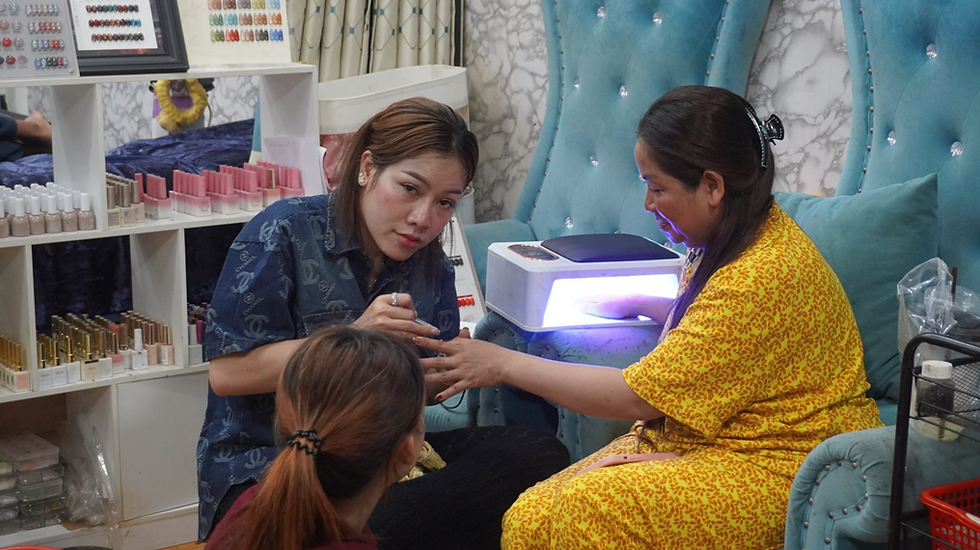

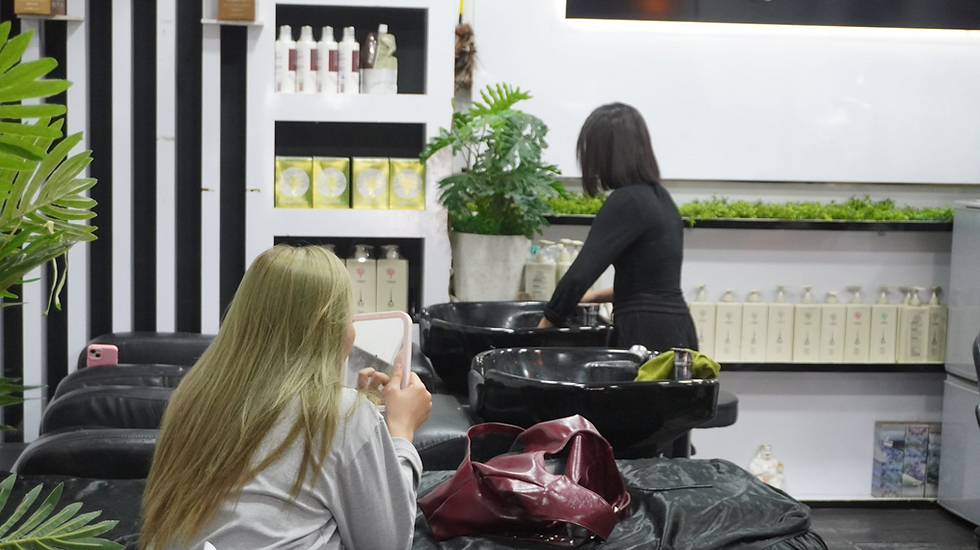
One of the most distinctive aspects of Phsar Leu Thom Thmey, and many markets in the Kingdom, is this ability to coexist radically different activities in the same space. A jewelry repairer might share his shop with a hair salon. A cosmetics stand neighbors a rice stall. Phsar Leu Thom Thmey is a city within a city, governed by its own quirky rules of organization.

Eating at the Market
Phsar Leu Thom Thmey’s food sector feeds the city twice: first with ingredients sold to home cooks, and second with ready-made dishes for workers and shoppers needing a meal between purchases or deals.
At one stall, two women sort and pack different varieties of noodles — rice vermicelli, fresh egg noodles — with the mechanical ease of people who’ve done this gesture ten thousand times.


Nothing signals a local market more faithfully than its butchery section. At Phsar Leu Thom Thmey, pork cuts — feet, ribs, offal, fatty belly slices — are laid directly on wide wooden boards, unpackaged, sold by weight on a hanging scale. It’s food in its most direct form: from animal to table, via this board, today. For a large part of the city, this is simply where dinner comes from.
The Fabric of the City
This is what Phsar Leu Thom Thmey ultimately is: a workplace turned place of belonging. The market’s physical structure — noisy, dense, unpretentious — is merely the container for something more enduring. The city’s social fabric is built and sustained here, one transaction, one conversation, one shared meal at a time.
Phsar Leu Thom Thmey has survived war, the forced silence of the Khmer Rouge years, the chaotic reconstruction of the 1980s and 1990s, the tourist boom of the 2000s that turned Siem Reap into an international destination. It has endured it all without ever changing its nature.


Comments