


Tourism & Siem Reap: The Business and Silk Sides, Two Nights at the Sofitel Angkor Phokeethra

Between millenary temples and blooming frangipani, one of Cambodia's most elegant hotels transforms business travel into an art of living.

Some hotels offer a nice roof over your head, while others gracefully take you by the hand upon arrival and never let go. The Sofitel Angkor Phokeethra Golf & Spa Resort is one of the latter—a place where every detail was conceived not to impress, but to make the pleasure endure. I arrived for what was, in appearance, a business trip—a few days of meetings, presentations, the usual rhythm of business travel in Southeast Asia. What I hadn't anticipated is that a few hours after check-in, the laptop would feel almost secondary. Not because the Sofitel Angkor is distracting in a frivolous sense, but because it is enveloping in a way that resets the clock and the concept of time. Work, it turns out, gets done better here than almost anywhere else; calm is not the absence of stimulation, but a quality that is deeper and more precise.
First Impressions: An Arrival That Sets the Tone
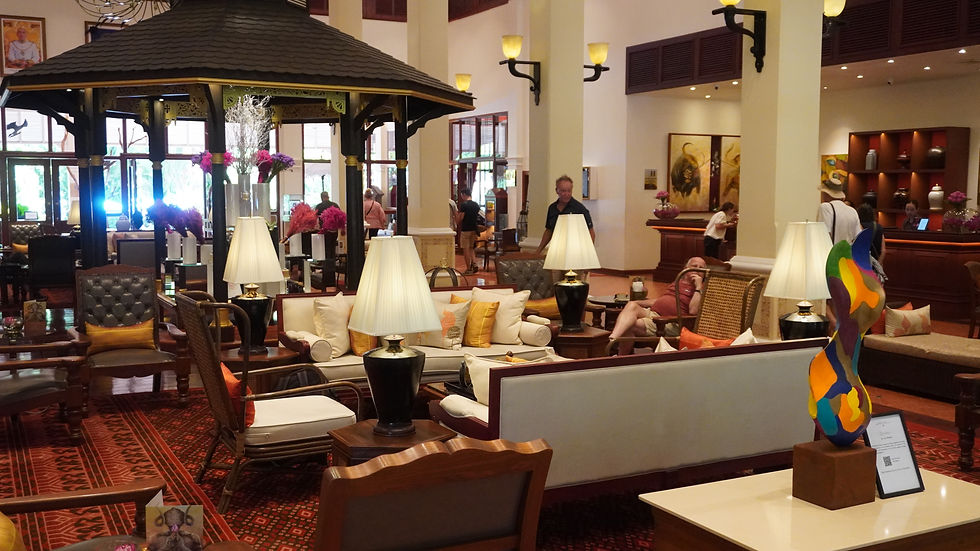
The approach to the hotel gently prepares you for what is to come. Siem Reap—gateway to the Angkor complex and one of Asia’s most history-laden destinations—unfolds behind the windows, and then the doors open to what feels like a private kingdom. The lobby announces itself with theater. Monumental floral compositions in the deepest shades of magenta and fuchsia—gypsophila tinted to an almost unreal intensity, bleached dried grasses, and lotus pods still green and pearly—burst from mirror tables beneath black lacquered columns enhanced with openwork gold. It is not subtle. It is not meant to be. This hotel knows that an arrival must be experienced as an arrival.
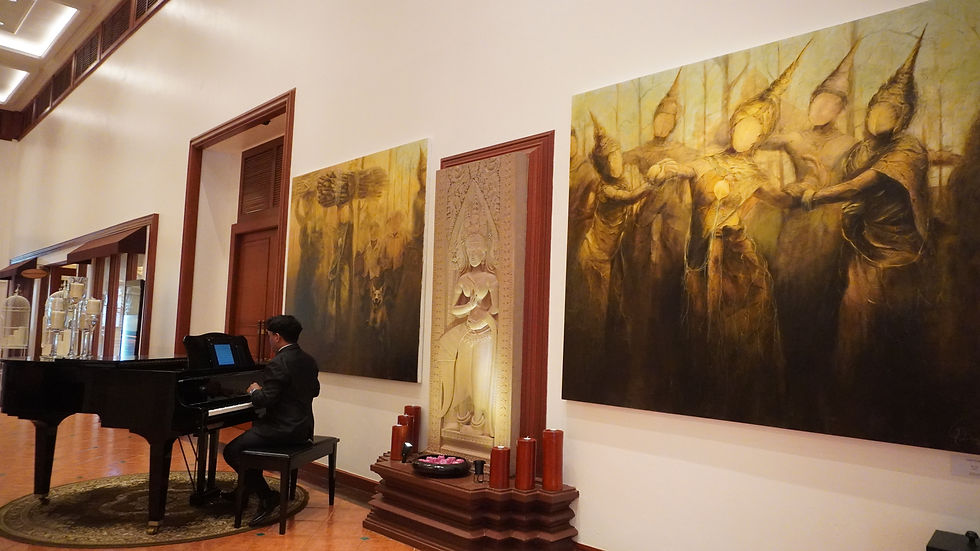
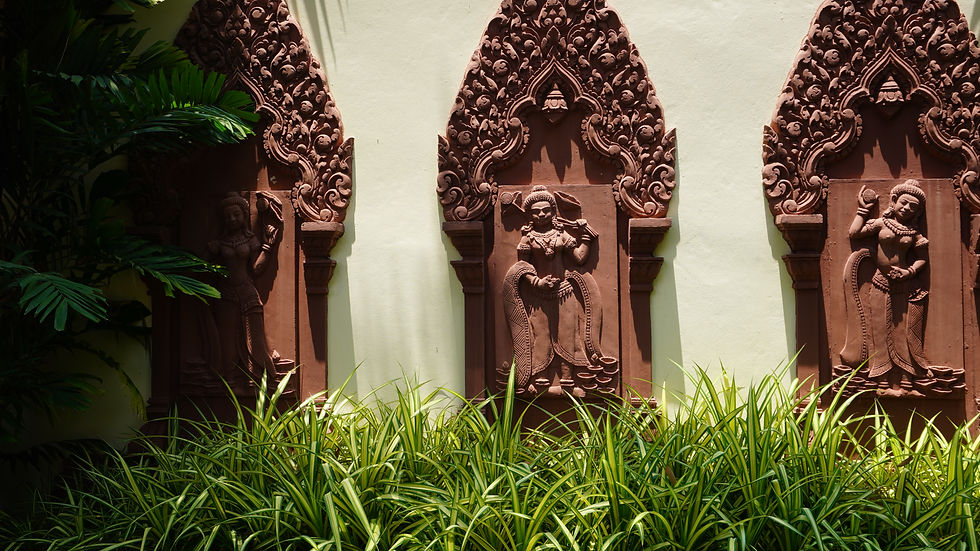
Look closer and the art reveals itself. Monumental canvases in ochres and golds depict Apsara dancers—those celestial figures carved into the walls of Angkor Wat itself—their crowns luminous, their gestures frozen in a millenary ritual. A white stone bas-relief of a Devata goddess radiates from a sculpted niche, flanked by red candles and a bowl of floating rose petals. And in a corner, a pianist in a tuxedo plays—truly plays—not background music, but something poised and unhurried, filling the high-ceilinged space with an atmosphere close to reverence. This is the Sofitel Angkor signature: wherever the eye rests, something deserves to be lingered upon.
A Warm Welcome, The First Art of Living
From the moment you cross the threshold, the tone is set: sincere smiles—warm without ever bordering on obsequiousness—and a discreet attentiveness, driven by the manifest desire to make your stay a bespoke experience. Estelle Legrand, the establishment's Director of Marketing & Communication, welcomes us. French, young, and sparkling with energy, she naturally embodies this elegance of hospitality that cannot be improvised. Without haste but with benevolent precision, she takes care to define the contours of my business stay, anticipating needs before they are even formulated. A few exchanges follow—about the organization of an event planned for the end of the month, and about the cultural life that pulses around the hotel, as she perceives and brings it to life. In just a few words, the scene is set: one is in good hands.
The Rooms: Colonial Grandeur, Discreetly Perfect
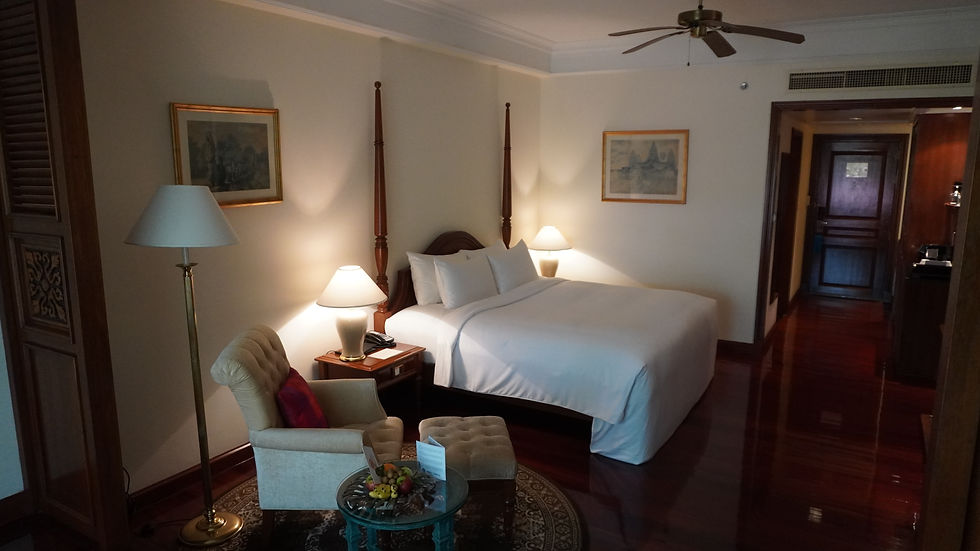
The rooms continue the dialogue between French colonial refinement and the Khmer soul that runs throughout the property. Mine was generous—polished dark hardwood floors reflecting the golden glow of brass floor lamps, a four-poster bed dressed in immaculate white sheets beneath a slowly rotating ceiling fan. It felt like being in a movie. On the coffee table, a bowl of welcome fruit. On the walls, framed watercolors depicting the temples, their colors in the muted tones of an ancient map.
Proportions matter here. There is space to breathe, space to set up a computer and spread out documents without feeling like you are working in a hallway. The lounge area—armchair, upholstered ottoman, round glass table—is truly comfortable, not just decorative. It is the kind of room where it is very easy to linger too long. The attention to detail is constant. The shuttered wardrobes, the quality of the towels, the particular silence that falls when you close the door—everything speaks of a house that has thought seriously about what rest truly requires.
The Gardens: A Living Sanctuary of Uncommon Scale
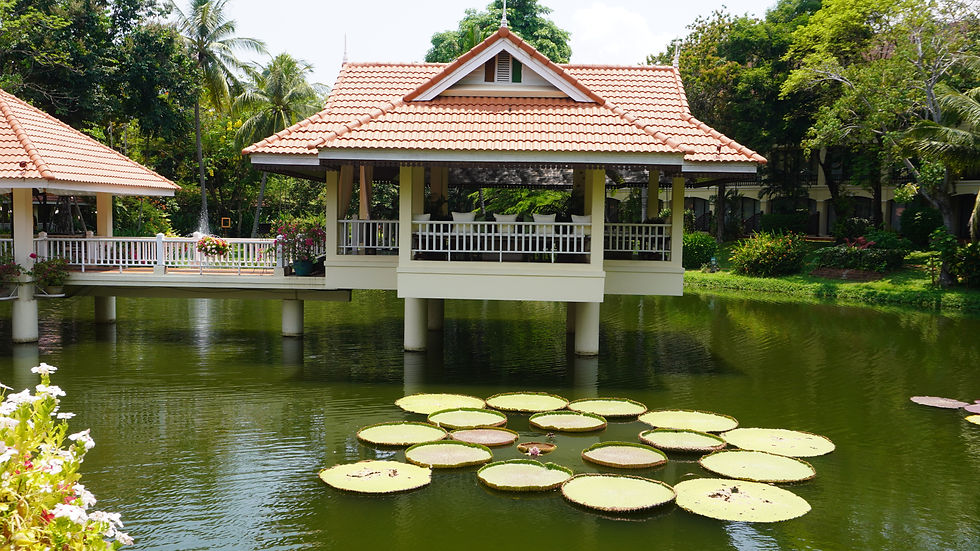
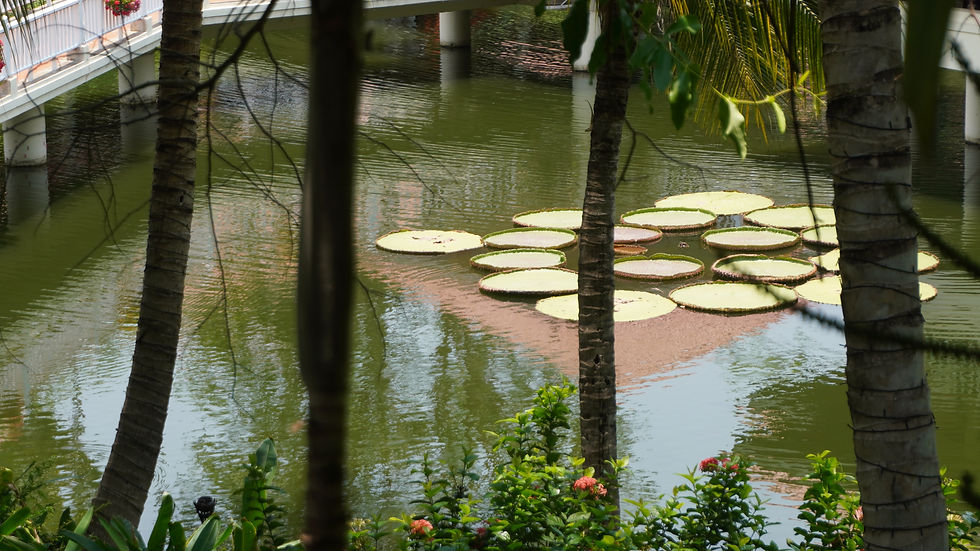
Whatever image you have of a five-star hotel garden, scale it up. The gardens of the Sofitel Angkor are not landscaping in the common sense. It is sustained horticulture—hectares of tropical plantings crossed by paths, stone sculptures emerging from the undergrowth like discoveries. A life-sized elephant carved from pale sandstone kneels near a white ceremonial umbrella edged in red. A rattan bull—a remarkable artisanal piece, woven from hundreds of meters of vine into something between animal and sculpture—watches the gardens from a veranda, its glass-bead eyes catching the light. A pond floats immense Victoria water lilies, each as large as a small table, their serrated edges shimmering under the afternoon sun.
The palms are tall enough to offer real shade. The bougainvillea explodes in pinks and reds. The lawns bear the mark of human hands, not just machines.
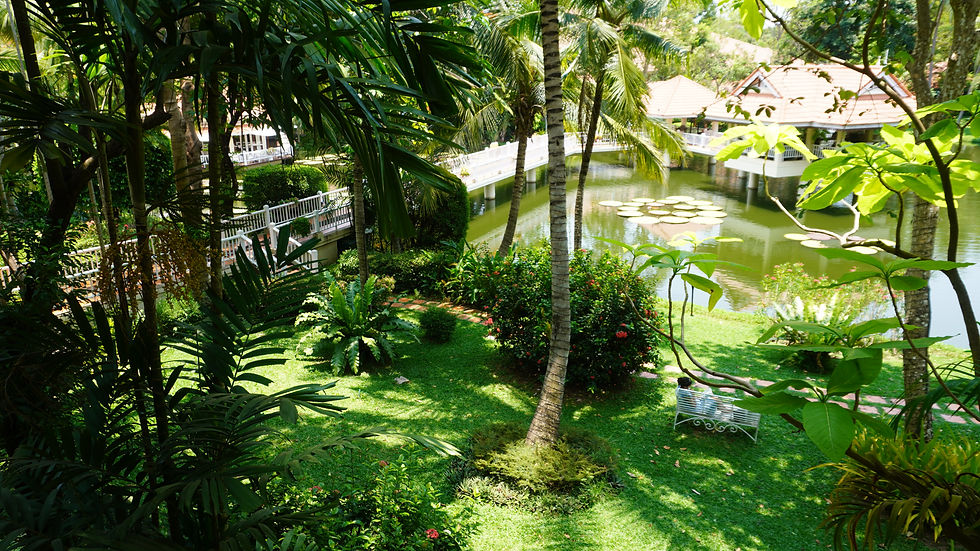
Walking through the gardens between two meetings—or, more honestly, as a pretext for not staying seated in front of a desk—becomes a practice of observation. There is always something new: a stone guardian lion hidden behind a plantation, a winding stream, the particular quality of light through the palm leaves at four o'clock. For a property ranked among the top 20 resorts in Asia by Condé Nast Traveler, the gardens alone justify the distinction.
The Pool: A Jewel, Even in a Heatwave
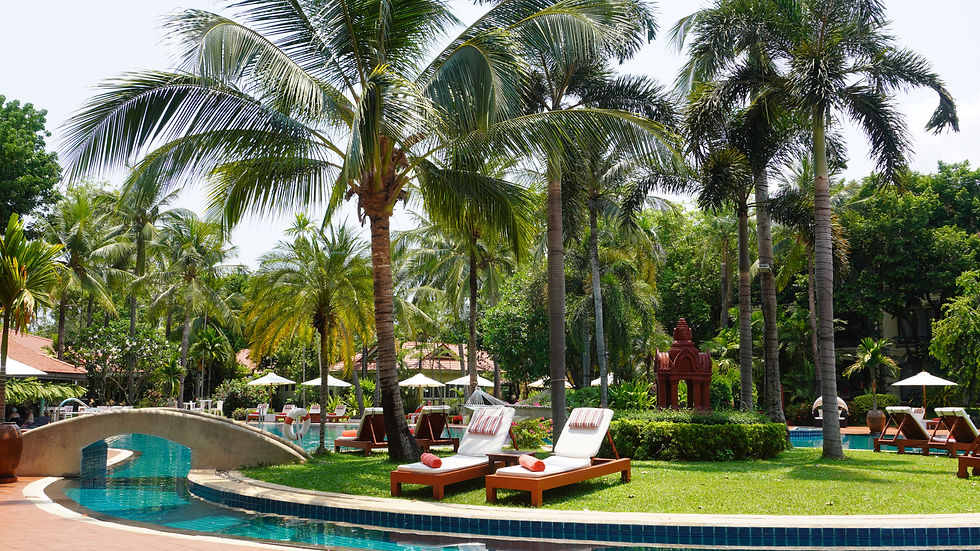
The main pool of the Sofitel Angkor is one of those rare amenities that exceeds its photographs. It is vast: an organic expanse of tiles in the deepest blue-green, its free-flowing curves cutting through the lawn as if it had always grown there naturally. Dark mahogany loungers are placed all around the perimeter, dressed in coral-colored rolled towels. White umbrellas offer shade without interrupting the sense of space. At one end, an arched stone bridge spans a narrowing of the basin.
The background setting is a wall of tropical green—coconut trees, broad-leafed trees, ornamental plantings—that entirely masks the outside world. A small caveat, however, and it is not attributable to the hotel: in the midst of a Cambodian heatwave, the pool water inevitably becomes lukewarm during the day.
The heat is such—easily exceeding 38 degrees (100°F) in the shade—that no cooling system can quite fight against it. This is not a criticism; it is Cambodia in the hot season. The secret is to be there early, when the light is still golden and the water, cool from the night hours, keeps all its promises. That is what I did the second morning—coffee and notebook on a lounger, watching the light change on the pool—and I thought to myself: this is how business trips should feel.
Breakfast: When a Buffet Becomes a Spectacle
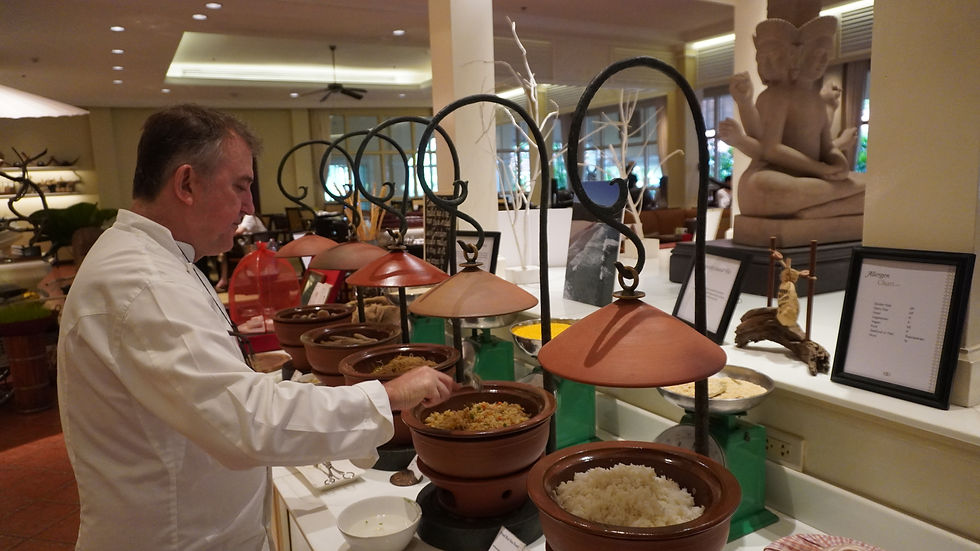
The breakfast at the Sofitel Angkor is, without exaggeration, one of the most beautiful I have encountered in Southeast Asia. It occupies the main restaurant—a space with high ceilings and terracotta floors, presided over by a large stone Khmer deity who observes the ballet with detached serenity. The scale of what is laid out is frankly striking. An entire station is devoted to fresh fruit of every tropical variety, flanked by rows of small glass jars filled with yogurts, panna cottas, chias, and compotes. Carafes of freshly squeezed juices—mango, dragon fruit, passion fruit—gleam on the counter.
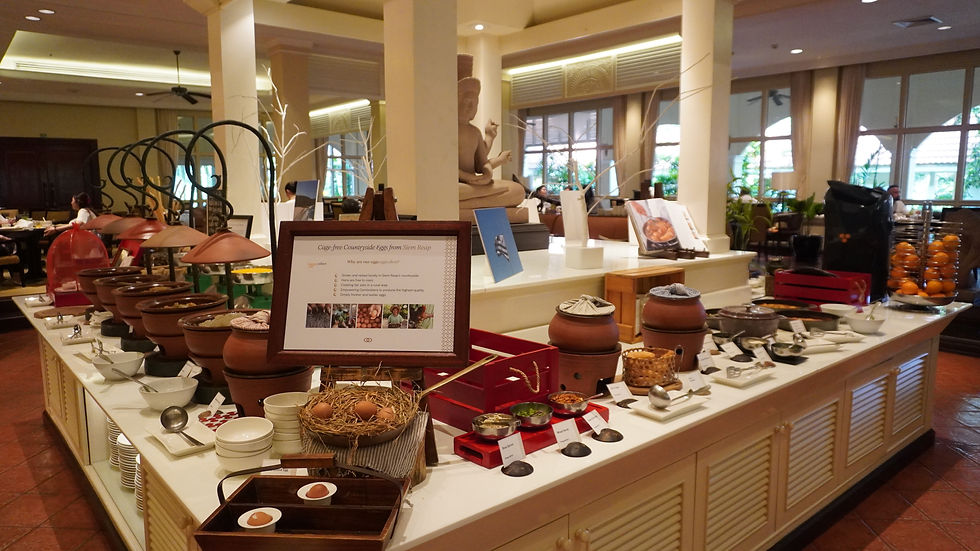
A station dedicated to noodles and soups offers a continuous Vietnamese pho and congee bar, with about fifteen toppings on crushed ice in ceramic bowls: bean sprouts, choy sum, white cabbage, red cabbage, chicken, shrimp, fresh herbs—all labeled with the care of a culinary exhibition. There is a dessert corner—titled, with good French humor, Le Dessert—presided over by a vintage ice cream bike, a stone Singha lion, a traditional parasol, and a calligraphed chalkboard explaining the dessert philosophy. The French chef, Eric Berrigaud, circulates through the room, checking, adjusting, sometimes stopping to chat with a client. The service is attentive without being overbearing—glasses filled, plates cleared, suggestions offered with a warmth that seems sincere. I ate too much. Both mornings. I regret nothing.
Art, Distinctions, and a Letter from Michelle Obama
The Sofitel Angkor bar—recognized as the Best Champagne Bar in Asia (Vanilla Luxury, 2023) and among the Top 30 Bars in Cambodia—is housed in a space of character. An impressively tall mahogany cabinet displays the establishment’s accolades on small brass plaques: semi-finalist at the Luxardo Cocktail Competition 2024, finalist at the Campari Red Hands Asia 2024, cited in DestinAsian’s Top 10 Best Hotels in Cambodia 2024. The Houses represented—Bollinger, Veuve Clicquot, Dom Pérignon, Moët & Chandon, Billecart-Salmon, Louis Roederer—read like a map of the finest Champagne cellars.
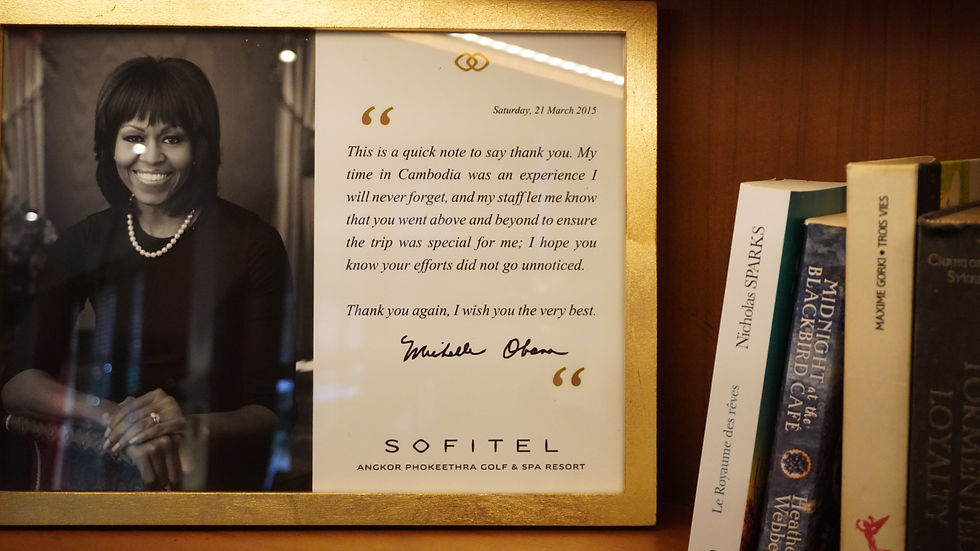
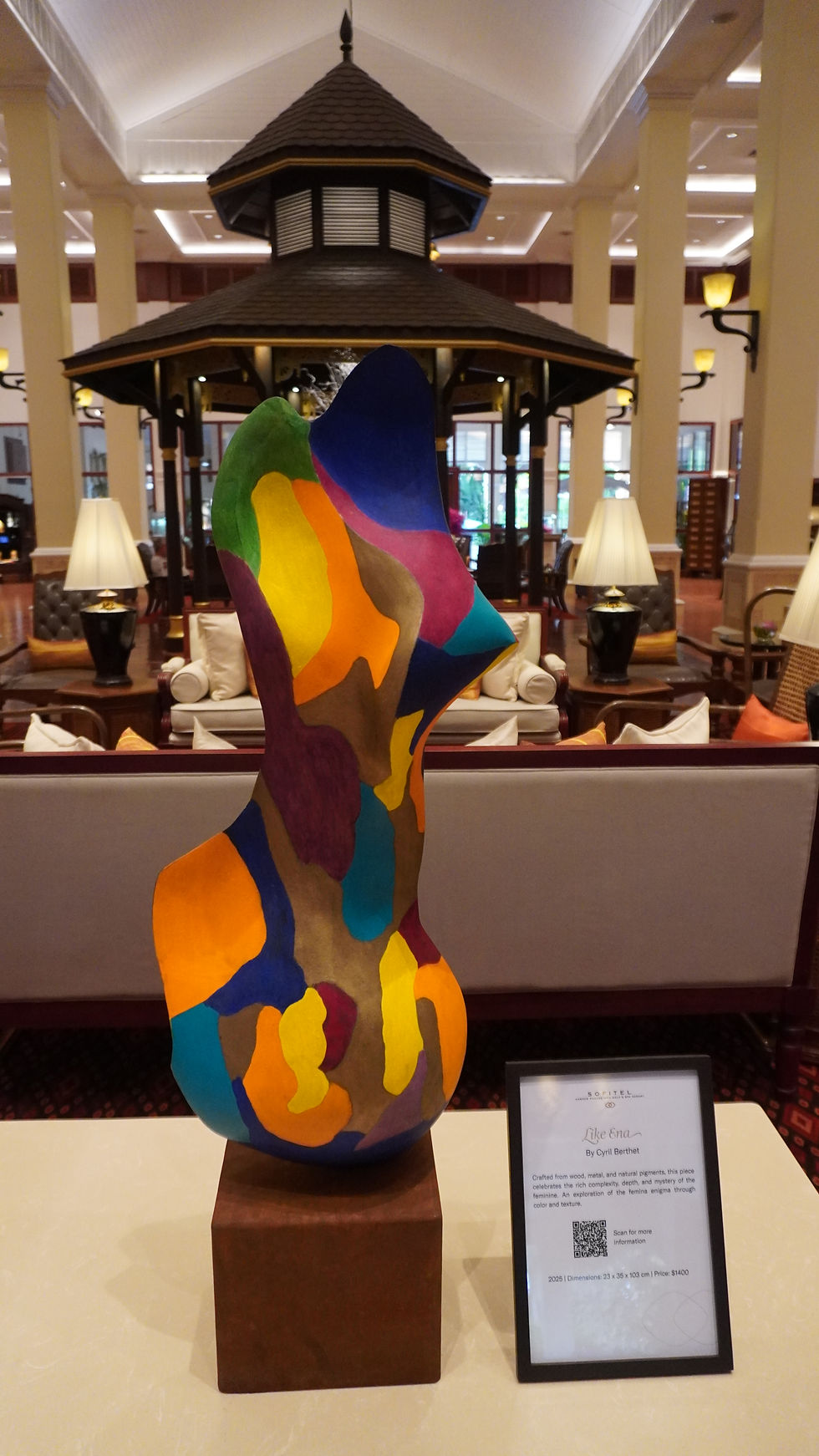
But the most precious piece is found on the neighboring shelf: a framed photograph accompanied by a handwritten note from Michelle Obama, dated March 21, 2015, thanking the hotel for the care taken during her visit to Cambodia. The note is warm and precise. It is the kind of testimonial that no jury can award. Throughout the common areas, the hotel acts as a moving gallery. During my stay, the exhibition Nout Daro: Echoes of Nature in Human Hands—displayed from February to May 2026—presented works of real visual power: paintings blending skeletal forms with lotus flowers, patinated wood and light stone sculptures borrowing the vocabulary of Khmer script to transform it into abstract forms.
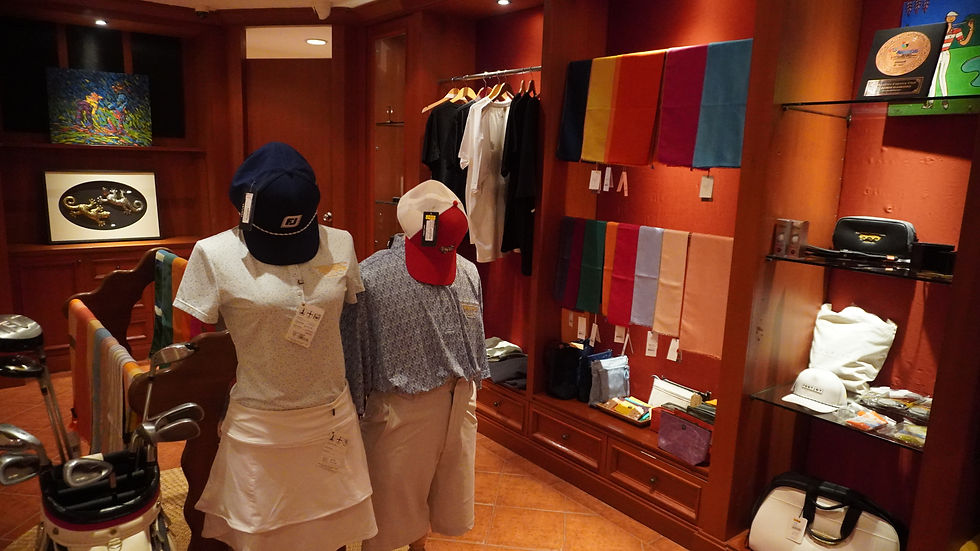
The boutique is also worth a visit: lacquered Buddhas, hand-woven textiles, ceramics, local condiments, incense, silk scarves in the tones of the temple frescoes. And for those who associate work and swing, the golf shop offers a complete range of items for the Phokeethra Country Club course that adjoins the resort.
Working Here: The Setting That Nourishes
A word on what a stay in such a place represents professionally, because it matters and we talk about it too little. We tend to think that luxury hotels are reserved for leisure, and that a business trip calls for the efficient anonymity of a business hotel—good Wi-Fi, a desk, a breakfast swallowed in fifteen minutes. The Sofitel Angkor puts this idea in its place. The quality of rest here is real. The silence holds. The cuisine provides real energy. The beauty of the surroundings—the gardens, the art, the pool, the coherence of the whole—installs a form of calm which, against all odds, frees concentration. Ideas come more easily. The thread of a thought holds longer. The evenings, instead of the emptiness of a soulless hotel, offer something worth waiting for: a walk in the gardens, a carefully crafted drink at the bar, the pianist playing again. I left having accomplished everything I came for, and having experienced something I hadn’t planned: the feeling that these two days had given me something rather than simply taking something from me.
The Final Word
The Sofitel Angkor Phokeethra is not without flaws, in the sense that no establishment is. But it is something more interesting than a flawless hotel: a hotel with real character, a sincere relationship with its territory, and the assurance of placing beauty as a necessity without sacrificing substance. For the business traveler, it is proof that comfort and elegance do not hinder efficiency—they give it a firm foundation. For the couple, the family, the lover of art and temples, it offers pleasures intense enough to fill entire days without ever feeling the need to step out the doors. And always, behind those doors, the temples of Angkor wait—built by a civilization that knew, better than many, that greatness is not excess. It is intention, held in stone. And here, in a hotel out of the ordinary.
Sofitel Angkor Phokeethra Golf & Spa Resort, Vithei Charles de Gaulle, Khum Svay Dang Kum, Siem Reap, Cambodia. Ranked in the Top 20 Resorts in Asia by Condé Nast Traveler 2024.


Comments