


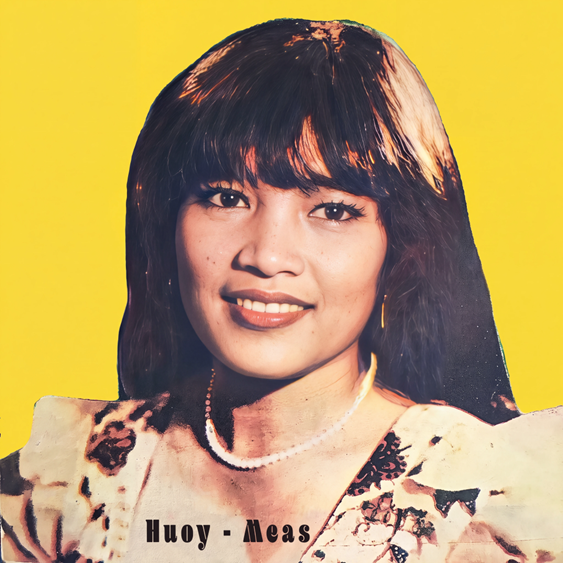
Huoy Meas, the Khmer singer Sihanouk compared to Edith Piaf

She was the most listened-to voice on Cambodian national radio: the one who introduced the artists, told stories at the weekend, and sang her own sorrows. In April 1975 the first thing the Khmer Rouge seized in Phnom Penh was the radio station. Huoy Meas left for Battambang with her two sons and lived there under a false name, trading songs for snails.

In the history of Cambodia's golden age, Huoy Meas holds a particular place. She was not simply one singer among many: she was the one who made the others known. As a host on National Radio she interviewed Mao Sareth, Sos Math and most of the figures on the scene. Without her, part of what is known today about that period would never have been recorded at all.
A diligent student from Battambang
Huoy Meas was born on 6 January 1946 in Svay Pao commune, Sangkae district, Battambang province. Her parents were Buth Chin and Huoy Yoth. She was the youngest of three children and the only girl. At Sor Heu primary school, then at the Net Yang girls' secondary school, she stood out at school and pagoda festivals: she sang, told stories, performed smot. She worked hard, taking extra lessons in French and ethics at the home of her teacher, Bun Thorng.
Her classmate was Pen Ran. A senior from the neighbouring school was Im Song Soeum. An entire generation crossed paths there without knowing it.
In early 1962 her teacher entered her in the Sakmach Cheat contest. She sang “រាត្រីនៅសូមួរ” (“Night in Somuor”), a Mao Sareth song, and took first prize among the women. Battambang now knew her name. That June she failed her school certificate. For a student of that seriousness the blow was heavy: she abandoned her studies and shut herself away at home.
It was Im Song Soeum who came to fetch her. He proposed she join a vocal troupe, with Pen Ran, at the Steung Khiev restaurant in Battambang. Ros Serey Sothea would join later. Within months the troupe was known across the province. It then moved up to Phnom Penh, to Toul Kork.
The voice that held the weekends
In Phnom Penh, Huoy Meas was introduced to National Radio and became a presenter. Every weekend she ran a lakhon niyeay programme, Khmer radio theatre, alongside the narrators Yuok Kem, Khun Pol and Meas Kok. She sang as well. In 1969 she took the on-air name Meas Mathrey.
She sat on the jury of the national Samdech Cheat contest, created by Norodom Sihanouk, with Sinn Sisamouth, Liev Tuk, Touch Teng, Mao Sareth and Chhoun Malai. Until April 1975 she was the most listened-to woman on Cambodian radio, and she used that position to promote the kingdom's pop and rock scene.
Songs drawn from her own life
In 1962 she began recording and met the drummer Oum Sophanoureak. They married in 1965 and had a daughter, Oum Somavattey, born in 1966. The marriage went badly. Her husband drank; her mother-in-law accused her of putting aside her own earnings — which she was doing in order to raise her daughter. One argument too many, a refusal to apologise, and she was put out of the house. She filed for divorce in 1968 and was separated from her child.
That story runs through her entire repertoire. Her songs are about herself, her break-ups, her regrets. The exchange even became public: after the divorce her former husband wrote lyrics for other singers that took aim at her obliquely, and she answered him in her own. Sihanouk compared her lyrics and her singing to Edith Piaf. Among her known titles: “សម្ផស្សបុរីជូឡុង” (“The Beauty of Tioulongville”) and “កូនអើយកុំសួរ” (“My Child, Don't Ask”).
She remarried in 1969, to Vanly Kesaro, a senior officer, and had two more children, Vanly Daly and Vanly Dodo, both now settled in the United States. Those were the years of her greatest fame.
Under the name Lom
On 17 April 1975 the Khmer Rouge took National Radio first. Her husband, like many state employees, was “called” to welcome Sihanouk's return to the country: he was never seen again. Huoy Meas was evacuated from the capital with the rest of the city. She made her way to Battambang with her two sons.
What follows comes from testimony gathered long afterwards, and it corroborates. Assigned to dam construction, she lived near a pagoda at Ream Kon, in Moung Ruessei district, under the false name Lom. A neighbour, the grandmother of a film student, recounts trading snails and crabs with her for a song, while a friend kept watch for cadres. The guitarist Thach Soly, of the band Apsara, tells a story that matches. Both give the same ending: she fell ill, her identity was discovered, she disappeared.
Another account, from one of her children, places the scene on 17 April 1977, the regime's second anniversary: recognised, she is said to have been made by soldiers to sing one last time, then taken from her home that night. The dates vary between sources — some put her death as early as 1975, others in 1977 — and her exact fate has never been confirmed.
What remains
The Cambodian Vintage Music Archive has gathered most of what survives of her discography. Her work as a broadcaster as much as a singer features in the documentary Don't Think I've Forgotten, released in 2015. And one recording of her programme still exists, captured in 1975: a few minutes of the voice that, for millions of Cambodians, was the radio itself.


Comments