


Cambodia & Dossier: In the vaults of history: the exceptional fate of the former Bank of Indochina in Phnom Penh

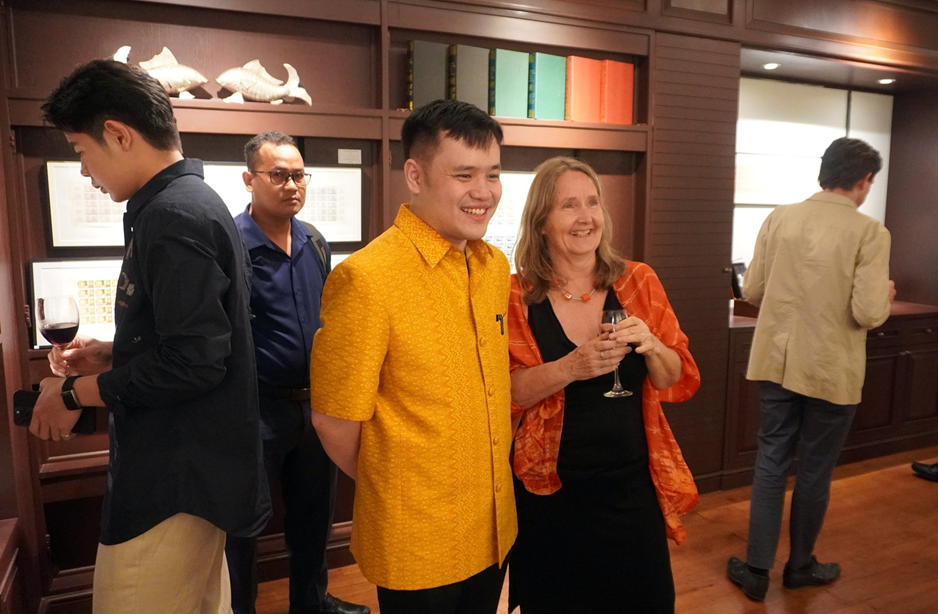
On Sunday morning, behind the wrought-iron gate of the former Bank of Indochina, frangipani trees filtered a still-soft light over an unusually protocol-heavy crowd — ambassadors, ministers, researchers.

They were inaugurating [Angkêt] de mots, a temporary exhibition devoted to Khmer borrowings from French, hosted in the rooms of the SOSORO museum extension at the corner of Streets 102 and 13. The ochre-yellow façade gleamed under the dry-season blue sky, the century-old gates wide open. There was something slightly unexpected about such a formal gathering around such an intimate subject — the way two languages, when they rub against each other long enough, end up resembling each other a little. And something perfectly logical as well: there may be no better place in Phnom Penh to speak about this story.
For this building is itself a borrowing. A French architecture set upon Khmer soil, a century of colonial memory recycled into a cultural institution. Its fate alone is a dizzying condensation of the Cambodian destiny.
A bank at the heart of empire
Created on January 21, 1875, with headquarters in Paris, the Bank of Indochina was a private commercial and merchant bank to which the French government had granted the privilege of issuing currency in Indochina. Both a financial instrument and a political tool, it accompanied French colonial expansion from Saigon to the edges of Southeast Asia. Its network gradually expanded: Hanoi from 1886, Phnom Penh around 1890, Hong Kong in 1894, Shanghai in 1898 — so many trading posts connected by the piastre, the colonial currency that would circulate from one bank of the Mekong to the other for nearly a century.
The Phnom Penh branch, established as early as 1891, was one of its essential cogs in Cambodia. The current building — rebuilt at the beginning of the 20th century — expresses this ambition in stone and precious wood. Positioned on the corner of Street 102, facing the Central Post Office, it displays a French colonial architecture enhanced with Khmer ornaments, a rare dialogue between two aesthetics that connoisseurs describe as unparalleled in the kingdom. Inside, floor mosaics, carved woodwork, and reinforced vaults testify to a level of craftsmanship that would withstand everything — or almost.

From bank to villa, from villa to oblivion
Cambodia’s independence, proclaimed in 1953 under King Norodom Sihanouk, had already ended the Bank of Indochina’s monopoly on currency issuance — its privilege had officially been withdrawn in 1948, and the riel had established itself as the national currency. The building on Street 102 then changed hands, and purpose.
In 1965, the Cambodian industrialist Van Thuan acquired it and turned it into the headquarters of his companies. He left the country for Hong Kong in 1969. His Cambodian properties were expropriated in 1975 by the Khmer Rouge regime. Empty, then repurposed, the building passed through the Khmer Rouge years like a ghost of stone, before reappearing in the 1980s as a state bank for rural development — one of those absurd reconversions that post-genocide history produced in abundance.
It was not until 2003 that its rebirth began. The Van family rented the building from the Cambodian authorities and undertook its renovation. Van Thuan’s daughter, Porleng, opened in December 2007 a French fine-dining restaurant named Van’s — an elegant table nestled in the former vault rooms, between armored doors built in Paris by the Trichet company and the vaults that once housed the gold reserves of colonial Cambodia. A place like no other, still mourned by regulars of that Phnom Penh.

A new museum life
The Van’s Restaurant closed its doors in 2023, and the building has finally found a purpose worthy of its past. Since February 24, 2024, the former Bank of Indochina has housed three new permanent exhibition rooms, inaugurated as an extension of the SOSORO Museum — the Preah Srey Içanavarman Museum of Economy and Currency, developed by the National Bank of Cambodia.
The main museum has, since 2019, occupied another restored colonial building on Street 106 — a former municipal residence that became Phnom Penh City Hall at the beginning of the 20th century. Its permanent exhibition traces nearly two millennia of Cambodian history through the lens of currency and economy. The Street 102 extension now complements this narrative with the darkest and most foundational chapters of contemporary history: the Independence era, the Khmer Republic, the Pol Pot regime.
The circle closes with an almost unsettling elegance. The institution that, for decades, controlled the currency of the entire Cambodian colonial territory now houses the rooms that recount precisely how that territory freed itself from it. Vault doors, gold chambers, the monogram engraved in metal — all this past becomes both setting and document. And on that Sunday morning, behind the wide-open gates, a crowd gathered to speak about borrowed words completed the logic of history.


Comments