


Cambodia, Documented: Sofitel lets a century of Khmer objects speak

Plans of Angkor, banknotes from 1972, records, period prints: on 1 October, Sereyvong Jason Chhinlim opened his private collection at Sofitel Phnom Penh Phokeethra. One hundred and twelve pieces, two months on view, and an opening night carried by a warm crowd.
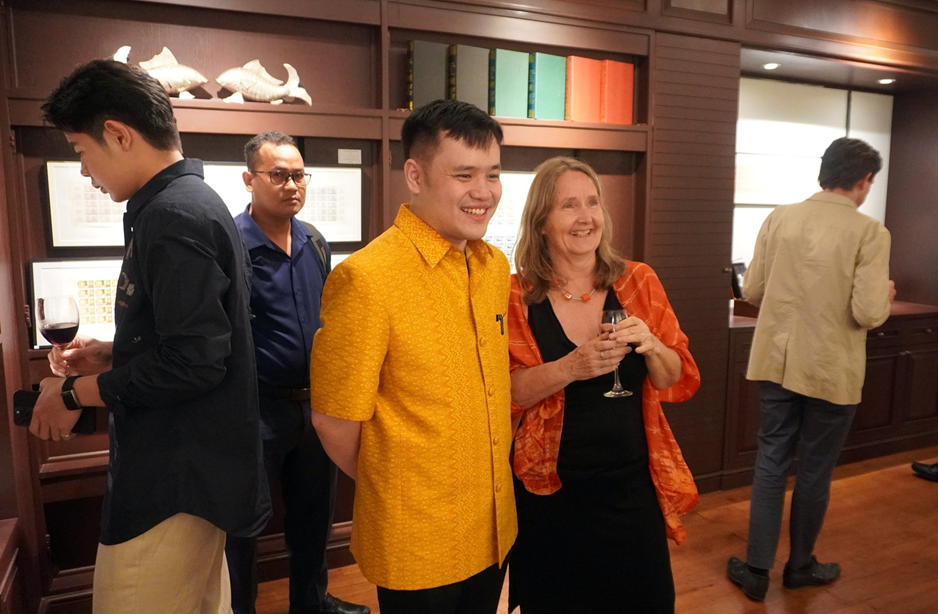
On Thursday evening, about seventy people filled The Gallery at Sofitel Phnom Penh Phokeethra. They looked delighted to be there. Guests leaned over display cases, lingered in front of frames, and put questions to the collector, who answered with a smile. The enthusiasm held the room.
A world from before the screen
Marc Emmanuel, general manager of the hotel, opened the evening. This exhibition, he warned, is not quite about paintings. It brings back a time when "I'm thinking of you" meant a postcard, a stamp and a trip to the post office. When you brought a record home, put it on the turntable, and waited for the soft crackle before the first note.
Younger generations often never knew these objects. Jason Chhinlim wants to hand their history on to them. He thanked Marc Emmanuel and his team. The first discussions go back a few years. The project took shape last year, then came together in 2026.

One hundred and twelve pieces, from the 1880s to today
The exhibition is titled Cambodia, Documented, with the subtitle "Over a Century of Khmer Identity". Everything comes from the personal collection of Jason Chhinlim, an author and collector based in Phnom Penh. A few objects were there for the evening only. The 112 pieces stay at Sofitel.
The oldest document dates, he says, from the 1880s: original plans of Angkor Wat, surveyed by French archaeologists and their expedition. Further on, Le Petit Journal records events that marked the Khmer monarchy. Marc Emmanuel also mentioned maps from the 18th century.
The display cases hold surprises. An orange record sleeve, Chants révolutionnaires du FUNK, shows a soldier and a peasant woman. A 100-riel banknote from 1972, printed in London by De La Rue for the Banque nationale du Cambodge, carries a weaver on the front and the Bayon on the back.


It all started with a postcard
The collection began in 2012, in Poland. Jason was 18. He was volunteering on a social project, far from Phnom Penh. Another volunteer suggested going to the post office to send a letter home. "I had an iPad my mom had just bought me. I could just send a message," he remembers.
He tried anyway. A postcard for one dollar, a stamp for one dollar, less than a burger. Back then, four or five postcards out of ten reached his home. Today, he says, the post office delivers nine out of ten. What won him over was the trace: his handwriting, a specific post office, an address. He asked travelling friends to send him cards. He told himself that in twenty years it might make an exhibition. "A silly idea," he laughs.
Then came a first salary, then some savings. He started buying.
Stamps, banknotes, and plenty of questions
Jason Chhinlim spent eleven years in Cambodian public school. He skipped a grade. In the history textbooks, he noticed gaps. He never liked taking an answer at face value. Stamps gave him leads: a design, a year of issue, and behind it an event. Banknotes took him down the same road.
To him, these pieces are documents. They deserve to be kept and read. Otherwise, he warns, history ends up distorted.
Two photographic prints hold a place of their own. One is by Colin Drafton, who attended the evening. In the 1970s, this British man taught English in Cambodia and photographed what he saw. Jason was not yet born. Listening to a witness of the time, in front of a negative turned into a paper print, moved him. He sees a starting point for conversation: why things were the way they were, what happened, what can be learned.
The exhibition is meant for Cambodians as much as for visitors from elsewhere, tourists or expats, who want to know more about the country. Before leaving guests to their discoveries, Jason Chhinlim added a caution: he is "98 percent sure" that everything on display is original. "We have to leave some room for error."
Practical information
Cambodia, Documented – Over a Century of Khmer Identity
The Gallery, Sofitel Phnom Penh Phokeethra
October and November 2026


Comments