


Cambodia & Economy: Building with the Wind, Not Against It

Interview with Sébastien Mezailles, specialist in ultralight structures in Asia
Arriving in Cambodia as early as 2004, Sébastien Mezailles closely witnessed the first phases of the country’s economic structuring before specializing in ultralight structural engineering.

Now based in Thailand, he maintains close ties with the Kingdom through his partnership with Confluences Trading. In this interview, he offers both a technical and human perspective on Cambodia’s evolution and on an issue that has become increasingly central as projects grow in ambition: wind.
About
An industrial engineer from Paris, Sébastien Mezailles has built his entire professional career in Asia. After arriving in Cambodia in 2004, he contributed to the early stages of the country’s economic development before continuing his work across several regional markets. The former head of the Trading Division at Comin Khmere, he now operates in Cambodia through Shades Asia, for which Confluences Trading has been the official distributor since 2021.
Specialized in ultralight and textile structures, he brings both technical expertise and experience to an issue now central to the country’s development: learning to build with the wind, not against it.
Interview
Can you briefly introduce yourself and tell us about your background in Asia?
My name is Sébastien Mezailles, I’m an industrial engineer from Paris. I left France at 23 and have never worked there since. My entire career has been built in Asia, with experiences in Australia, India, the Philippines, China, Thailand, and of course Cambodia, where I’ve lived several times.
You arrived in Cambodia in 2004. In what professional context?
I came to Cambodia to join Comin Khmere, a company re-founded and developed at the time by Dominique Catry and his son Pierre-Yves Catry, which was one of the country’s key industrial players.
The company was active in equipment supply for projects, contracting, and maintenance, before later being acquired by the RMA Group.
I headed the Trading Division, overseeing a wide range of industrial equipment—especially for energy, safety, water treatment, and elevators—with strong involvement in both public and private projects.
What do you retain from your time at Comin Khmere?
It was a period that left a mark on many people. A significant number of Cambodians trained at Comin Khmere now hold senior positions or have founded their own companies.
Many expatriates from that era have also become well-known figures within the French economic community in the region. This human and professional legacy remains very visible today.
How did your relationship with Confluences begin?
I met Soreasmey Ke Bin during my time at Comin Khmere—he was in charge of communications while I handled trading. When I began developing Shades Asia for the region, Confluences hosted me for several months in Phnom Penh. Our relationship developed naturally over time, long before the partnership became formal.

What role does Confluences Trading play in your work in Cambodia today?
Confluences Trading is much more than a distributor—it’s a trusted operational partner. The team, led by Dimitri, is intentionally small but very solid. They can handle imports in complex contexts, ensure installation, dismantling, and project follow-up, all while remaining attentive to both clients and partners. Recent regional events clearly demonstrated their adaptability.
Can you describe your current activities in Cambodia?
My work focuses on the design and analysis of ultralight and textile structures, intended to provide protection from sun, rain, and wind. These are primarily tensioned architectural membranes used in international schools, sports areas, hotel rooftops, or public spaces—where traditional structures would be too heavy or unsuitable.
Together with Confluences Trading, we are rolling out a joint offering in Cambodia that brings together Shades Asia (for permanent installations) and Stretch Tents Asia (for temporary, event-based uses). This complementarity allows us to meet a wide range of project needs with a consistent and technically sound approach.
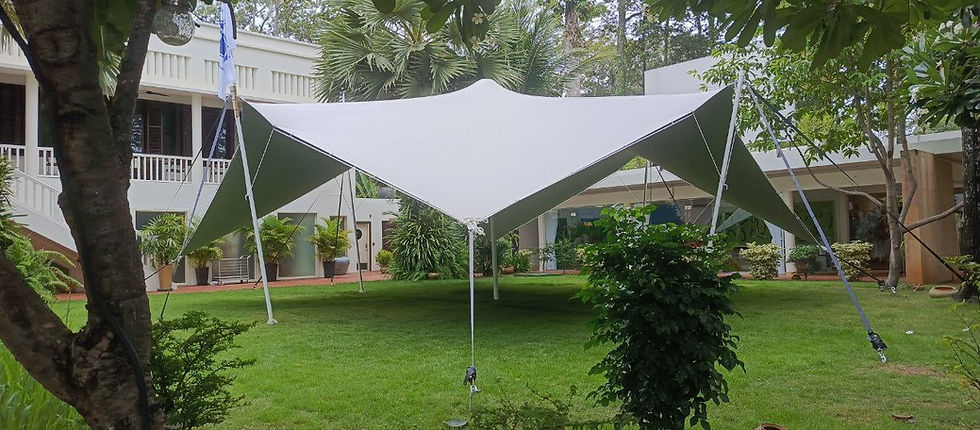
You also develop stretch tents. How does this offering fit locally
Stretch tents meet the needs of outdoor events—private receptions, hotel events, and temporary activations. The first stretch tent was sold in Siem Reap a few weeks ago, confirming strong market interest. Cambodia is particularly well-suited to these solutions, provided that a high level of comfort, aesthetics, and safety is ensured.
What recent projects illustrate this dynamic?
One of the most emblematic recent projects involved installing rain protection systems for the Soma Hotel, located along Phnom Penh’s riverside. It’s one of the city’s most remarkable rooftops and an important reference for Shades Asia in Cambodia.

Other projects are now under study, including for a shopping mall and several international schools. My regular visits also allow me to meet with architects and clients and to finalize increasingly technical projects.

Have regional tensions affected your operations?
Yes—particularly on the logistics side. The current situation between Thailand and Cambodia saddens me personally since I know both countries and their economic ecosystems well. I hope things calm down over time.
Operationally, we made a strategic decision with Confluences Trading: to manufacture part of the metal support structures locally in Cambodia, while continuing to import the textile membranes. This approach secures supply chains, increases responsiveness, and improves long-term competitiveness.
Wind is central to your approach. Why is it still underestimated?
Wind is the key design parameter for ultralight structures. These structures don’t forgive approximation. “You can’t see the wind, but it determines everything.”
As projects become more open, ambitious, and exposed, technical knowledge becomes vital. I also work upstream through wind behavior analysis and feasibility studies for lightweight structures. Several recent accidents in the region have shown the risks of undersized or poorly designed installations.

This realization led us—together with Confluences Trading—to consider organizing a technical seminar on wind-exposed structures, with an educational focus.
The goal is to share feedback, explain real risks, and spread best practices as projects grow in complexity and ambition in Cambodia.

How do you perceive Phnom Penh’s evolution today?
The city has transformed greatly. It’s cleaner, infrastructural modernization is underway, and the new airport symbolizes this change. But what impresses me most are the people I meet.
There’s a genuine desire—especially among Cambodians—to build beautifully and properly, to understand technical factors, and to move beyond rough solutions. It’s precisely in this context that our approach makes sense.
To conclude, what message would you like to share with project developers in Cambodia?
As project quality rises, the question is no longer whether these aspects should be considered, but when.
As Cambodia continues to develop, its projects become more ambitious and complex. This creates a growing need for technical expertise—particularly regarding wind, loads, and lightweight structure safety.
With Confluences Trading, our goal is to support this evolution by intervening as early as possible. Architects, developers, hoteliers, and event organizers are invited to meet with us—to analyze their projects, share experiences, and jointly craft solutions that are aesthetic, durable, and safe.

To learn more
Contact: +855 10 749 427

Comments