


ASEAN's 48th Cebu Summit: Unity Tested by Thai-Cambodian Tensions

At the 48th Cebu Summit, Southeast Asian leaders reaffirmed their commitment to rules-based multilateralism—while decades-low tensions between Thailand and Cambodia nearly shattered the regional bloc's united facade.
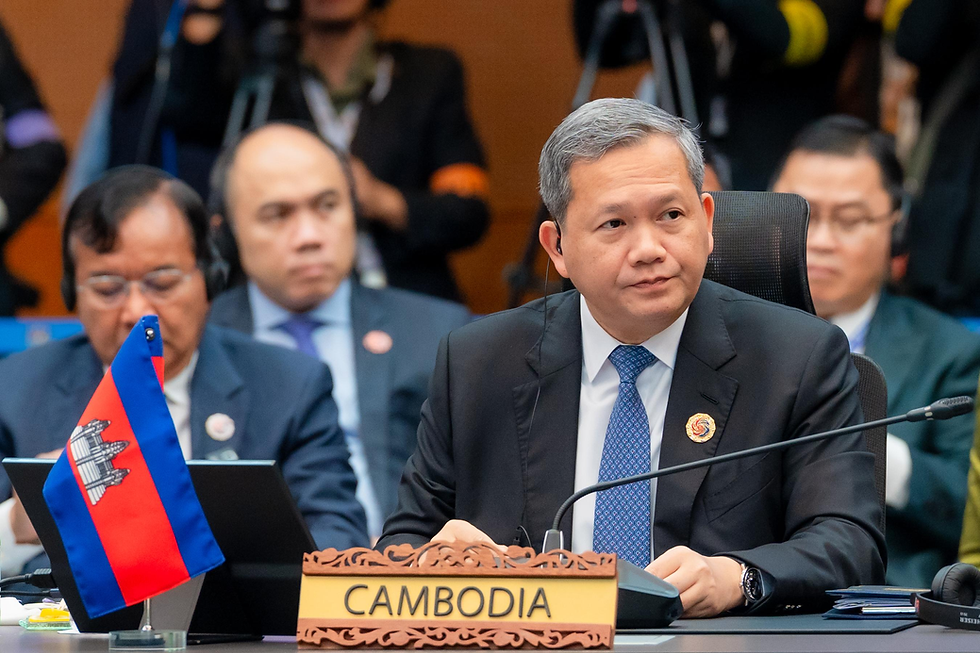
In Cebu, Philippines, the ten ASEAN heads of state and government gathered under the theme of an ambition as old as it is fragile: “Navigating together towards our future.” Behind the rhetoric of unity, the organization's ability to remain a sovereign actor in a bipolar world was at stake—but also, behind the scenes, the management of an explosive bilateral crisis between two of its founding members.
Cambodian Prime Minister Samdech Moha Borvor Thipadei Hun Manet took care to remind his counterparts of what they know but rarely express with such clarity: ASEAN “remains a beacon of rules-based multilateralism, a force for peace, dialogue, and constructive cooperation.” The formula is almost ritualistic. But in the context of 2026—where major powers are redrawing their zones of influence with assumed brutality—it takes on particular resonance.
What stands out in reading the Cambodian communiqué is less what is said than what is implied.
The expression of a “world landscape that is increasingly fragmented” recurs in the Prime Minister's mouth as a polite euphemism to designate Sino-American rivalry, the war in Ukraine, and the conflagration in the Middle East. ASEAN, as a “neutral and trusted interlocutor capable of engaging all parties with equity and credibility,” positions itself as a space for mediation—a role that neither Washington nor Beijing could fulfill in the eyes of the Global South.
“ASEAN's relevance and soft power stem from its role as a neutral and credible interlocutor capable of engaging all parties.”
On the economic front, the summit highlighted the imperative of digital integration. Accelerating the ASEAN Single Window 2.0, negotiations with Canada and the Gulf Cooperation Council, and the prospect of a Framework Agreement on the Digital Economy outline a modernization ambition—but also a race against time amid global trade reconfigurations.
Bangkok vs. Phnom Penh: A Legacy Abyss
It was on the sidelines of the summit, on May 7, that the week's most charged diplomatic episode unfolded. Philippine President Ferdinand Marcos Jr., as 2026 ASEAN chair, convened a closed-door trilateral meeting between Hun Manet and his Thai counterpart Anutin Charnvirakul.
An initiative presented as regional mediation—but which above all signaled how unmanageable the crisis between Bangkok and Phnom Penh had become without external intervention.
Relations between the two countries have never been simple, but 2025 brought them to their lowest point in decades. Two eruptions of armed clashes along the 817 kilometers of shared border caused massive population displacements on both sides. A ceasefire, obtained in December under murky circumstances—with intervention, according to some sources, from the Trump administration—had held by a thread since then.
Timeline of a Crisis
January 2026: Cambodia ratifies the United Nations Convention on the Law of the Sea (UNCLOS), the last ASEAN member to do so after 40 years—partly motivated by the Thai threat.
March 8, 2026: Cambodia's accession to UNCLOS enters into force.
May 5, 2026: The Thai cabinet approves the unilateral termination of the 2001 Memorandum of Understanding (MOU 44), the only bilateral framework governing overlapping maritime claims in the Gulf of Thailand. Phnom Penh announces on the same day the initiation of a compulsory conciliation procedure under UNCLOS.
May 7, 2026: Trilateral meeting in Cebu under Philippine auspices. First de-escalation commitments.
The central issue is maritime: an overlapping claims area of about 26,000 km² in the Gulf of Thailand, potentially rich in hydrocarbons, whose boundaries have never been definitively drawn since the 1970s.
For 25 years, MOU 44—signed in 2001 by Thaksin Shinawatra and Hun Sen in a climate of mutual goodwill—had served as a minimal framework to manage this ambiguity without resolving it. Five rounds of negotiations in a quarter century, with no tangible result.
Bangkok's unilateral termination of this agreement, on the grounds that negotiations had “not advanced in 25 years,” was perceived in Phnom Penh as a deliberate rupture. Cambodian Foreign Minister Prak Sokhonn described the Thai decision as an abandonment of the “spirit and political will” that had enabled peaceful dialogue. Cambodia's recourse to UNCLOS—activated in the very hour the Thai cabinet voted—was no improvisation: Phnom Penh had prepared this legal option for sixteen months, in exact anticipation of the scenario that occurred.
“Thailand no longer has MOU 44. Whatever discussions take place from now on, new rules will have to be agreed upon together.” — Prime Minister Anutin Charnvirakul
In Cebu, the two Prime Ministers did not resolve their differences—it would have been illusory. But the meeting, described by the Thai government spokesman as “constructive, frank, and forward-looking,” produced some concrete commitments: the two countries will assign their Foreign Ministers to work on immediate confidence-building measures, and commit to resuming existing bilateral mechanisms—the Joint Border Commission, the General Border Committee—that the crisis had suspended.
Hun Manet reaffirmed the Cambodian path: compulsory conciliation under UNCLOS is “a peaceful path to a just solution for both parties.”
Anutin, for his part, called to “open a new chapter with sincerity and goodwill.” Two speeches that do not contradict each other head-on, but which do not quite speak of the same thing: one internationalizes the dispute, the other would prefer to bilateralize it.
This Cebu meeting may not have resolved the crisis, but it prevented it from worsening—which, in ASEAN diplomacy lexicon, already represents a non-negligible success.
This summit will have confirmed, once again, that ASEAN excels in the art of apparent consensus. And that its non-interference doctrine sometimes clashes with its own contradictions: how to claim neutrality in world affairs when its members are themselves in conflict? The real test will come in the coming months, when it comes to translating Cebu's statements into concrete policies—and demonstrating that regional peace does not rest solely on the discretion of crises.


Comments