


Adaptation(s): Phnom Penh's Architectural Vanguard Previews Francophonie Summit
Updated: Apr 6
The French Institute of Cambodia (IFC) has just launched “Adaptation(s),” a manifesto exhibition bringing together nine major architecture agencies from the Kingdom. More than a mere showcase of projects, the event foreshadows the buzz that will grip Phnom Penh during the Francophonie Summit next November.

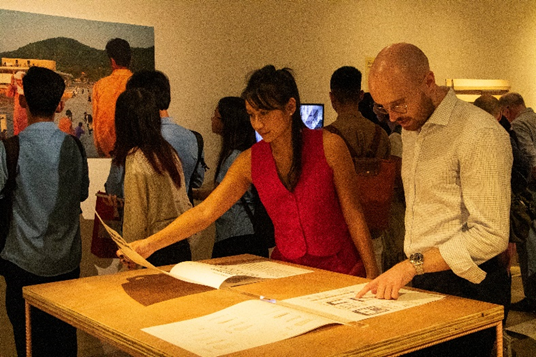
There was a crowd on Thursday, April 2, under the lights of the French Institute. You’d spot figures from the local and international cultural scene, of course, but what stood out was the density of young people present.
Dozens of architecture students, notebooks in hand, jostled alongside young entrepreneurs, designers, and curious onlookers, all come to see what’s taking shape today behind the fences of Phnom Penh and Siem Reap. You could feel that special energy that inhabits the IFC: a place that, under successive directors, has established itself as a true laboratory of ideas where Khmer culture and international expertise hybridize with constant relevance.
An Institution in Motion
This vitality fits into a beautiful continuity, now carried by the personal touch of Fanny Pagès, deputy director of the IFC. Building on the institution’s solid heritage, she infuses a dynamic of openness and a curious eye on contemporary issues. For “Adaptation(s),” she created a framework conducive to dialogue, allowing architects to share a demanding vision of their profession.
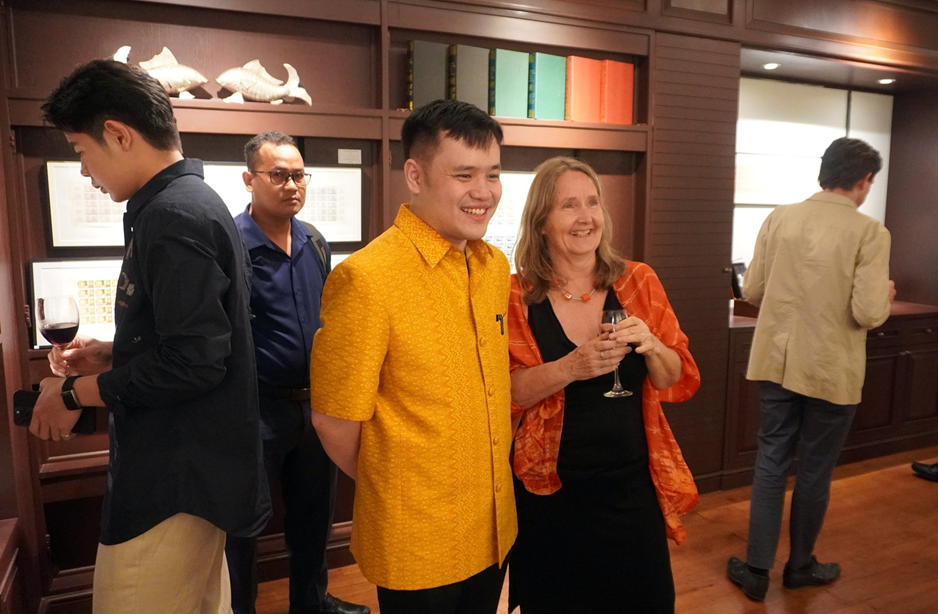
This collective success is driven by Pierre Vincent, Cultural Counselor and director of the French Institute of Cambodia (IFC). In his speech, he emphasized the importance of architecture as a vector for cultural outreach and deep societal reflection. “Welcoming these nine agencies is a testament to the vitality of a Kingdom building its future in dialogue with its climate and history,” he recalled, reaffirming the IFC’s mission as an indispensable hub for creation under his leadership.

En Route to the Francophonie Summit
The exhibition is an essential milestone on the road to the 21st Francophonie Summit, to be held in Phnom Penh from November 16 to 19, 2026. Hosting this global summit is a major recognition for the Kingdom. By highlighting contemporary architecture, the IFC perfectly illustrates the values of this gathering: cultural dialogue, diversity, and the ability of Francophone actors to address climate, urban, and social challenges together.
A Staging Signed Melon Rouge
To give body to these reflections, the IFC called on the expertise of the Melon Rouge agency, led by Alexandre Burgeat. Under this banner, team leader Hadrien Diaz orchestrated the event’s scenography, extending the historic complicity that has linked the agency to the Kingdom’s cultural projects since 2012. With his team, he designed an immersive journey that shuns technical jargon. By transforming plans and models into an accessible experience, Adrien Diaz elegantly reveals the invisible logics shaping our environment, making architecture finally tangible for the general public.

Nine Agencies, Nine Views on the Kingdom
What strikes you is the maturity of this local scene. In Kep, Yvon Chalm’s Farmhouse (K-Architecture) dialogues with sea breezes through exemplary bioclimatic design, using natural ventilation to enhance tropical comfort. In Phnom Penh, the Magdalena Center for the NGO Taramana, designed by Vannak Seng (Vannak Architects), recalls the architect’s social mission. This project, a true bridge in the heart of the Boeng Salang neighborhood, shows how architecture designed for people—using raw materials and smart light management—can transform the daily lives of a vulnerable community by offering a space of dignity.

Heritage is elevated by HKA & Partners (Hok Kang), who reinvent Vann Molyvann’s former house with great delicacy, proving that modernity can be a living heritage, capable of evolving without betraying its soul. Meanwhile, Archetype Group and architect Dilip Abye tackle the institutional challenge with the National Assembly, a large-scale project blending technical rigor and national symbolism to anchor the state’s presence in the city. Innovation is also carried by Bloom Architecture (Antoine Meinnel) and its cultural project “The Bang,” exploring new urban textures and organic forms, as well as by ASMA Architects (Ivan Tizianel), who make the Baitong Hotel breathe through bold vegetal integration—a true green lung in the city center.

From Siem Reap, Martin Aerne (Aerne Architect) offers a renewed vision of collective housing with Bakong Village, more solidarity-focused and adapted to contemporary Khmer lifestyles. UAD Architects with Angkor Market proves that contemporary design can root itself strongly in local craftsmanship and reinterpreted traditional materials. This movement is completed by Hun Chansan’s RUPP Campus 3 (re:edge), a true ode to human fluidity and academic innovation, where space itself becomes a pedagogical tool.
A Dialogue That Continues
“Adaptation(s)” is just the beginning of a cycle leading up to November’s festivities. The Institute is already offering conferences and screenings, including the documentary Moriyama-San on May 30, with commentary by Antoine Meinnel.

Leaving the exhibition, you realize that Khmer architecture is no longer copying elsewhere. It reinvents itself here, proud of its tropical identity and resolutely turned toward a sustainable future.
Practical Info:Exhibition: Until June 13, 2026, at the French Institute of Cambodia, Phnom Penh.Next events: Full program available at the IFC welcome desk or on their website: https://www.ifcambodge.com/fr/


Comments