


Walking Street, Phnom Penh: A Night by the River

Every evening, between the Tonlé Sap and the Mekong, an entire street vanishes behind its stalls. Neither quite a market nor quite a fairground, the riverside Walking Street has become Phnom Penh's liveliest stage — a concentrated version of the city that only reveals itself once the heat has broken.
It takes only a few steps from the Royal Palace to feel something shift as night falls. The pavements narrow, the tuk-tuks vanish, replaced by a tide of pedestrians moving to the rhythm of grilling smoke and string lights. Welcome to the Walking Street, the pedestrian stretch of the riverside quay that, every evening, turns into one of the most generous spectacles the Khmer capital has to offer.
The keepers of sweetness
Right at the market's entrance, two women in beige hijabs set the tone, bent over a display of candied fruit skewers — strawberries, cherry tomatoes and kumquats coated in a caramel that catches the streetlight. One adjusts her gloves, the other looks on with quiet amusement behind sunglasses, despite the late hour. Around them, rows of fermented milk drinks with Chinese labels round out the stall — a quiet sign of the cosmopolitanism running through the whole market.

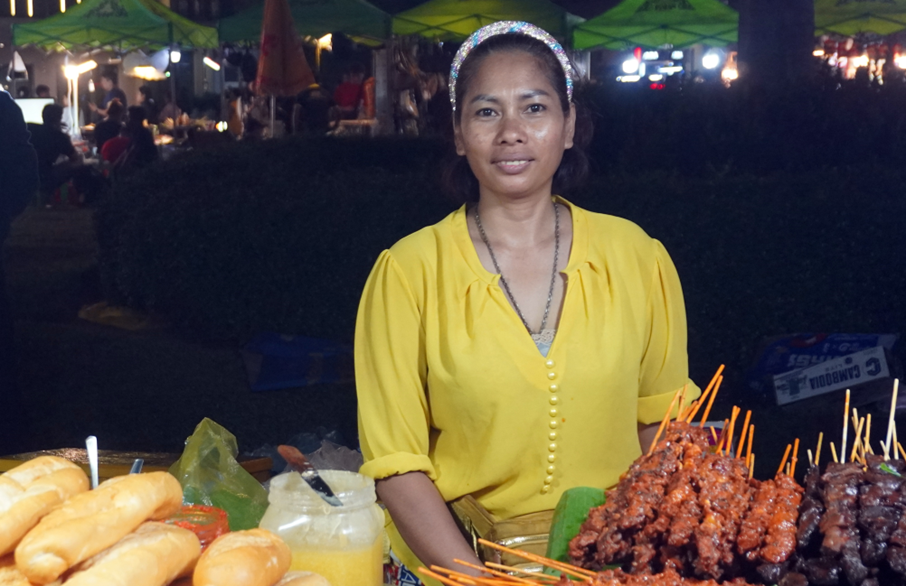
A little further on, another vendor stands proudly behind her mountain of caramelised meat skewers and steamed buns stacked like pebbles. Yellow blouse buttoned to the collar, sparkling headband, quiet smile: she embodies that particular street hospitality of Phnom Penh, where selling a dish is also selling a moment of conversation.
The great roadside buffet
There is no crossing the Walking Street without stopping in front of tables groaning under spicy salads, black snails piled in wide baskets, freshly sliced limes and lemongrass-spiked pork marinades. There is no fixed menu here: you point, you taste, you walk away with a plastic bag hastily knotted shut. Children eat noodles standing up, chopsticks in hand, while adults haggle over the basins. It is an orderly kind of chaos, run by habit more than by rules.

The music that never stops
Past the food stalls, the street changes register. A lone musician plays under a green spotlight, a chapei dang veng in hand — the traditional long-necked lute whose deep strings have carried Khmer folk tales for centuries. Around him, instruments on display, bananas set out as an offering, an improvised backdrop between a clothing stall and an advertising QR code: the sacred and the commercial sit side by side without any tension.

Further down the boulevard, a very different kind of ensemble: a group of young dancers in traditional dress — bright orange sampot, bodices embroidered with green sequins — move to the sound of skor thom drums and gongs held by young musicians in white-and-red silk. The scene, entirely spontaneous, instantly draws the crowd, phones raised, smiles exchanged.

The cyclo, last witness of another era
In the middle of the crowd, a cyclo pushes its owner more than the other way around. Emerald green, decorated with yellow and red fabric flowers, the tricycle moves slowly, a silhouette from a Phnom Penh that predates electric scooters and neon signs. The driver, maroon shirt and krama scarf around his neck, looks straight ahead, unshaken amid the night's commotion.

Small trades, great patience
Not far from the market's canvas tents, a candy and single-cigarette vendor waits, seated on a red stool, phone in hand. Under a still-empty tent at this quiet hour, she embodies the patience at the heart of street economics — selling little, but selling every single night.

A little apart from the bustle, a woman in a bright pink krama watches over her baskets of freshly cut sugarcane, stacked like pale logs. Sitting directly on the ground, one bare foot resting on the cool pavement, she takes in the crowd without hurry — one of those faces you pass and don't forget.

Perfume and phones: Walking Street, Gen Z edition
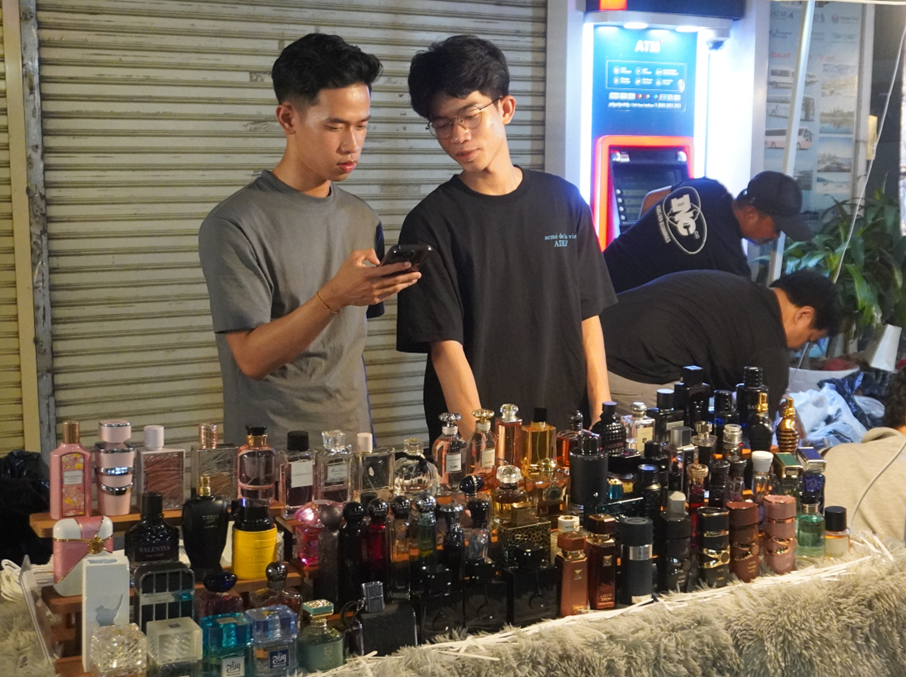
The market is not only a conservatory of tradition. Under a metal shutter, two young vendors in branded T-shirts compare rows of perfume bottles lined up by the dozen on a faux-fur rug — copies and originals side by side, chosen by eye and confirmed on a smartphone. Behind them, an ATM blinks, as incongruous as it is reassuring in this bazaar setting.
The crowd, the street's real star
Past 8pm, the Walking Street becomes a human river running counter to the nearby Tonlé Sap. A small boy in a football kit tears down the street on his orange bike, watched by a teenager immortalising the scene on his phone, arm raised above the crowd — the street as a permanent photo studio, where everyone is, by turns, subject and photographer.

Further on, two cyclos pedal side by side in front of the market's green tent curtain, one carrying a schoolgirl in a white-and-blue uniform, the other a passenger in a straw hat. The drivers, in matching maroon jackets, seem to know each other — a quiet choreography in the middle of all the commercial bustle.

On the boulevard, the stream of walkers never thins out: well-dressed young Phnom Penh women, families, groups of friends, all moving at the same unhurried pace, between lit-up stalls and traffic lights that, here, no longer serve much purpose.

Smoke, embers and sunglasses
A street vendor pushes his cart piled with golden fried rice and a pyramid of sunglasses, cap screwed down, bag slung over his shoulder — mobile commerce in all its versatility, ready to stop wherever the crowd thickens.

Not far from the river, smoke from a grill wraps around a vendor focused on his skewers, while a young woman in glasses looks on, amused, through the haze. Around them, jars of dried fruit and peanuts line up under the string lights — an almost painterly scene, somewhere between sizzle and steam.

One street, several Cambodias
Perhaps that is the true identity of the Walking Street: the coexistence, without hierarchy, of the sacred and the profane, the traditional and the counterfeit, the silence of a weary cyclist and the energy of a drum struck with open hands. You come here to eat, you stay to watch, and you leave, every time, with the feeling of having seen Phnom Penh tell its own story, one stall at a time.


Lottery followers often want quick access to the latest draw information. A reliable page with clearly presented numbers can make checking results more convenient and allow readers to review previous draws while searching for resultados de Powerball.