


Thierry Tea — From Innovation in Aviation to Building the Cambodia of Tomorrow

Interview with Thierry Tea, Co-President of La French Tech Phnom Penh, Vice President of OCIC and CEO of Canadia Impact Fund (CIFC)
Build • Reinvent • Develop • Mentor • Pass It On

Could you introduce yourself in a few words?
I am an entrepreneur, founder of several companies in aerospace and aviation, and over time I have expanded my activities into real estate, technology, education and investment.
I started my career in aviation. I was fortunate to take on responsibilities at a young age, becoming CEO of the Airbus Helicopters subsidiary in the Philippines at 26, at a time when the company was facing financial difficulties and needed to be turned around.
That experience laid the foundations for the rest of my career: entrepreneurship founding PhilJets and Sphere Aero, followed by investment with my VC firm Negocia Capital, and progressively expanding into real estate, technology and education.
I chose to return to Cambodia with my family in 2017, both to support my wife’s entrepreneurial project and to contribute to the development of my parents’ country.
Today, as Vice President of OCIC, I try to bring together what my different experiences have taught me: the discipline of major international groups, combined with the agility and appetite for risk of an entrepreneur.
I started my career as a business turnaround specialist, but today I am more a business builder, evolving to become a mentor passing on opportunities to the next generation. That is the common thread connecting my different roles at OCIC, La French Tech Phnom Penh and in education, through my involvement with CamTech University, Dichi Academy, UNICEF’s Generation Future programme and the Alliance Française de Siem Reap.
I realized early in my career that building business is about developing people and talent.
More broadly, I now want to strengthen the links between Cambodia, France and the wider Francophone community, and, above all, help prepare the next generation to build the Cambodia of tomorrow.
Tell us about your education and academic background
From Chinatown Paris to Harvard
I grew up in Paris’s 13th arrondissement and I obtained a Master’s degree in International Business in 2003. I studied in Philadelphia and Singapore.
In 2019, after fifteen years of experience in multinational companies and entrepreneurship, I decided to go back to school. I completed Executive Programs at INSEAD and Cheung Kong Business School, followed by three years at Harvard Business School’s Owner & President Management Program, from which I graduated in 2022.
Going back to school taught me one thing above all: you must always remain hungry.
Hungry to learn, to improve, to understand and to build.
Markets, technologies and responsibilities are constantly changing. You therefore have to remain curious, accept that you will need to step outside your comfort zone, question yourself and continue to reinvent yourself.
I started working at 18. During my studies, I took weekend and summer jobs as a waiter, warehouse assistant and supermarket inventory worker to help pay for part of my education. Those first experiences taught me the value of hard work, effort and independence.
Tell us about the beginning of your professional career
Intern at 21, Airbus Country CEO at 26, Entrepreneur at 31
I started with internships in Hong Kong and Shanghai before joining Airbus Helicopters in 2004, first as an intern in Paris and then in Singapore and the Philippines. What was supposed to be a 12-month adventure turned into eight years with the Airbus Group, during which I progressively moved up the ladder of the organization.
In 2007, I became CEO and President of the Philippine subsidiary, which was facing difficulties and which I was tasked to turn around. I managed to redevelop the subsidiary and became Country Manager for the entire Airbus Group in the Philippines covering Commercial Aircraft, Space and Defense.
Before returning to Cambodia, I was also involved in French business networks in the Philippines, including serving as a French Foreign Trade Advisor and as a board member of the French Chamber of Commerce and Industry. During my years at Airbus, I was involved in the sale of more than 100 aircraft and more than 70 helicopters, representing approximately US$11 billion in contracts for Airbus.
In 2012, I took a leave of absence to pursue entrepreneurship.
Then, in 2013, I acquired a nearly bankrupt air transport company and founded PhilJets. What began as an aviation startup became, 13 years later, a leading business aviation SME in the Philippines, with a fleet of around 15 aircraft comprising private jets and helicopters, operated by approximately 100 employees.
Since 2021, PhilJets has also been the distributor of engines, parts and services for the helicopter division of French aerospace group Safran in the Philippines.
In 2019, I founded Sphere Aero, an advisory and aircraft brokerage company based in Singapore. We support clients across Asia, Europe and North America with helicopter and private jet acquisitions and sales, combining advisory services with a turnkey process from transaction to aircraft delivery. Sphere has supported more than 60 transactions for clients across different markets.
For the past 13 years, PhilJets has also invested heavily in training technicians in the Philippines, particularly through our OJT (On-the-Job Training) and MTP (Mechanic Training Program) initiatives. More than 300 technicians have been trained.

A business cannot develop sustainably without the skills and talent required to support it.
To succeed over the long term, we had to make difficult decisions, rebuild teams, pivot several times and navigate crises such as Covid. That experience taught me that a business turnaround requires the right mindset to innovate and to reinvent itself.
You have to restore a vision, rebuild a team, restore trust and create a new sense of momentum.
Aviation has therefore remained a constant thread throughout my career, even as my activities have gradually diversified.
Tell us about your relationship with Cambodia
Cambodia: A Family Story
My parents were refugees in France. They had lost everything and sacrificed a lot so that my brother and I could have an education. They passed on to me the values of hard work, humility, respect, sacrifice and, above all, the ability to never give up. I first came to Cambodia in 2001, when I was 20, as a backpacker and to teach English to children. The country left a profound impression on me.
In 2014, I began investing in Cambodian startups, and in 2017 I settled here permanently with my wife.
Coming back to build here is a way of paying tribute to my ancestors and passing a tangible part of our family story on to my children. There have been sacrifices, difficulties, successes and setbacks, but what matters is to look towards the future, get back up and continue building. I also grew up at the intersection of three cultures, French, Khmer and Chinese, with a strong international dimension.
For a long time, having such a multifaceted identity made it difficult to understand where I belonged.
As someone from an immigrant family, with a different appearance, it felt like a disadvantage in France. I was rejected for some sales positions in Australia and China back in 2004, because I was told that to sell French products in Asia, you need to be white or have grey or white hair. I did not tick the right boxes.
Then, in Cambodia, people returning from the diaspora are not always considered “real Cambodians”. So integrating here was not easy either. Eventually, I learned to accept and be at peace with my multiple identities.
Why try to be like everyone else when you have the chance to be different?
It taught me to understand different ways of thinking, to adapt and to build bridges.
Today, what once felt like a difference has become a real strength. I still don’t tick the right boxes, especially with my multiple hats. But I am past waiting for approbation and I have learned that you need to live your life, without wanting to please everybody. The real ones know, like they say, where I grew up!

Building and Passing It On
Professionally, I began coming regularly to Cambodia around 2011–2012 to support my father-in-law, a Cambodian entrepreneur who had built his career in Africa and had himself chosen to return home to invest. He founded Primalis Corporation in Kampong Speu in 2013 and progressively built and developed the company into a major player in Cambodia’s rice sector.
Today, my wife, Lynda Him, who also worked at Airbus, leads Primalis together with her brothers and sisters. Under her leadership, the company has diversified into international markets and became one of Cambodia’s leading producers and exporters of fragrant rice.
I see this as a powerful illustration of what a second generation of the diaspora can amplify.
My own journey has progressively become part of this same desire to build.
In 2018, I began working with Canadia Group, as we acquired and turned around the Pandora brand in Cambodia, while continuing to develop my own businesses. Then, during Covid, I had more time to advise and exchange ideas with Dr Carolyne Pung. We agreed that it was time for me to be more involved in the development of the Group, particularly in the evolution of OCIC.
The ambition was clear: give OCIC new momentum, develop the sustainability of the Group and strengthen its international dimension, while remaining faithful to the foundations and achievements built over the previous decades.
It has now been almost four years since I joined OCIC, and I am particularly pleased to see that it is possible to transform a group built more than 35 years ago while respecting what the previous generations created.
At OCIC, whether through urban development, airports, roads, bridges or the neighbourhoods we are building, we improve the daily lives of millions of people. That is a significant responsibility, but also an extraordinary source of motivation.
Today, I have the opportunity to contribute in my own way to this family story, give it a new dimension and create positive impact at scale, both for the Group and for Cambodia.
How did you become involved with French Tech in Cambodia?
From French Tech in the Philippines to Mentoring Young Talent
In 2016, I launched the French Tech Philippines. It was great to see the beginning of the movement. Then, I launched a mobility travel tech platform in early… 2020! Covid changed the market and we had to stop in 2023 and close in 2024. So I did experience the frustration of failing and the sadness to disappoint the friends and family who invested and believed in us. It was really hard to look into the mirror and look at my own face.
But there is no choice, we have to accept, take it, and eventually move on. This is why I believe it is important to share knowledge and experience with younger founders.
Then, in 2025, UNICEF invited me to become a mentor for its Generation Future programme. Mentoring young aspiring entrepreneurs reinforced something I had increasingly come to believe:
“I was often the youngest person in the room throughout my career. Today, it is my turn to give back to the younger generation.”

Throughout my career, I have built teams that were often composed of young people and had the opportunity to welcome many French, Filipino and Cambodian interns. Some have since built remarkable careers, and many now hold positions of responsibility. It is extremely rewarding to see young people whom you have supported or advised succeed in their careers.
Earlier this year, I accepted an invitation to join the new advisory committee of the Alliance Française de Siem Reap and to support the development of French language and Francophone connections in Cambodia.
So when I was invited to help develop La French Tech Phnom Penh, it felt like a natural fit. The objective is to build bridges between France and Cambodia in technology and innovation, while, above all, giving young Cambodian talent confidence by providing them with international exposure and opening up new perspectives.
What interests me today is identifying potential, creating the right conditions and enabling a team or a project to reveal what it is capable of achieving.
It is also in synergy with my investment activities. Today my portfolio of startups ranges from Fintech, EdTech, PropTech, Logistics Tech, hybrid decarbonized aerospace, and AI.
What are your ambitions within La French Tech Phnom Penh?
Helping Cambodia Build Its First Unicorns
Since spring 2026, I have been Co-President of La French Tech Phnom Penh. Our ambition is to help support the emergence of Cambodia’s first unicorns.
To achieve this, we are working with several ministries, including through initiatives around the Digital Trade of the Ministry of Commerce, Franco Tech of the Ministry of Post and Telecommunication, as well as with Khmer Enterprise, universities, major private-sector groups and international networks.
Cambodia has genuine technology talent. Our role is to help that talent emerge, connect it with international opportunities and position Cambodia as a regional innovation platform.
The 2026 Francophonie Summit in Phnom Penh is also an extraordinary opportunity. I am involved in the government committee responsible for parallel events, with the ambition of showcasing Cambodia’s dynamism to the wider international Francophone community.
French Tech is a community. Everyone can contribute, share their experience and help others move forward.
Can you describe your professional activities?
Setting Objectives, Building Teams, Making Decisions and Executing
I often inherit problems that need to be solved and projects that need to be rebuilt, redeveloped or repositioned. But I also have the opportunity to launch new projects, whether in investment, education or urban development.
After three years of redevelopment, Koh Pich is now a rapidly growing 100-hectare business district. Rents have increased by 150%, while residential property sales have grown year after year.
I have been able to launch projects such as Connexion Hub with Dr Carolyne and push the evolution of Diamond Bay Garden, using an approach that combines real estate, infrastructure, green spaces, partnerships, innovation, lifestyle and community.
Chroy Changvar Bay, which I took over a year ago, represents another 300-hectare district that we want to transform into a living ecosystem. The objective is to create places where people want to live, work, visit and return to. For me, developing a city goes beyond constructing buildings.
It is about creating an identity, preserving memory and giving places a soul.
Art, culture and identity must have a place in urban planning, tourism and major development projects.
At Koh Pich, for example, we are working to showcase Khmer art and culture through exhibitions at the City Hall, environmental events at Connexion, a statue of King Jayavarman VII, murals and a Khmer statue project in one of the new parks. We also want to continue making the district greener, cooler and more vibrant.
Our ambition is to bring to maturity the lifestyle in Koh Pich, and keep improving as a solid young, international Khmer Central Business District combining business, restaurants, cafés, sports, education, running, cycling, events, community life and tourism.
A neighbourhood needs to be designed for its customers, residents, visitors and tourists. There are still walls and underused spaces. We have projects for new murals, artworks, signage, green spaces and landmarks to strengthen the district’s identity and attractiveness.
There is still an enormous amount of work to continue to improve. We are working hard to make it happen.
My activities might look quite diverse, but they all rely on the same method:
Understand the situation. Define a vision. Build the right teams. Bring people together around a common objective. Then execute.
Tell us about one of your projects
From an Abandoned Building to a Technology Ecosystem: Connexion
Connexion is a project that is particularly close to my heart.
Together with my aunt, we transformed an abandoned 45,000-square-metre building into a vibrant ecosystem in the heart of Phnom Penh, with more than 150 tenants and occupancy above 85%. We went from zero to 2,000 people in two years.
Today, the community brings together AI companies, major international digital groups, Cambodian startups, investment funds, international institutions such as the Canadian Chamber of Commerce, and a Francophone academic dimension through the Université Francophone d’Asie, developed in partnership with Université Paris-Panthéon-Assas. Among the organisations based there are Smart Axiata, Sabay Digital and the Swedish Consulate. There are also lifestyle destinations such as Bean Embassy café and Ascaro Padel & Pickleball, which contribute to the atmosphere and community. This diversity is what makes Connexion unique.
Beyond being a technology hub, it has become a place where entrepreneurs, investors, large companies, students and young talent can meet, work, learn, create and share experiences.
This is the type of transformation I enjoy because we do not destroy what already exists. We try to give it a new purpose, a new meaning and a new ambition.
Many people told us that changing Koh Pich or repositioning Connexion would never work. Even some friends told me I was crazy! We proved that it is possible to pivot and reinvent yourself.
Of course, today there are people who say it was easy, or that nobody had tried before. That always makes me smile. Over time, I have learned that there will always be critics. You have to listen to them, but you cannot give them the power to influence your decisions.
If you believe in a vision, you have to take risks, step outside your comfort zone and go for it.
For me, after almost four years, I still consider myself an intern in real estate, construction and urban development! I am fortunate to be learning at OCIC, one of Cambodia’s leading property developers and infrastructure groups. I still have a lot to learn.
What do you do outside work?
Dad, Husband and Family Trips
Being a father of three children is my main activity and hobby and by far the most fascinating and inspiring one.
We travel a lot as a family, and I strongly believe that discovering different cultures is one of the most valuable memories we can share with our children.
My children speak French, Khmer, Chinese and English. Cultural diversity is a treasure that we try to pass on to them, so they can understand their roots while remaining open to the wider world. Educating young people also helps me stay young and discover new ways of thinking. My children teach me how Generation Alpha thinks!
We also try to teach them the value of hard work. We work a lot, but now we are trying to dedicate more time to being together. We only have one life, and it is short. So we also need to make the most of it.
What do you like most—and least—about Cambodia?
What I Like Most: The Opportunity to See the Country Evolve and Help Build It
In Cambodia, decisions can move quickly, projects become reality and you can see the impact of your work relatively quickly. There is a collective energy among young people and a genuine desire to build.
Through urban development projects, I can contribute every day to making Phnom Penh greener, more dynamic and more attractive, while preserving and developing its cultural identity. We have already planted more than 20,000 trees, and we are only getting started.
In my view, the future of a city depends heavily on culture, art, heritage, green spaces, tourism, innovation and, above all, the people who bring these places to life.
Building the Cambodia of tomorrow is about creating a new economy and developing the talent that will drive it.
Through my Singapore-based investment holding company, Negocia Capital, I have built a small portfolio of startups since 2016, including Toulouse-based Ascendance Flight Technologies, which is developing hybrid-electric aviation technologies, and Bongloy Payments in fintech. Since I am in Cambodia, I am involved in 5 Cambodian startups. I invested in 3 personally and 2 with Canadia Impact Fund (CIFC) that I had the chance to co-found. I believe that artificial intelligence is now opening new opportunities for Cambodia.
Through Canadia Impact Fund, Connexion, startups and La French Tech, I have the privilege of being at the heart of an ecosystem that is evolving extremely quickly. With the different positioning of being an entrepreneur, an investor, an advisor, a business leader within a conglomerate, I am lucky to be close to young founders and to learn from them about tomorrow’s trends. That is why we will keep investing in several startups each year.
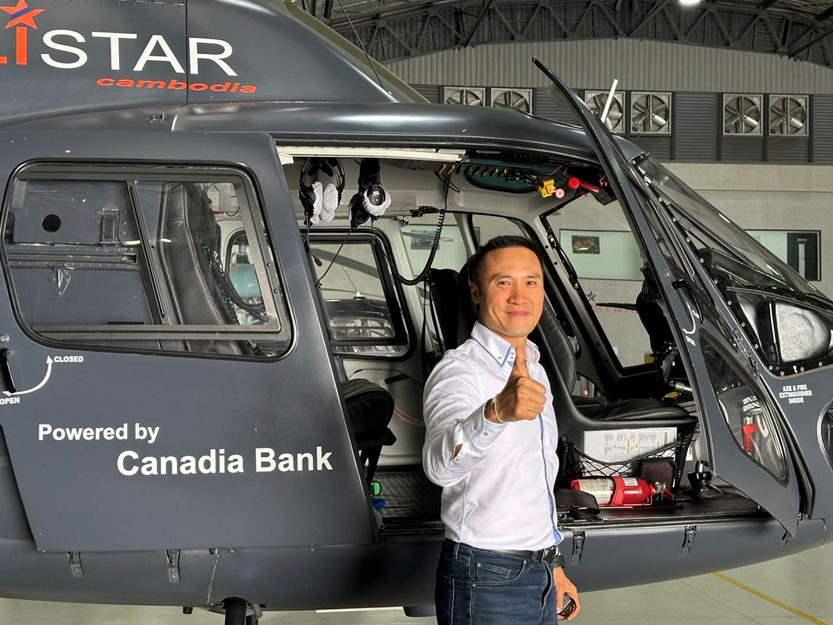
And then there is aviation, which remains a constant north star throughout my career. After more than 20 years in the sector, being able to contribute to the development of Techo International Airport and work on the launch of Phnom Penh’s new airport is an extraordinary opportunity.
But it is not finished yet.
We will soon launch our aviation school and university with our Philippine partner, World Citi Colleges (WCC). Our ambition is to contribute to developing the technical skills and capabilities that Cambodia’s aviation industry needs.
This is another dream that I already wanted to realise six or seven years ago in the Philippines and that I can finally bring to life in Cambodia. It is particularly exciting because today I can put my experience to work for the development of the country’s human capital.
What I Like the Least
I don’t like the gap that still exists between Phnom Penh and the rest of the country. Growth must benefit everyone. The dream is for every Cambodian to own a house, a home. I believe education, vocational training and human capital development are just as important as real estate projects.
I have experienced highs and lows, but I have always tried to look positively towards the future and keep moving forward. This is a philosophy that my parents passed on to me.
As long as we have the determination to move forward, nothing is permanently fixed. I believe the same is true for a country. With the new technology, the AI revolution, there is a big reset. Everyone has the potential to have access to tools anywhere in the world. The cost of learning and innovating has been reduced tremendously. But of course, we need to learn and know how to use these tools.
Today, I want to pass that confidence and energy on to the generation that is coming next.
That’s the reason why we have invested in Bamnang and Dichi Academy. It is the reason why I am involved with CamTech University and the Alliance Française de Siem Reap.
Education and training are a natural extension of entrepreneurship.
After training more than 300 technicians in the Philippines, I am particularly happy to bring this experience to young people in Cambodia. But I would like to go further. I began by training Filipinos in aviation. Today, I want to train Cambodians.
Building means creating value that lasts. To redevelop means creating a new trajectory. But to mentor and to pass on knowledge and know-how means enabling others to build their own route, their own future. And this is what motivates me today.


Comments