


“Spirit, Body, and Land”: final weeks to see Khvay Samnang at the Institut français du Cambodge

On the walls of the Institut français du Cambodge gallery since 26 June, “Spirit, Body, and Land” closes on 26 September. It brings together ten years of work by Khvay Samnang: masks woven from forest vines, panels where the weave crosses plastic strapping, brass seeds set on dead wood. Admission is free.

You see them before you have quite walked into the room. A dozen animal heads, mounted on black rods at eye level, each turned a different way. A long snout lined with teeth. Two eyes of red fibre. Pointed ears, a muzzle edged with coarse hair. Everything is woven, in raw vine, with no paint and no varnish. The shadows thrown onto the white wall double the crowd.
Khvay Samnang has been working with this vocabulary for a decade. Between 2016 and 2017, for documenta 14, he had eleven animal masks made with a small group of weavers in the Areng Valley, in Koh Kong province, from forest vines normally used for fish traps. Each animal pointed back to a Chong totem: a being honoured in a particular family for having once led an ancestor to water. A second set of masks followed in 2021, for a commission by the National Gallery Singapore. In the videos it is dancers, among them the choreographer Nget Rady, who wear them, in the waterfalls and the rice fields.

A valley, a dam, and a long stretch of fieldwork
The Chong are a Pearic-speaking minority who have lived for more than six hundred years in the south-west of the country, in the Cardamom Mountains. Their valley is part of one of the last great forest blocks in the region. It was targeted by a hydroelectric dam project, the Cheay Areng, backed by the Chinese state group Sinohydro, and residents mobilised against it from 2014.
That is when Khvay Samnang turned towards them. He spent the equivalent of a year among them, in non-consecutive stays. The project ran sixteen months in all. Out of it came masks, costumes, drawings and video — not illustrations of a struggle, but objects made on site, with the people concerned, from whatever grows nearby.
Counter-mapping, in practice
The Institut français uses a precise term for this: counter-mapping. The idea is easy to state and harder to accept. Among the Chong, territory is not defined by a land registry but by stories passed on orally and by what the body does. Knowing where a spirit’s forest begins means remembering a story and being able to perform it again. The official map, meanwhile, mostly establishes who owns what.
The video works in the exhibition document performances filmed in those landscapes — rivers, forests, contested land. Bodies sink into mud, coil, disappear under sand. None of it is staged for effect. It is a way of tracing a geography that no cadastre reproduces.
Vines, plastic, brass
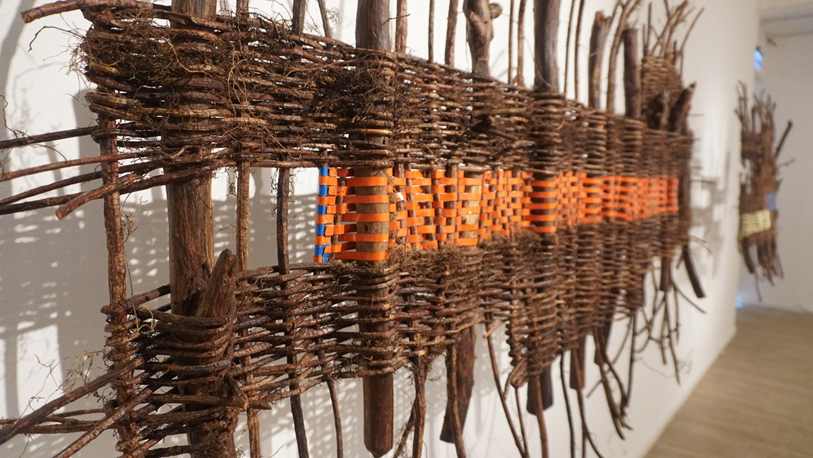
Elsewhere in the gallery the register changes. Large woven panels hang on the wall, bristling with bare branches that jut out above and below. Through the middle of the brown weave runs a wide band of plastic strapping in bright orange, or blue, or green, threaded on the same crossings as the vines. On the floor, a heavier piece repeats the method along its whole length.
This mixing of forest material and factory material runs through a whole section of his recent work. Since 2024 the artist has developed a series of woven wall sculptures that spell out words in Khmer and Pali script. On one side, Mchas Teuk, master of water, and Mchas Dei, master of land. On the other, the four elements: Kongkea, water; Aki, fire; Thorani, earth; Khyal, air. In the animist systems of “Monsoon Asia”, as long as those elements hold together, everything is alive. Separate them and everything dies.
Pralung are the spirits of that belief system, among them Nak Ta, ancestor of the soil, and Mrenh Kongveal, the supernatural guardians. The artist’s question is blunt: who is master of land and water today? For the video that accompanies the series, Khvay Samnang stepped back in front of the camera himself, for the first time in more than ten years. Sitting on a rattan chair in full sun, several hours a day over three days, he strikes a brass object. The sound carries through the forests of Koh Kong, on Koh Kong Krao island, then over islets in the Mekong in the north of the country. The point is to wake spirits he imagines fast asleep. Brass is not a neutral choice: it is cast for ceremonial gongs, and it is cast for bullets.

Dead wood and a brass seed
One last wall carries dozens of branches and pieces of driftwood. On each one sits a small gilded form, spiked, cast in brass: a seed. The whole thing is airy, almost silent, a long way from the density of the masks.
The seed is a recurring motif for Khvay Samnang. It already ran through “Forest Myth”, his solo exhibition shown in Phnom Penh at SNA Arts Management between October and December 2025, which the American magazine Artforum reviewed. He paired it with a fable written with Chum Chanveasna. A group of boys sets out to find a “Real Tree” whose fruit grants immortality. They never find it. On the way home, a black, shining seed drops out of a flock of birds. Nobody can say which tree it comes from. They plant it anyway, on bare ground, and water it in turns. The tree grows, then a storm brings it down. A year later the whole field turns green again: before falling, the tree had produced its fruit, and the wind did the rest.

An international career, a hometown exhibition
Born in 1982 in Svay Rieng and a 2006 painting graduate of the Royal University of Fine Arts in Phnom Penh, Khvay Samnang is among the most widely exhibited Cambodian artists abroad. The Jeu de Paume in Paris and the CAPC in Bordeaux gave him “Rubber Man” in 2015, Haus der Kunst in Munich a Capsule show in 2019, Tramway in Glasgow “Calling for Rain” in 2021, and ifa in Stuttgart “Dancing the Land” in 2022. He took part in documenta 14 in 2017, then documenta 15 in 2022 with Sa Sa Art Projects, and in a collateral event of the 60th Venice Biennale in 2024. His work is held by the Singapore Art Museum, the National Gallery of Australia and the National Museum of Art in Osaka, among others.
He is also a co-founder of the Stiev Selapak collective and of the two independent spaces that shaped the Phnom Penh scene, Sa Sa Art Projects (2010-2024) and SA SA BASSAC (2011-2018), where he taught contemporary art to a generation of Cambodian artists.
“Spirit, Body, and Land” is organised by SNA Arts Management, curated by Chum Chanveasna, in collaboration with the Institut français du Cambodge. It gathers works made between 2016 and 2026. Several of the artist’s series have already been shown in Cambodia, one at a time: “Where is my land?” at Sa Sa Art Projects in 2017, “Preah Kunlong” at Batia Sarem gallery in Siem Reap in 2019, “Forest Myth” at SNA Arts Management late last year. Brought together in a single route through the rooms, they read differently.
Practical information
“Spirit, Body, and Land”, an exhibition by Khvay Samnang.
Gallery of the Institut français du Cambodge, 218 Street 184 (Keo Chea), Phnom Penh.
Until Saturday 26 September 2026. Free admission.
Curator: Chum Chanveasna. Organised by SNA Arts Management and the Institut français du Cambodge.


Comments