


Siem Reap's New Hub for Sustainable Francophone Tourism

On the eve of Earth Day and approaching the Francophonie Summit, a new crossroads for sustainable tourism takes root in the heart of Siem Reap.

It took a full day, two workshops, around twenty partners, and several opening speeches to give birth, on Tuesday, April 21, 2026, to Siem Reap's second Destination Éco-Talents (DET) center. Hosted within the walls of Artisans Angkor—a living symbol of Cambodian craftsmanship—this new hub for sustainable Francophone tourism complements the setup launched last November at the Paul Dubrule School of Hospitality and Tourism. This dual presence makes Siem Reap a unique strategic anchor for the project led by the OIF and its Francophonie Institute for Sustainable Development (IFDD).
A project born from a vision, rooted in the field
To understand the April 2026 inauguration, we must go back to the project's origins. Destination Éco-Talents stems from the vision of the Francophonie's Secretary-General, who wanted sustainable tourism to serve as a concrete lever for training, professional integration, heritage promotion, and the spread of the French language. Led by the IFDD, the project supports several countries—Vietnam, Comores, Cape Verde, Cambodia—around a shared conviction: Francophonie can and must translate into concrete, useful actions that shape the future.

In Cambodia, the first step was taken in November 2025 with the inauguration of the initial DET center at the Paul Dubrule School of Hospitality and Tourism in Siem Reap. This center, focused on professional training and job placement, served as an entry point into the local tourism ecosystem. From then on, the idea of a second center—more oriented toward coordination, networking, and promoting best practices—began to take shape. The April 21 inauguration brought this idea to life.
“The sustainable tourism is built first on the ground, with those who bring territories to life.” Cécile Martin-Phipps, Director of the IFDD
The afternoon workshop: giving the floor to partners
Before the official ceremony, the day of April 21 began in a deliberately more discreet and collaborative manner. At 3:30 p.m., around twenty project partners—NGOs, training institutions, tour guides, private sector players, and association representatives—gathered for a workshop led by Cécile Martin-Phipps, Director of the IFDD, and Thi Cuc Phuong Nguyen, OIF program specialist.
The discussion, conducted mainly in English to allow everyone to participate, revolved around three key questions: What are the partners' needs and ambitions? How do they envision collaboration with the OIF and IFDD? And above all—a deliberately provocative question—is sustainable tourism a niche or a mass market?
Niche or universal framework? An unexpected consensus
The answer came quickly and almost unanimously: sustainable tourism should not remain a niche but impose itself as a framework applicable to all forms of tourism. Participants stressed the need to strengthen concrete practices rather than sticking to ideal models, favoring a bottom-up approach over imposing complex standards like those of the GSTC. The idea of a simplified framework—ten or twenty criteria—was raised, with the OIF as a potential leader, though the organization's resource constraints make this challenging in the short term.
The reflection spilled beyond the strict sectoral framework: how can we expect sustainable tourism if contemporary lifestyles themselves are not? Some suggested leveraging institutions like the World Bank to elevate these issues to a more ambitious scale.
SMEs, the tourism sector's blind spot
One observation dominated the exchanges: small and medium-sized tourism enterprises remain the weak link in sustainability. While major international hotel groups like Accor have well-established internal environmental policies, small local owners and entrepreneurs do not apply them—due to lack of knowledge or motivation. Sectoral associations such as CATA or PATA were cited as potential levers. SPOONS Cambodia shared an encouraging signal: small boutiques and hotels are spontaneously seeking training on best practices. The demand exists. Now it must be organized.
Main themes of the workshop
The workshop highlighted several key themes for the future of tourism in Cambodia. Sustainable tourism must shift from a niche to a universal framework, supported by a simplified, accessible reference system. Tourism SMEs are the top priority for support and training in best practices.
Cleanliness and waste management require sustained public action beyond private initiatives alone. Diversification efforts aim to redirect flows toward the Tonlé Sap and Mekong, while promoting the “green season.” Finally, French stands out as a major asset for attracting European Francophone retirees.
Government, cleanliness, and collective responsibility
Waste management took a prominent place in the debates. While major tourist sites—temples, riverside—are relatively maintained, residential neighborhoods suffer from a glaring lack of garbage collection. Without public action, private initiatives struggle to create systemic impact. One participant's phrase hit home: “Cambodia is not ready.” A harsh but shared assessment that calls for working on two levels simultaneously: lobbying the government through sectoral associations on one hand; direct support for entrepreneurs on the other.
Participants also advocated for a long-term educational approach: it's not enough to encourage cleaning; we must explain why it's beneficial, especially economically. The tour guide, as a mediator between visitors and local communities, was identified as a key player in this education.
Diversifying Cambodia beyond Angkor
The workshop also raised the need not to reduce Cambodia to the image of its temples alone. Tourist flows must be directed toward under-promoted areas: Tonlé Sap, the Mekong, rural communities. The comparison with Vietnam—which successfully diversified and accelerated its tourism development—served as a spur. Francophonie could play a role in attracting European visitors, especially Francophone retirees. A concrete example of positive repositioning was praised: talking about the “green season” rather than the “rainy season.”
“The IFDD's goal is not to distribute funding, but to lend credibility to small projects, acting as a catalyst to build high-impact initiatives.” Cécile Martin-Phipps, closing remarks of the workshop
The inauguration ceremony: a political and symbolic act
At 5:30 p.m., the tone shifted. Official guests began arriving: Cambodian authorities, institutional partners, private sector and civil society players. The presence of SUN Sovanna, Secretary of State at the Ministry of Foreign Affairs and International Cooperation; NGOUV Sengkak, Vice-Governor of Siem Reap Province; and THIM Sereyvuth, Director of the Siem Reap Tourism Department, gave the event undeniable political weight. SENG Sotheara's presence, representing the APSARA National Authority, underscored the project's heritage anchoring.
The voice of Artisans Angkor
Phloeun Prim, Commercial Director of Artisans Angkor, opened the ceremony. In his speech, he framed hosting the DET center as a direct extension of his organization's mission: preserving and promoting Cambodian craftsmanship while creating opportunities for local communities. For him, welcoming this center is not a one-off opportunity but a natural extension of the values Artisans Angkor has upheld for years.

He outlined the site's concrete purpose: a living space where tourism stakeholders can meet, test ideas, forge collaborations, and link training to employment. A bridge between local initiatives and the private sector, communities and visitors. The center's location in a space that daily welcomes visitors from around the world was presented as an irreplaceable strategic asset for raising awareness of sustainable tourism on a large scale.
Cécile Martin-Phipps' speech: a vision in four pillars
The IFDD Director then delivered the evening's central address. She outlined an exacting vision of sustainable tourism, structured around four complementary pillars.
The economic pillar first: creating sustainable activity and revenue.
The social pillar next: ensuring benefits truly reach communities, especially youth—who make up over 60% of the global Francophone population—and women.
The environmental pillar: no development is viable if it destroys the ecosystems it depends on.
And finally, the cultural pillar, which gives the Francophone space its uniqueness: culture is not peripheral to sustainable development; it is at its core.
On the role of French in this setup, the director was explicit: the language is more than an emotional or symbolic link. In sustainable tourism, it provides real economic added value—facilitating exchanges, structuring offerings, marketing—and a sustainability value, enabling the sharing of responsible practices and the dissemination of more respectful tourism models for cultures and the environment.
“This center is not meant to be the OIF's center. It aims first and foremost to be a trigger space: a place that connects, values, and radiates.” Cécile Martin-Phipps, Director of the IFDD
Complementarity and network under construction
One highlight of the speech was contextualizing this second center alongside the first, opened at the EHT Paul Dubrule. Cécile Martin-Phipps emphasized the deliberate and embraced complementarity between the two Siem Reap sites: on one side, skills-building and job access; on the other, valorizing expertise, circuits, and living heritage.
The fact that the OIF now has two centers in Siem Reap was described as a strong signal, recognizing the city's major role in Cambodian tourism and its unique position as a major hub for Francophone tourism.
The director also discussed long-term network ambitions: DET centers in Vietnam, Comores, Cape Verde, and other countries. A network in the making, of which the Artisans Angkor center is a precious new link.
A calendar rich in symbols
The date of April 21 was no accident. On the eve of Earth Day, the inauguration carried special resonance. Approaching the Francophonie Summit in November 2026, it fit into a broader political dynamic. And in this Year of the Horse, symbol of momentum and movement, Cécile Martin-Phipps concluded with a phrase summing up the project's ambition: making Destination Éco-Talents a driver of training, valorization, solidarity, and sustainability—so that tomorrow's tourism cares for the Earth, cultures, and people all at once.
A second center, the same ambition
At the end of this packed day, the central message stands clear: Destination Éco-Talents is not just another institutional project. It is a bet on collective intelligence and the field's ability to invent concrete, locally rooted solutions. In Siem Reap, the project's dual implantation—at the EHT Paul Dubrule for training, at Artisans Angkor for coordination and outreach—offers a coherent ecosystem model, with initial results eagerly awaited ahead of the Francophonie Summit.
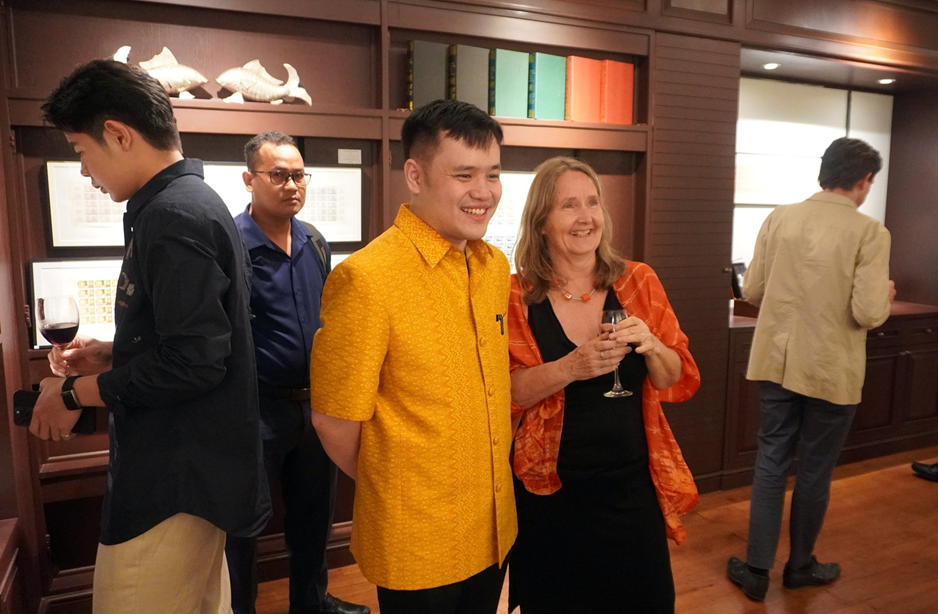
This center now belongs to those who inhabit it: partners, entrepreneurs, young talents, artisans, guides, visitors. That, at least, was the wish expressed that evening during the cocktail that gathered all participants in Artisans Angkor's garden—just hours from Earth Day.


Comments