


Royal Ploughing Ceremony in Cambodia: An Ancient Sacred Rite

On this Tuesday, May 5, 2026, Cambodia pauses to celebrate one of its most sacred traditions: the Royal Ceremony of the Sacred Furrow, known in Khmer as Preăh Réach Pĭthi Chrát Preăh Neăngkoăl (ព្រះរាជពិធីច្រត់ព្រះនង្គ័ល).
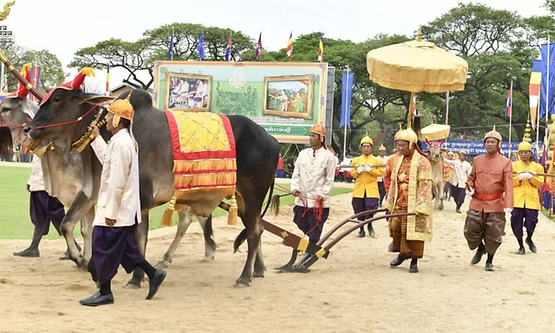
This day is officially recognized as a national holiday, listed in the calendar of 22 official public holidays for Cambodia in 2026, in accordance with Sub-Decree No. 167 promulgated on September 18, 2025 by the Royal Government.
But beyond its administrative status, this festival embodies a rare depth of cultural and spiritual continuity.
Origins Dating Back to the Funan Empire
The history of the Ploughing Ceremony in Cambodia dates back to the Funan period (1st–6th century) and was introduced from ancient India. The ceremony also appears in the Reamker, the Cambodian version of the Indian epic Ramayana, as well as in several Buddhist texts.
In Angkor Borei, the ancient capital of Funan, a statue of Balarama holding a plough, dated to the 6th century, was discovered — considered the oldest material evidence linked to this rite.
Originally, it was a Hindu ritual dedicated to deities of fertility and agriculture, such as Shiva and Vishnu. Over the centuries, it incorporated Buddhist elements, reflecting the religious transformation of the region. It is this unique fusion — animism, Hinduism, and Theravada Buddhism — that gives the Cambodian ceremony its distinctive character in the region.
The Ceremony's Proceedings
The ceremony is traditionally held on Veal Preah Meru, the esplanade located in front of the National Museum, in close proximity to the Royal Palace of Phnom Penh.
Monks recite chants to request permission from the earth spirits to plough. Ceremonial furrows are then traced, rice seeds are sown, and offerings are presented to the deities.
In the ceremony's protocol, the King's representative is called Sdach Meak, while Preah Mehuo represents the Queen. The Sdach Meak begins the ploughing with the two royal oxen, symbolizing the start of the season and a good harvest. He ploughs the field three times around, while Preah Mehuo sows the seeds behind him.
Prediction by the Royal Oxen: The Heart of the Ritual
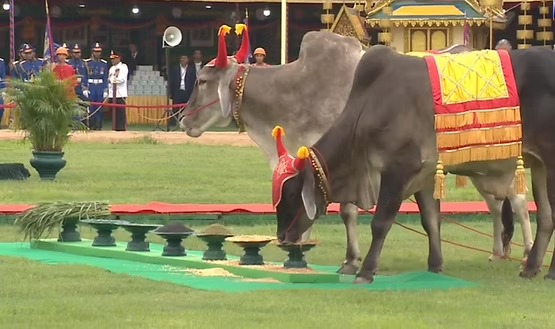
The most anticipated sequence is undoubtedly the divination by the royal oxen, the Usapheak Reach. At the end of the procession, the oxen are unhitched and led to seven gold trays. On each tray is one of the following foods: rice, corn, sesame seeds, beans, grass, water, and wine. Each symbolizes a different prediction for the future.
If the oxen choose rice or grains, the harvest will be good; water foretells abundant rains; grass means crops will be ravaged by insects; and wine announces drought. If one of the oxen drinks the wine, Cambodia would face a surge in crime and drunkenness.
Each year, Cambodian farmers anxiously await the predictions from this ceremonial rite, which they observe with deep faith and conviction.
A Ceremony Presided Over by the Nation's Highest Authority
The ceremony has been celebrated in recent years under the auspices of His Majesty Norodom Sihamoni, King of Cambodia. In Cambodia as in Thailand, the ceremony is traditionally presided over by the monarch himself or a designated representative. It sometimes happens that the sovereign participates in person and guides the plough behind the oxen.
The exact date of the ceremony, set this year for May 5, is determined by the lunar calendar: it is celebrated on the fourth day of the waning moon of the sixth lunar month.
A Tradition Shared Across Asia
Cambodia is not alone in perpetuating this rite. This ceremony is practiced in several Asian countries as a means of marking the traditional start of the rice planting season. In Burma, it was called Lehtun Mingala before being abolished in 1885. Thailand, Sri Lanka, and certain regions of southern India also observe it, each according to their own traditions.
Agriculture, Spirituality, and National Identity
Although there are various modern scientific methods for weather forecasting, Cambodians have developed their own systems to anticipate harvests and climate. These traditional rites, solemnly celebrated at the national level, ward off calamities and ensure good harvests.
This festival is a major celebration in Cambodia, signaling the start of the monsoon season. Inhabitants gather to celebrate and pray for an abundant harvest. It also serves as a powerful moment of affirmation of Khmer identity in its centuries-old continuity — a living culture rooted in the earth and the sky.


Comments