


Deadly Escalation: Thailand Bombards Cambodia for Third Day — Strikes Reach as Far as Pursat

For the third consecutive day, the Thai armed forces have unleashed a torrent of fire on Cambodian territory, extending their assaults as far as Pursat province — inflicting devastating destruction on the Preah Vihear temple, a UNESCO-listed heritage site.
A Deluge of Shelling and Tears for Thousands
According to Maly Socheata, spokesperson for Cambodia’s Ministry of National Defence, the attacks have involved “toxic smoke” shells and heavy artillery barrages, targeting both military positions and civilian areas.
Meanwhile, Bangkok accuses Phnom Penh of having initiated hostilities with BM-21 rockets and reconnaissance drones. The human toll is mounting: at least seven confirmed deaths — one Thai soldier and six Cambodian civilians (including two more killed in a strike on Banteay Meanchey) — alongside widespread evacuations affecting hundreds of thousands of people on both sides of the border.
This outbreak of violence shatters the fragile cease-fire brokered in October 2025 under US mediation, reopening deep wounds in a long-standing territorial dispute. The Cambodian government denounces what it calls unilateral provocations by its Thai neighbour, which allegedly mobilized tanks, F-16 warplanes, and heavy artillery in a massive show of force.
Morning Brief from Maly Socheata: Details of the Assaults
At dawn, Maly Socheata convened an urgent press briefing to report on the night’s and morning’s events. In the commune of Thma Da, district of Veal Veng, Pursat — part of Military Region 5 — the Thai forces launched a methodical offensive. According to her:
“From 04:58 to 05:25, large drones flew over Phnum Tra Ngol for reconnaissance missions, immediately followed by ‘toxic smoke’ shells. Then, from 05:30 to 06:10, they shelled the area of O’Phluk Damrei with conventional 105 mm artillery shells. The bombardment continues in Pursat.”
She added that parallel operations targeted Military Region 4, covering the provinces of Preah Vihear and Oddar Meanchey — beginning at 04:45 near Phnum Khmoch and rapidly spreading across a long list of sites: Ta Thav, the Ta Mone temple, Preah Vihear, Khnar, Veal Intri, Koal 8, Choam Tae, An Ses, Thma Doun, O’Smach, Phnum Anousavary — even reaching the gates of Wat Keo Sikha Kirisvara.
Toxic-smoke shells were reportedly spotted at the temple of Ta Krabei — a worrying indication of chemical-warfare capacity being used in areas frequented by civilians. The Cambodian side insists it has not responded with any offensive fire, preferring instead to meticulously document each violation and appeal to international bodies.
Heritage Destroyed: Preah Vihear Ravaged — a Calculated Provocation
This morning, the Ministry of Culture and Fine Arts issued a damning alert: the Thai army has razed the “Gopura V” conservation building within the Preah Vihear complex. Around 07:00, after initial shelling at An Ses and Ta Mone Thom beginning at 05:00, heavy artillery struck the heart of the temple grounds — demolishing vital infrastructure needed to preserve the site.
“This attack clearly aims to provoke a lasting conflict and torpedo the peace agreement of Kuala Lumpur,” the official statement thundered — recalling a dark history: since Preah Vihear’s inscription on the UNESCO list on July 7, 2008, Bangkok has repeatedly used territorial disputes as a pretext for armed aggression in 2008–2011, and more recently during July 24–28, 2025.
The ministry strongly condemned these “renewed provocations,” which obstruct conservation efforts, force the evacuation of Preah Vihear staff and local residents, and strike at a cultural treasure shared by humanity. This destruction is not collateral damage — it is perceived as part of a deliberate strategy to wreck recent diplomatic progress.
A Humanitarian Nightmare: Refugees Under Makeshift Tents
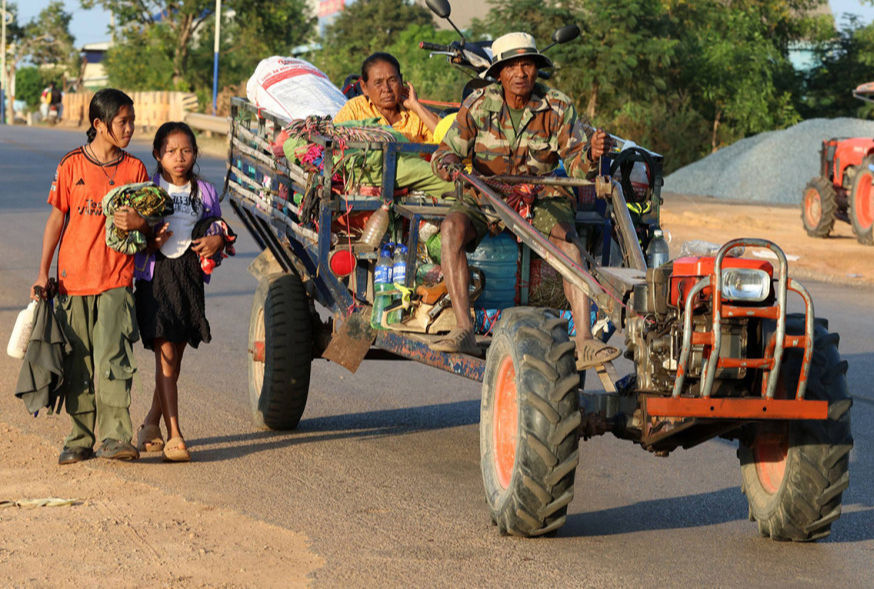
Amid the military chaos, the human face of the crisis comes into sharp relief. On the night of December 8, Cambodian families fled in droves from Thai assaults, seeking refuge in the village of Chroy Neang Nuon, district of Srey Snom, Siem Reap province — living under makeshift plastic-sheet tents tied to trees.
Elderly people, parents, and children now huddle under threadbare shelters, some lighting small lighters to feed their children, others burning wood to keep warm. These heart-wrenching scenes reflect the broader exodus: more than 385,000 Thai civilians evacuated from border areas, and thousands of Khmer people displaced internally.
In Banteay Meanchey, two additional civilians lost their lives hours ago, raising the confirmed death toll to seven, with an unknown — but likely large — number of wounded. Schools remain closed, roads are blocked, and the local economy has ground to a halt.
A Conflict Rooted in History — International Reactions and Fears
This latest surge of violence is the newest chapter in a decades-old saga poisoning Thai–Cambodian relations. The Preah Vihear temple — awarded to Cambodia by the International Court of Justice in 1962 — remains a flashpoint. Despite repeated international rulings, territorial claims and nationalist fervour have repeatedly triggered deadly clashes: in 2008–2011, and again in the July 2025 flare-up.
After a brief lull, tensions resurged in July 2025, culminating in a fragile cease-fire brokered in October under the aegis of Donald J. Trump — only to collapse under fresh accusations: rockets and drone attacks from the Cambodian side, and territorial incursions by Thai forces.
The international community is watching with deep concern. Governments such as Australia have voiced their worries and urged dialogue; the regional bloc ASEAN risks marginalization if its founding members continue down this path of confrontation. In the meantime, Trump — architect of the recent armistice — has reiterated calls to honor the agreements, while other voices within the United Nations call for urgent mediation.
The Thai authorities promise “targeted operations until sovereignty is secured,” yet experts fear this may mark the start of a dangerous downward spiral — potentially drawing in more regional actors.
What’s Next: Fragile Peace or Open War?
As guns continue to roar on the morning of December 9, a burning question looms: will this military brinkmanship lead to renewed diplomacy, or spiral into a wider conflict? Phnom Penh, holding its narrative of victimhood, is mounting press briefings and intensifying appeals to the UN, documenting every alleged violation. Bangkok, under domestic pressure, justifies its strikes as defensive.
For the refugees of Chroy Neang Nuon, the guardians of the destroyed Preah Vihear, and the bereaved families from Banteay Meanchey to Pursat, the urgent needs are clear: an immediate cease-fire, humanitarian aid, and a return to meaningful negotiations.
This crisis — at the heart of Southeast Asia — tests the resilience of ASEAN and the willingness of global powers to prevent a new flashpoint in the region. Whether nationalism or reason prevails remains to be seen, but the world’s eyes are on Bangkok and Phnom Penh.


Comments