


Chroy Changvar: In the Shadow of the Towers, the River's Last Fishermen

Across the river from the Royal Palace, on the bank where the Mekong, the Tonlé Sap and the Bassac meet, Cham and Vietnamese families have lived on their boats for generations. As Phnom Penh raises glass towers all around them, all they have left for an address is a mooring spot — temporary, and always under threat.

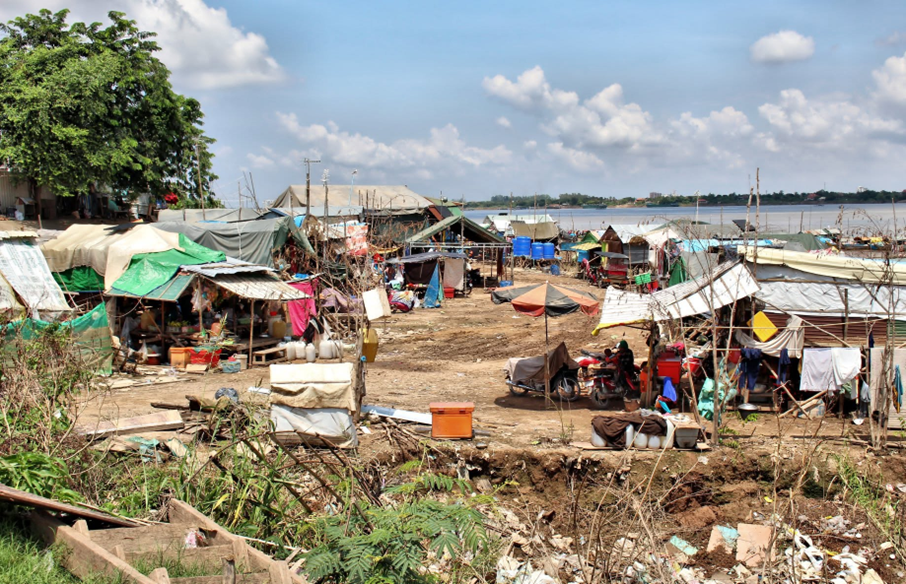
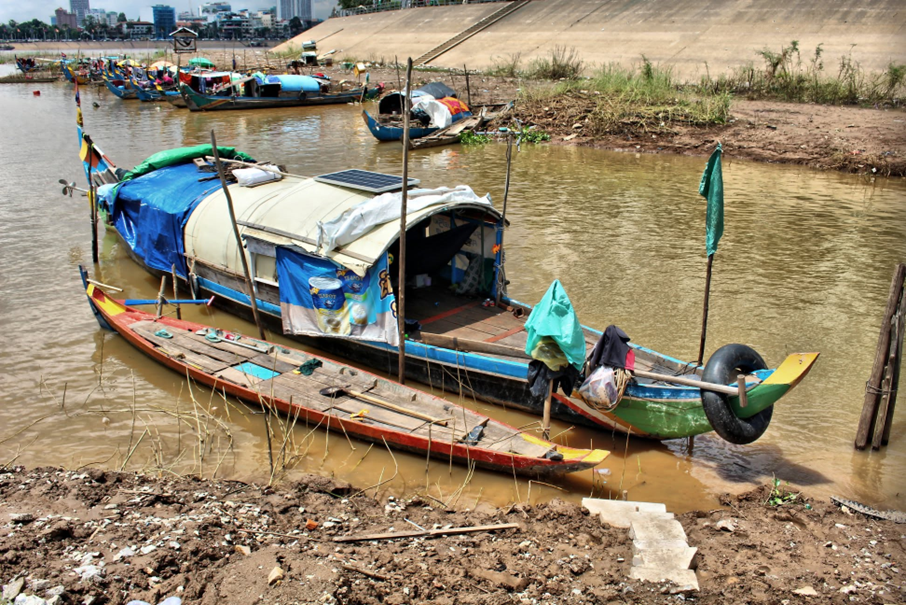
Seen from the other bank, Phnom Penh's skyline looks like a miniature Singapore: towers under construction bristling with cranes, mirrored office blocks, the Royal Palace's golden dome squeezed between two high-rises. Seen from the Chroy Changvar shore, that same skyline becomes a distant, almost abstract backdrop looming over an entirely different world: dozens of wooden boats moored to one another, topped with blue tarpaulins and makeshift parasols, laundry drying between bamboo poles, children bathing beside painted hulls, a rooster picking its way across the mud. Welcome to Chroy Changvar, the peninsula facing the capital's historic heart — and one of the last homes of a floating fishing community that the city, as it gentrifies, keeps trying tirelessly to make disappear.
One Confluence, Four Arms
The site is anything but incidental. It is here, precisely, that the Mekong, the Tonlé Sap and the Bassac meet and split at a point Khmers call Chaktomuk, the "four faces." This river confluence has made Phnom Penh a commercial crossroads for centuries, and Chroy Changvar — literally the "tilted river mouth" — a privileged vantage point over the royal city just across the water.

The peninsula was long a rural area, connected to the capital by a single bridge, built between 1963 and 1966 with Japanese aid. That bridge, later renamed the "Cambodia-Japan Friendship Bridge," has a turbulent history: partially destroyed by the Khmer Rouge in 1972 and 1973, it stayed out of use for more than twenty years, forcing residents to cross by ferry, before being rebuilt with the help of Japanese cooperation and reopened in 1994.

A second, China-financed bridge came to complement it in 2015. Within a decade, these two crossings transformed Chroy Changvar: from a sleepy agricultural peninsula, it became one of the capital's most sought-after real-estate frontiers, dotted with residential towers, medical centers and luxury hotel complexes — one of the most emblematic, the Sokha Hotel, now looms directly over the fishing encampment.
Who Are These River Families
Two distinct communities make up most of this floating population: Cham families and families of Vietnamese origin.

The Cham are descendants of the Champa kingdom, a cluster of city-states that once dominated the center and south of what is now Vietnam, before being annexed by the Nguyễn dynasty in 1835. Facing the persecution and forced-assimilation attempts that followed, a large share of the Cham population fled to Cambodia, converting to a distinct form of Islam and settling along the Mekong, where fishing became their principal livelihood. Today, roughly two-thirds of all Cham worldwide live in Cambodia.
Families of Vietnamese origin share an equally long history on these waters, but an even more precarious legal status: many of them have lived in Cambodia for several generations without ever obtaining Cambodian citizenship, while also not being recognized as Vietnamese citizens. This leaves them stateless, with no legal existence, and therefore no access to the basic rights — education, property, judicial protection — that come with it.
A Life of Successive Departures
The history of this community in Chroy Changvar is punctuated by relocations. A group of Cham families once anchored near Sisowath Quay, before moving in 2012 during the construction of a nearby hotel complex; some of them then regrouped at Chroy Changvar, within what would become the Chong Koh community.
In November 2019, local authorities asked residents to leave the area temporarily ahead of an international summit, citing urban beautification. In June 2021, in the middle of the pandemic, several riverside neighborhoods of the capital, including Chroy Changvar, saw further displacements, with some families redirected toward more outlying communes. According to a Mongabay investigation published in 2025, similar movements recur regularly around major events; the families concerned describe these episodes as trying, before generally coming back to moor not far from where they started.

Fishing Rules That Are Sometimes Disputed
Some Cham fishermen interviewed by Mongabay say enforcement of fishing rules is not always applied evenly: their nets are sometimes seized for non-compliance, while other operators on the river appear to face fewer checks. Local fisheries police officials, for their part, say they have stepped up river surveillance in recent years and are working on new regulations meant to better govern fishing practices as a whole.
Daily Life, Come What May
Despite this permanent precarity, life keeps organizing itself around the floating encampment, with stubborn ingenuity. Improvised solar panels power a few light bulbs and radios aboard the better-equipped boats.
Salvaged tarpaulins, stretched over bamboo frames, serve as roofs for makeshift dwellings planted directly on the muddy bank, amid improvised ladders, cooking pots and jerrycans.

Children grow up at the water's edge, bathing directly in the river between hulls painted blue, red and bright yellow — the traditional colors of Cham boats.


A rooster wanders among the debris left by the last flood; men rinse off with buckets of water by the roadside, under the indifferent gaze of passing motorbikes.


It is these details, just a few hundred meters from the air-conditioned glass towers, that best capture the dizzying gap between the two Phnom Penhs that face each other across this river.
A Future in Limbo
Researchers studying the issue agree on one point: the pressure on these communities is not going to ease. The stretch of river where they moor today, between the Friendship Bridge and the Sokha Hotel, remains one of the most coveted areas in the capital's real-estate market. Some experts call for fairer solutions that take into account these river communities' long history, rather than treating them as a mere urban-planning problem to be relocated. Others, on the authorities' side, argue that the global decline in fish stocks is making artisanal fishing less and less viable in the long run regardless, and advocate for a gradual shift toward other livelihoods.
Between these two readings, the families of Chroy Changvar continue, for now, to live day by day, at the mercy of floods and eviction notices — on a river that has always belonged to them, and less and less.


Comments