


Cambodia : Unearthed Sanctuary in Koh Nhek, Bridging Khmer History and Highland Memory

The teams from the Hill Tribes Memory Community Center uncovered, on April 22, 2026, the remains of an unknown sanctuary in Koh Nhek district. A discovery that questions both Khmer history and the memory of the highland peoples.
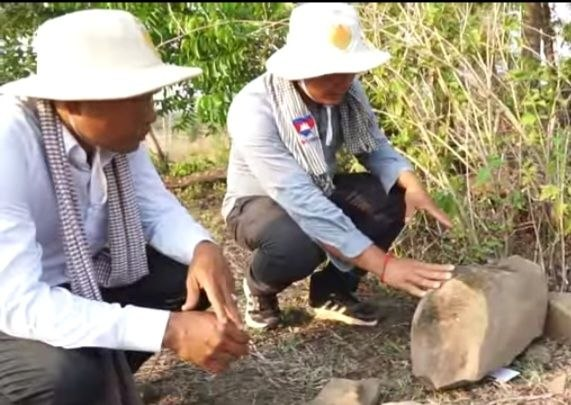
At first, there was only a whisper among the Bunong villagers: something was sleeping under the moss and roots, deep in a forest in Cambodia's most remote province. On April 22, 2026, researchers from the Hill Tribes Memory Community Center — the provincial branch of the Documentation Center of Cambodia (DC-Cam), located in Putang village — documented what the elders may have known all along: a temple, unrecorded in any official archive, lay buried in the heart of Koh Nhek district.
Photographs released by DC-Cam on social media on April 25 show blocks of laterite overrun by vegetation, fractured lintels, and foundations not entirely erased by decades. No grand pyramid like Prasat Thom, no Angkor galleries. But something infinitely precious: a sanctuary off the beaten path, preserved by oblivion itself.
A territory long kept from official history
Mondulkiri, officially established as a province in 1960 from the eastern part of Kratié, has been for centuries the land of highland peoples, foremost among them the Bunong, of Mon-Khmer origin.
This hill people, whose culture blends animist beliefs and deep knowledge of nature, is said to have migrated from northern Vietnam and southern China. Their history is oral, their collective memory long ignored by major Khmer academic institutions.
To archaeologists, Mondulkiri is a nearly virgin province. Attention has always focused on Angkor, on Koh Ker — the rival ancient capital of the Khmer Empire from 928 to 944 AD, founded by King Jayavarman IV and recently inscribed on the UNESCO World Heritage List — or on the Tonlé Sap plains. The northeastern highlands, difficult to access and poorly mapped in terms of heritage, have remained on the margins of major excavations.
It is precisely this archaeological silence that makes the Koh Nhek discovery so singular.
DC-Cam, guardian of a dual memory
Since early 2023, the Documentation Center of Cambodia has launched the Hill Tribes Memory Community Center project in Putang village, Sen Monorom, to support Khmer Rouge genocide survivors and strengthen community development activities.
It is therefore not a classical archaeological organization — it is an institution dedicated to the memory of 20th-century traumas: the American war, the 1969 bombings, the Pol Pot regime, forced displacements.
But memory is indivisible. By collecting testimonies from Bunong elders, the Center's teams have gradually touched a much older memory — that of a territory inhabited, structured, and sacred long before modern history devastated it.
In forums organized by the Center, survivors speak indistinguishably of work elephants, rice fields, animist rites, and decades of war — a living tapestry of memory where the pre-colonial and the contemporary meet. The Koh Nhek temple discovery fits into this continuum.
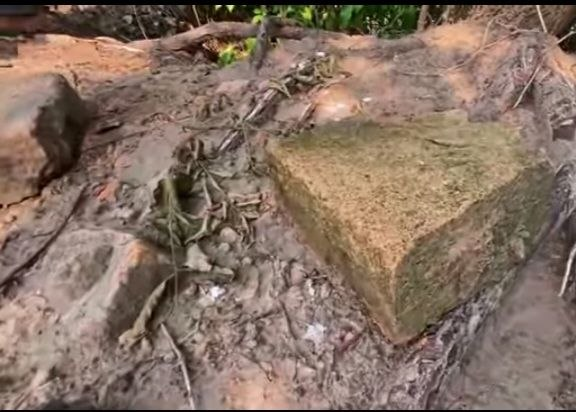
What the forest has preserved
Precise details on the temple's dating and nature remain to be confirmed by Khmer archaeology experts. The images nevertheless reveal brick and laterite architecture consistent with Khmer Empire construction techniques, perhaps between the 9th and 12th centuries. The presence of such a structure in Koh Nhek district — located more than 150 kilometers from the provincial capital, on the banks of the Sre Pork River — suggests that the Empire's trade and spiritual routes extended far beyond what was assumed.
For archaeologists, every new temple discovered in peripheral areas is an invitation to reconsider Khmer power geography: not a single radiant center, but a network of sacred sites irrigating entire territories, including the most inhospitable ones.
Memory as method
What stands out in this discovery is how it happened. It was not an international archaeological mission that spotted the site via airborne lidar. It was a team of local researchers, engaged in community memory work, who — by listening, walking, and trusting Bunong knowledge — uncovered what maps ignored.
The Center, supported by DC-Cam, aims to make young Bunong students conscious heirs of a complex history, giving them tools to understand their past and protect their territory.
The April 22 discovery gives this ambition an unexpected dimension: highland peoples are not only witnesses to a recent and painful history. They may also be guardians of an ancient civilization that the forest alone has preserved.
Cambodian authorities and international archaeological institutions should now be involved in a site assessment mission. Before, hopefully, other Mondulkiri forests disappear under the chainsaws of agricultural concessions.
The Hill Tribes Memory Community Center is an initiative of the Documentation Center of Cambodia (DC-Cam / Queen Mother Library), Phnom Penh.


Great insights on modern real estate solutions. SISGAIN really highlights how digital transformation improves property buying experiences. The idea of custom real estate app development is crucial for scalability and user engagement in today’s market.
Great explanation of customer journey tracking. Effective CRM development helps businesses understand users better and improve engagement.