


Cambodia & Tourism: Chhlong, the Last Lights of the Mekong

Between baroque façades eaten away by the monsoon, a market bursting with color, and pre-Angkorian legends, Chhlong, a small town in Kratié province, still holds the memory of a vanished golden age.

You have to leave the national road and press on into the red laterite dust before it appears: a row of ochre façades, worn down by the monsoon, framed by Italianate arcades and green balustrades weathered by a century of tropical humidity. This is not Battambang, nor Kampot. This is Chhlong (ឆ្លូង), a sleepy market town on the bank of the Mekong, about thirty kilometers south of Kratié, in northeastern Cambodia. Few travelers stop here. That is perhaps precisely what makes it, still today, one of the country's best-preserved — and least visited — sanctuaries of colonial architecture.
A Name Born of the River
The origin of the toponym remains debated. Some say Chhlong comes from the Khmer word for "crossing," a reference to the passage toward the western bank of the Mekong; others believe it is named after a native tree. Both versions converge, in fact, on what still defines the town: water and wood, river and forest.
Built at the confluence of the Mekong and a small tributary known locally as the Prek Chhlong, the town today stretches in a long ribbon parallel to the riverbank, dotted with pagodas, stilt houses, and the remains of once-grand residences. The flat terrain invites walking or cycling; rice paddies and orchards nibble at the edge of the forest as one moves away from the river.
On the Trail of the Chenla Kingdom
Chhlong's history reaches back far beyond the colonial period. The Kratié region, and in particular the nearby site of Sambor — the ancient Samphu Borak — once held one of the capitals of the pre-Angkorian Chenla kingdom, a mosaic of Indianized principalities that predated the civilization of Angkor by several centuries before being gradually absorbed into the Khmer empire. Archaeological excavations in recent years have unearthed more than a hundred temple foundations dating from the 6th and 7th centuries, scattered between Kompong Damrei and Koh Rongeav.
Oral tradition, for its part, has kept alive a very different memory: that of Princess Bopha Vatey, known as Preah Krapum Chhouk, swallowed by the mythical crocodile Nen Thun in Longvek. According to legend, the epic tale of her flight traveled up the Mekong as far as Chhlong itself — the monster is said to have briefly taken refuge in the Prek Chhlong before finally being captured at Sambor, where a stupa is said to still hold the princess's remains to this day. These stories, painted on the walls of several pagodas in the region, continue to circulate among the village elders.
The Golden Age of Timber and River
Chhlong reached its peak at the turn of the 20th century. The town became a strategic river port where Chinese traders, European brokers from Phnom Penh, and Khmer timber merchants negotiated the precious wood floated downriver. One trading family founded what is believed to be Cambodia's first industrial plant of any real size: a sawmill. The same family built the famous House of a Hundred Pillars, constructed in 1884 — a name that has aged poorly, since the Khmer Rouge reportedly dismantled half of its columns; only 56 are said to remain today.

In 1916, the same family commissioned a brick-and-stucco mansion in a style then highly fashionable among Indochina's rising elites: a tropicalized baroque, blending Austro-Hungarian influences with French Second Empire comfort, with its high ceilings, wide balconies, and arcades designed to catch the slightest breeze. Long home to the Koy family, the mansion later became the residence of the local head of customs — tasked, ironically enough, with taxing the very timber trade that had made its first owners' fortune. Since restored, it is known today as Le Relais de Chhlong.
Other buildings from the same era, less fortunate, still stand today along the riverfront: yellow-and-white façades eaten away by black mold, round arches overrun by vines, disjointed wooden shutters hanging above the market stalls below. These two-story buildings, with their Corinthian columns and molded cornices, tell — better than any text could — the scale of what was once built here, and of what, for lack of means, is inexorably crumbling under the tropical climate.
The Dark Years
The decline began well before the Khmer Rouge. As early as 1968, the political situation in the northeast was deteriorating: irredentist movements, infiltration linked to the Vietnam War, and American bombing of border areas pushed residents into exile. Many of the town's grand residences, including the future Le Relais, were abandoned.

The first photographs taken after the fall of the Khmer Rouge regime show roofless buildings, their structures having nonetheless withstood the years. It was in these empty shells that displaced civilians took refuge during the darkest years of the country; pharmaceutical vials uncovered during restoration work suggest some of these houses also served as makeshift field hospitals. The large paper mill built in Chhlong during the golden age of the Sangkum — the era of Norodom Sihanouk, between independence and civil war — has also vanished, along with the timber trade that once brought the town its prosperity.
A Plural Community
What strikes the visitor, beyond the stonework, is the diversity that has shaped Chhlong over the centuries: Chinese merchants settled here for generations, Vietnamese river fishermen, neighboring Cham villages along the road to Kratié, and minorities from the northeastern highlands. The town's Chinese school, said to be the oldest in the country, still stands opposite the former governor's residence. Khmer-Chinese funerary rituals remain very much alive in the surrounding villages.
The river, too, has its own legends: the town's elders still remember a Vietnamese hermit who lived alone on a small islet called Koh Kandau — Rat Island — so close to shore that, as children, they would swim out to sit and listen to his stories. He is said to have predicted that Chhlong's prosperity would fade the day his islet was swallowed by rising waters. The islet has since disappeared — as has the timber trade, the paper mill, and so many other pieces of the town's past splendor.
The Market, Chhlong's Beating Heart
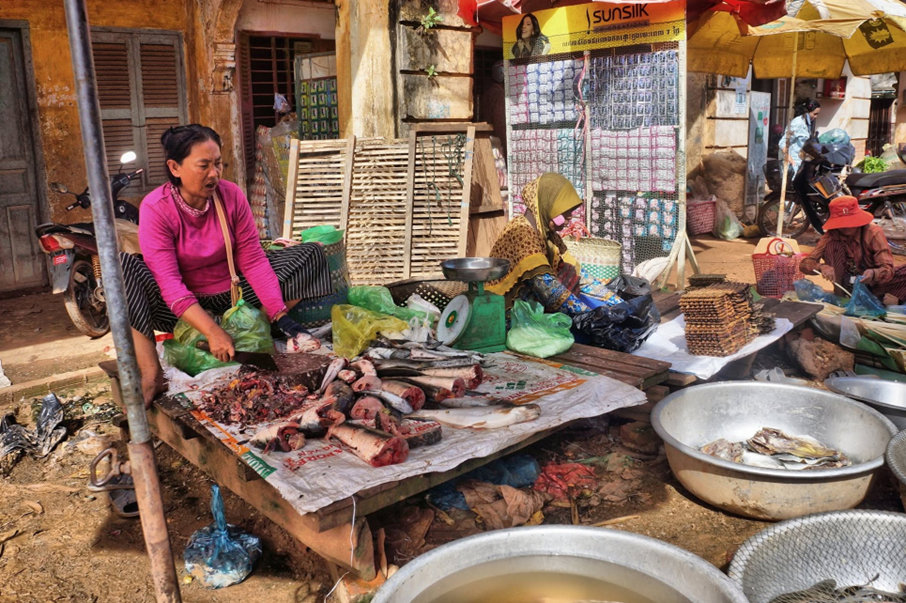
Far from the silent façades, life continues to pulse to the rhythm of the daily market. From dawn, freshwater fish stalls set up directly on the laterite ground: catfish and carp from the Mekong butchered on makeshift trestles, woven bamboo baskets overflowing with small silvery fish, women squatting to weigh their catch on old needle scales.


Zebu cattle, pale-horned and patient-eyed, still occasionally wander between the stalls, indifferent to the motorbikes loaded with egg trays that weave through the same narrow lane.

It is also in these streets that, early in the morning, one crosses paths with the tall orange silhouette of monks on their alms round, rice bowls held against their chests, bare feet in the red dust — an unchanging scene, repeated for generations, in stark contrast to the truck carcasses and piles of worn tires heaped along the roadside.
A Fragile Revival
Unlike Kampot or Battambang, whose colonial centers have been largely restored and turned toward tourism, Chhlong has so far escaped gentrification. The ground floors of its old residences serve as workshops, garages, or shops; the upper floors, often boarded up or reclaimed by vegetation, remain uninhabited. A group of local investors recently put forward a master plan aimed at preserving this architectural heritage and reviving traditional local crafts — a still-uncertain gamble in a country where economic urgency too often outweighs the conservation of old buildings.
For now, it is perhaps this raw authenticity, unfiltered for tourism, that constitutes Chhlong's true wealth: a town where one can still observe, without staging, the everyday life of a Cambodian river town, amid centuries-old pagodas, a lively market, and elegant ruins.
How to Visit Chhlong
Chhlong lies about an hour and a half by road or motorbike from Kratié, a town known for its Irrawaddy dolphins, and roughly half a day's drive from Phnom Penh. The dry season, from November to February, offers the most pleasant conditions for exploring the town on foot or by bicycle, particularly along the old river road between Kratié and Chhlong, which passes through several traditional Cham villages. The former governor's residence, now a boutique hotel, and the House of a Hundred Pillars remain the town's two must-see architectural landmarks, but it is by wandering without a fixed itinerary, between the market and the river, that Chhlong best reveals its soul.


Comments