


Cambodia's Electric Vehicle Rush Accelerates as Fuel Prices Surge

EV registrations jumped 151% in the first half of 2026, a surge driven largely by the war in the Middle East and a determined government policy. Chinese, Japanese, Korean and American carmakers are now racing to set up assembly lines in the Kingdom.
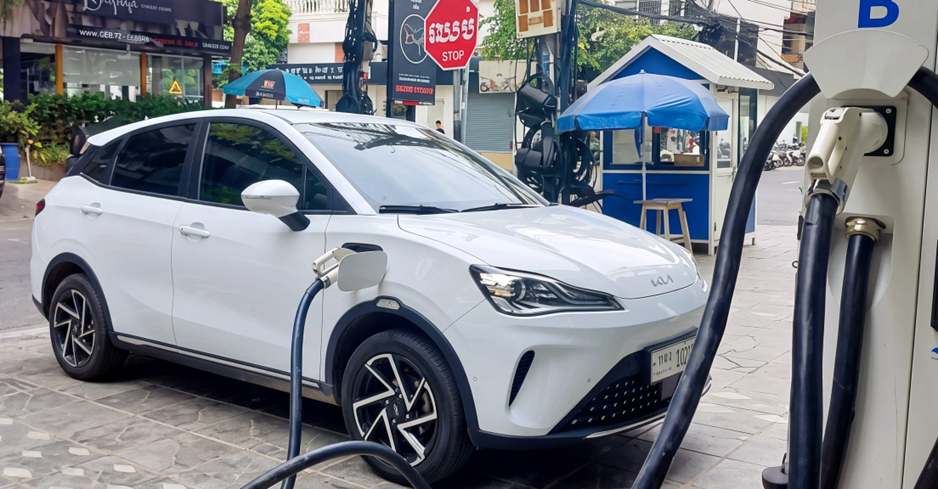
This week's figure is a striking one for a small Southeast Asian car market: according to a report from the Ministry of Public Works and Transport (MPWT), 6,174 electric vehicles were registered in Cambodia between January and June 2026, compared with 2,459 over the same period in 2025 — a jump of 151%. The Kingdom's total fleet of officially registered EVs now stands at 15,239 units, a cumulative total since 2021.
A shift accelerated by geopolitics
Behind this acceleration lies one dominant short-term factor: rising fuel prices triggered by the conflict in the Middle East. According to MPWT spokesperson Phan Rim, cited by Xinhua, the sharp rise in registrations began in March 2026, in the wake of that geopolitical shock to global fuel prices. In the March-June quarter alone, roughly 4,876 EVs were registered — an unprecedented pace for the Cambodian market.
The experience of Chou Sivly, a 30-year-old merchant who switched to an electric car, illustrates this economic shift: her monthly fuel bill previously ran between $150 and $200 with a petrol vehicle, before she opted for a Chinese-made Dongfeng Forthing S7. For the authorities, the case is straightforward: EVs cut fuel costs and eliminate tailpipe emissions, in the words of the ministry's spokesperson.
An industrial strategy backed by Phnom Penh
This short-term momentum nonetheless sits within a longer structural trajectory set by the Cambodian government. The Kingdom has rolled out its National Policy on the Development of the Electric Vehicle Sector 2024-2030, designed to encourage investment, expand charging infrastructure, and keep Cambodia's economic development in step with global trends.
To give substance to that ambition, authorities have layered on a series of incentives. Since 1 April 2026, Phnom Penh has scrapped import taxes on electric vehicles and related equipment, a move it attributed directly to pressure from rising fuel prices. That tax cut adds to other levers already in place: reduced special duties on EVs, revised road traffic laws to allow EV registration, and the nationwide rollout of charging infrastructure.
The stakes go beyond decarbonisation alone: according to the ministry, promoting electric vehicles will help cut fuel consumption and, given Cambodia's reliance on imported oil, strengthen the Kingdom's energy security. The numerical ambitions are notable: the country is targeting a 40% share of EVs in its car fleet and a majority of electric motorcycles and urban buses by 2050, as part of its long-term carbon-neutrality strategy.
Global automakers stake their claim
The fact that several international manufacturers have chosen to set up assembly operations in the country is a sign that Cambodia's trajectory is winning converts beyond its borders. The most emblematic case is BYD, China's leading EV maker: the group has begun construction of a CKD (Completely Knocked Down) assembly plant on a 12-hectare site in the Sihanoukville Special Economic Zone, representing an investment of roughly $32 million in its first phase, with production targeted to start in early November at an initial capacity of 10,000 vehicles a year.
But BYD is far from alone. According to the Phnom Penh Post, Cambodia now hosts six operating car assembly plants, including those of Ford, SsangYong, Hyundai, Kia, GTV and Toyota — a figure put at ten operational assembly sites in total by the Khmer Times, driven by the government's Automotive and Electronics Sectors Development Roadmap. Among the most active players, Ford, through the RMA Group, runs a major assembly plant in Pursat province, while other manufacturers, including GAC and Toyota, already rank among the most popular brands with Cambodian consumers, alongside BYD.
This industrial upgrade is also feeding local employment: the growth of the automotive sector is described as a driver of manufacturing job growth, with localised employment gains estimated at up to 13%.
A still-tiny market, but a momentum that shows no sign of slowing
The scale of the phenomenon should be kept in perspective: the EV fleet still represents only a small fraction of Cambodia's overall vehicle stock. Of the 8.3 million vehicles registered with the Ministry of Public Works and Transport as of February 2026, only 14,534 were electric. But the trend itself is unambiguous: monthly registration figures have climbed steadily since the start of the year, rising from 488 units in January to 1,078 in February, before the spring surge tied to the oil-price shock.
For Thong Mengdavid, deputy director of the China-ASEAN Studies Center at the Cambodia University of Technology and Science, this dynamic extends well beyond environmental concerns: widespread EV adoption immediately benefits urban micro-environments by sharply reducing localised air pollution and improving air quality in dense areas, while, he argues, sending a powerful demand signal to investors as Cambodian consumers shift toward electric mobility at scale.



Comments