


Preah Vihear temple: Phnom Penh answers Bangkok with 562 damaged areas and 501 craters

Cambodia's information minister, Neth Pheaktra, draws on the UNESCO-ICOMOS mission report and on surveys by CMAC deminers to put numbers on the destruction the temple suffered during the 2025 fighting. Thailand, for its part, says Cambodian soldiers were using the site.
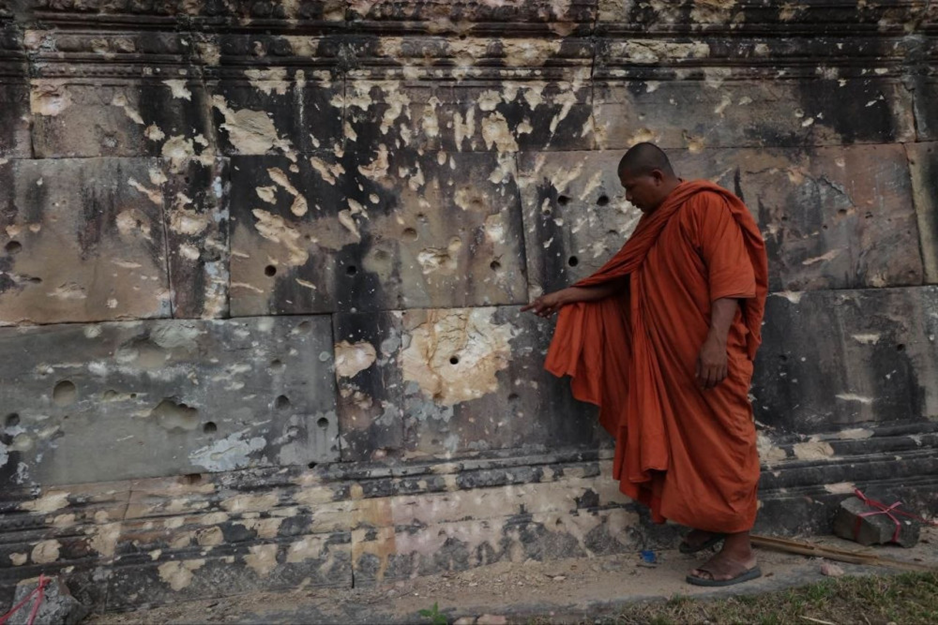
The Cambodian government has chosen to answer with figures. In a Facebook post on 12 September, Neth Pheaktra listed the damage recorded at Preah Vihear temple after the border clashes of July and December 2025: 562 damaged areas and 501 impact craters. These, he wrote, can be seen, measured and independently verified. Interpretations may differ, he said, but the physical traces remain on the site.
The post appeared on the same day the Thai military presented to the press what it describes as evidence that Cambodia used the temple for military purposes.
The International Court of Justice awarded the temple to Cambodia in 1962. It has been on the World Heritage List since 2008. It was already hit during the armed incidents of 2008 to 2011.
The UNESCO-ICOMOS report at the centre of the case
The minister first cites the report of the joint advisory mission of the UNESCO World Heritage Centre and the International Council on Monuments and Sites (ICOMOS), made public on 9 September. The two experts, Mechtild Rössler for UNESCO and Pierre Smars for ICOMOS, visited the site in early March 2026 at Phnom Penh's invitation. No official international mission had been there since 2009.
The report, around a hundred pages long, draws on records kept by the National Authority for Preah Vihear (NAPV). The authority counted 142 damaged areas from the July 2025 fighting and 420 from the December fighting. Each impact was photographed, described and geo-referenced. The visit did not allow a full inspection. The experts say they were nonetheless able to confirm the quality and objectivity of this work.
Their conclusions are severe. The scale of destruction is judged beyond comparison with earlier conflicts. The integrity, authenticity and Outstanding Universal Value of the property have been affected. The experts describe architectural elements destroyed by direct hits and others overturned or dislocated by blasts. Pediments have fallen. Most walls bear shrapnel marks. The shelling may have weakened the cliffs on which the temple stands. The mission considers the temple to be threatened by serious and specific danger, in the sense of the World Heritage Convention.
501 craters recorded by CMAC
Neth Pheaktra adds the technical surveys of the Cambodian Mine Action Centre (CMAC). The agency identified 501 craters attributed to aerial bombs, artillery fire and drones: 78 after the July fighting and 423 after the December fighting. The figures were also presented at a CMAC briefing on explosive remnants of the conflict, Khmer Times reported.
According to the minister, deminers found evidence of MK-82 aerial bombs, cluster munitions and 105, 125 and 155 mm shells. The damage affects the ancient causeway, the foundations, walls, pillars, lintels, pediments and several parts of the five gopuras, the temple's entrance pavilions.
The UNESCO-ICOMOS report also refers, based on information supplied by CMAC, to medium and heavy artillery fire, cluster munitions, drones and mortar shells.
The Gopura V crane, two accounts
Neth Pheaktra draws attention to Gopura V, where Cambodia and India were carrying out a conservation project. Photographs taken before the fighting show a crane and scaffolding set up against the structure. Images taken afterwards show heavy damage, including the collapse of the crane.
The international report confirms that restoration and tourism equipment was destroyed: cranes, a stone-cutting workshop, a weather station and an interpretation centre. The Thai military sees it differently. It acknowledged striking a crane at the site, saying it formed part of a military command and control system, according to the Associated Press.
Bangkok cites military use of the site
Thailand does not deny the strikes. It disputes how they are read. On 12 September, Air Chief Marshal Prapas Sornchaidee, director of the Thailand-Cambodia Joint Information Centre, said the temple had not been targeted and spoke of collateral damage. He said Thailand has evidence that Cambodian forces used the area as a military position: aerial images, coordinates, and photographs of anti-tank rocket launchers, small arms and anti-aircraft positions. Bangkok is calling for an independent review of this material.
The Thai official did acknowledge that the presence of troops would not automatically strip the temple of its legal protection. Army spokesman Maj. Gen. Winthai Suvaree maintains that Thai fire was aimed only at military targets. In February, Foreign Minister Sihasak Phuangketkeow told UNESCO the damage would not have happened had Cambodia not used the site as a base and weapons store. The organisation took note without taking sides.
Phnom Penh denies any military use. Cambodia's Ministry of Culture says the temple is under civilian control. Neth Pheaktra calls the Thai accusations unfounded. In his view, they rest on images whose location, date and context have not been independently verified. A weapon visible in a photo, he argues, does not prove that a place struck at a given moment was a military target. He has asked Bangkok to produce verifiable evidence.
Both countries are parties to the 1954 Hague Convention for the Protection of Cultural Property in the Event of Armed Conflict. The report notes that the convention provides for individual criminal liability for anyone who damages cultural property or orders its destruction.
Demining and guarantees against renewed fighting
The mission calls for urgent action. It recommends securing the most unstable structures, completing the documentation and protecting fallen fragments. Demining must come before any conservation work. The experts call for multilateral negotiations to secure guarantees against further hostilities. They also want the Joint Boundary Commission revived and Thailand involved in the International Coordinating Committee for the safeguarding of the site.
On the ground, NAPV director general Kong Puthikar says CMAC has inspected the temple and about 70 hectares around it. Cambodian teams have stabilised three badly damaged areas. Nine others are still waiting for emergency funding.


Comments