


Cambodia & Nature: On the Waters of the Sekong, the Cormorants Return

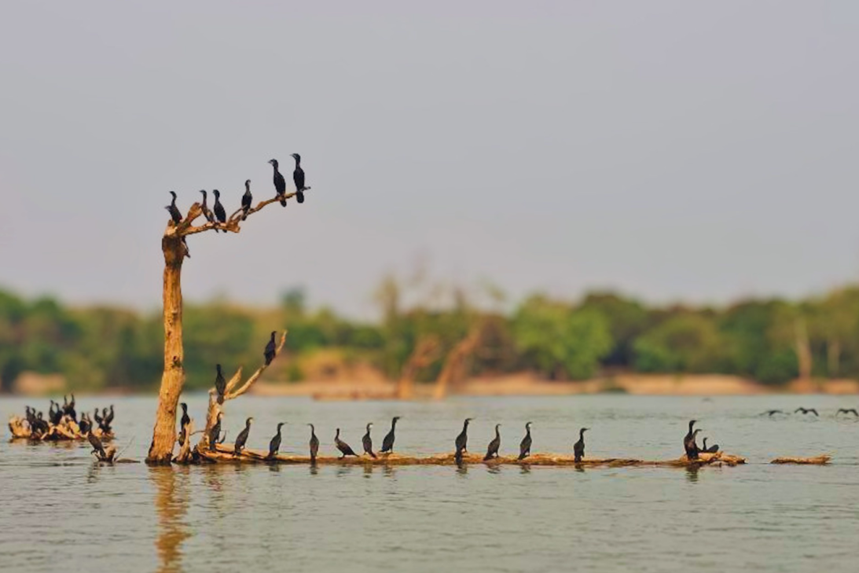
Every year, between the retreat of the low waters and the rise of the monsoon, the sandbars bristling at the confluence of the Mekong, the Sekong, the Sesan and the Srepok rivers become covered with a dense, dark population: cormorants. In early July, a new set of images published by the Stung Treng documentation center, devoted to the seasonal migration of these birds in Borei O'Svay Sen Chey district, served as a reminder of the quiet but vital importance of this Ramsar site for the Mekong's birdlife.
A river crossroads listed under the Ramsar Convention
The Stung Treng Ramsar site lies exactly where the Mekong receives the waters of the Sekong, itself swollen by the Sesan and the Srepok. This confluence shapes a striking landscape of rocky channels, whirlpools, deep pools and flooded forests, broken up by islands and sandbars that only emerge once the water recedes. In terms of surface area, this river system is surpassed in Cambodia only by the Tonle Sap Biosphere Reserve. The site's 2015-2019 management plan records no fewer than 207 fish species, 231 bird species, 42 reptile species and several mammal species, making this stretch of the Mekong one of the richest freshwater ecosystems in mainland Southeast Asia.
The Indian cormorant, a quiet sentinel of the sandbars
Among the regulars here is the Indian cormorant (Phalacrocorax fuscicollis), recognizable by its blue-green eye, small head with a sloping forehead, and long, narrow bill hooked at the tip. Slimmer than the great cormorant and slightly larger than the little cormorant with which it is sometimes confused, it moves in tight groups, diving in succession to fish cooperatively before drying its outstretched wings on a rock or dead branch. Widespread from the Indian subcontinent to Thailand and Cambodia, the species finds particularly favorable fishing and roosting conditions in the sandbars and calm waters of the confluence.
A biodiversity hotspot under watch
Cormorants are not the only ones drawing on this river's abundance. The site is also home to vultures, egrets, the grey-headed fish eagle, the river tern, the green peafowl and the darter, making the sandbars of the Mekong, the Sesan and the Srepok nesting grounds of regional importance. Surveys conducted on the Sesan River, downstream of the Yali Falls hydropower dam, have nonetheless shown how vulnerable these ground-nesting birds are to sudden water releases during the breeding season, which runs from February to May: a sharp change in flow is enough to submerge nests and clutches laid directly on the sand.

The monsoon, a seasonal turning point
The site's character changes dramatically with the seasons. From May and June, the arrival of the monsoon raises water levels, which typically peak between July and September, gradually swallowing the sandbars used by the birds during the dry season. This hydrological shift, which also paces the breeding of dozens of fish species migrating toward the Tonle Sap, explains why cormorant sightings cluster within a precise window of the year, before the flood reshuffles the territory.

Stung Treng, a laboratory for community-based conservation
Faced with the pressure of illegal fishing — the use of explosives, electrofishing, poison and small-mesh nets — provincial authorities and local communities have tightened surveillance of the site in recent years. A seasonal fishing closure was notably introduced in 2019, backed by a program funded by IUCN and the Netherlands, with guard posts set up near the deep pools most exposed to poaching. Borei O'Svay Sen Chey district has also embarked on a community-based ecotourism initiative, the very one behind the documentation center responsible for the latest cormorant images: a way for local residents to turn wildlife observation into both an economic resource and an awareness-raising tool.
Why this site matters
Beyond its ornithological interest, the Stung Treng Ramsar site plays a leading role in the balance of the Mekong basin: a spawning ground for around fifty economically important fish species, a biodiversity reservoir for threatened species, and, through its waterbird populations, an indicator of the river's overall health. Each new set of images, like the one published in early July, helps document, in its own modest way, a natural heritage still little known to the public, at a time when hydropower development and fishing pressure continue to weigh on the entire basin.


Comments