


Cambodge & Thaïlande : Le droit international compte-t-il encore aux frontières contestées ?

From Phnom Penh, where I live and daily observe the border frictions between Cambodia and Thailand, the question arises acutely. The temples of Ta Moan and Ta Krabey, perched on the Dangrek massif, are not just another chapter in a historical dispute tinged with nationalism.
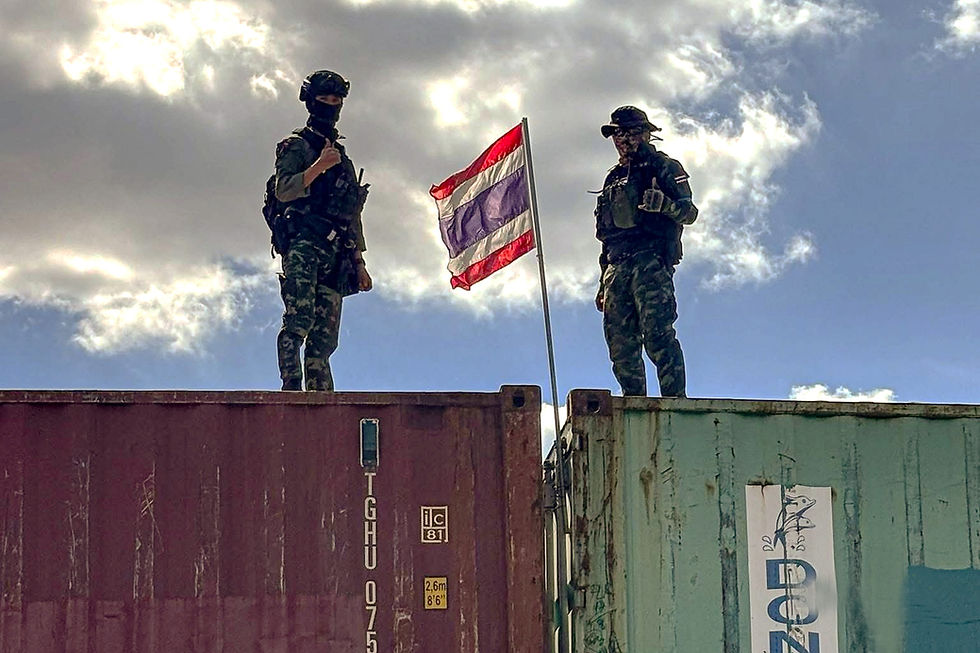
They embody a decisive test: do borders fixed by treaties, confirmed by official maps, and validated by international courts continue to govern relations between states? Or do de facto possession, administrative acts, and political pressures prevail over the law?
The founding treaties and uncontested maps
Let us recall the essential facts. The modern border between Cambodia and Thailand (then Siam) was drawn by the Franco-Siamese treaties of 1904 and 1907. France, protector of Cambodia, and Siam defined there not abstract lines, but a concrete process: joint technical commissions tasked with translating principles into maps and on-the-ground markers. These commissions surveyed the Dangrek massif, produced maps at a 1:200,000 scale – notably the central sheet covering the Ta Moan and Ta Krabey sector –, and transmitted them to both governments between 1907 and 1908.
These documents place the temples on the Cambodian side, north of the Ta Moan pass and the Ta Krabey promontory. For decades, these maps were used, reproduced, and integrated into administrative practices without formal protest from Siam or Thailand. In international law, this prolonged silence is not trivial. It amounts to tacit acceptance, as the International Court of Justice (ICJ) recalled in its landmark Preah Vihear judgment in 1962.
ICJ judgments: stability above all
The Court ruled there that the map annexed to the treaty, though slightly deviating from the "watershed line" mentioned in the text, represented the accepted outcome of the joint process. Thailand, by its inaction, had forfeited the right to contest it.
Thai authorities often invoke the watershed principle (dividing line of waters), chosen for its natural neutrality. An argument valid in theory, but the law does not separate text from implementing acts. When states mandate commissions to apply a treaty, accept the results, and refer to them for a century, stability prevails over retrospective reinterpretation.
The ICJ reaffirmed this in 2013 for Preah Vihear, insisting on the "finality and stability" of borders – universal principles, applied from West Africa (Burkina Faso/Mali case) to Central America (Nicaragua/Honduras). Ta Moan and Ta Krabey fall under the same regime: same Dangrek sector, same treaties, same maps.
Effectivités vs. legal title: a clear hierarchy
Thailand sometimes qualifies these areas as "overlapping claims" or "pending delimitation." False distinction. International law sharply separates technical delimitation (absence of physical markers) from sovereign title. The lack of pillars does not reopen sovereignty; it calls for cooperative implementation. Effectivités – military presence, de facto administration – are subordinate to legal title. The ICJ has hammered this: "Effective possession cannot prevail over a title founded in treaty."
The 2000 memorandum and the limits of ASEAN
In 2000, aware of undelimited segments, Cambodia and Thailand signed a memorandum of understanding for joint surveying based on the historical treaties and maps.
Objective: technical management, avoiding escalation, not reopening rights. Alas, recent incidents – firefights in 2011, tense patrols today – recall the limits. For ASEAN, champion of non-interference and quiet diplomacy, this legal framework is a pillar. But consensus stalls when sovereignty heats up.
Toward adherence or drift?
In Phnom Penh, frustration is palpable: the law is clear, backed by a century of treaties, maps, and judicial rulings. Yet Thai voices, relayed by nationalists, advocate a "revision" in the name of history or ground control. Fatal error. Borders stabilize; perpetually reinterpreting them sows regional chaos.
International law at borders? Yes, it matters – but only if states respect it as a binding commitment, not a malleable tool in the face of popular or strategic pressure. The Ta Moan-Ta Krabey case is living proof: adherence or drift?
For clarity reasons, the original text has been shortened



Comments