


Bruno D'Arcangues, General Director of Artelia Cambodia: 50 Years of Experience in Project Management, Construction, and Engineering

What remains after more than half a century spent building? Bruno D'Arcangues, General Director of Artelia Cambodia, an international engineering and project management firm in Cambodia, looks back on a career where technical skill meets management. From a childhood split between France, Algeria, and Morocco to his projects across Asia, a portrait emerges of a builder as demanding as he is imperfect.

Before even discussing his profession, Bruno D'Arcangues describes himself with a single word: “Basque.” Not engineer. Not executive. By his roots. Basque.
Born in France, he spent part of his childhood in Algeria and then in Morocco, following his father's postings as a naval aviator. “A profession that demands a great deal of courage and determination,” he notes. From a very young age, departures were part of daily life.
For a long time, he in fact imagined following the same path: “At first, I wanted to be an airline pilot.”
Every two years, his father took him to the Paris Air Show at Le Bourget. Every plane that crossed the sky became a ritual: “Every time I saw a plane, I said a little prayer that the flight would go well.”
He attended the Lycée Hoche in Versailles, then the École spéciale des travaux publics (ESTP). Yet construction was not a calling: “I ended up there somewhat by accident.”
Diploma in hand, he spent several months hitchhiking across Scandinavia with the equivalent of one hundred euros in his pocket, and then through Ireland in the midst of civil war. His parents struggled to understand this urge to leave: “My parents had a hard time with me. I was more in rebel mode.”
A few years later, fresh out of school, he crossed the Sahara with his best friend in an old Peugeot 404.
“We set off with a Michelin map. There was no phone, no GPS, no internet. Those were real adventures!”
This taste for adventure took him successively to the Middle East, India, Yemen, Fiji, and Vietnam, before he joined Cambodia, where he now heads Artelia Cambodia.
A subsidiary of a French engineering, project management, and consulting group present in more than forty countries, Artelia supports investors in Cambodia in carrying out complex projects — from the future ODOM Tower to FTB Tower, as well as the AMK head office, Khema International Polyclinic, and the Coca-Cola factory.
50 Years of Construction and Engineering Evolution in Cambodia
What has changed the most in construction over fifty years? Bruno doesn't hesitate: “The thing that has changed the most is time. The time to build. The time to decide. The time to deliver.”
At the start of his career, a single floor of a building took about two weeks to complete. Today, some projects accomplish the same work in eight days. Hand-drawn plans have given way to software. Twenty-storey towers, once considered feats of engineering, have become almost ordinary.
But for Bruno, the real revolution is human.
A project no longer brings together only engineers and contractors. It gathers investors, architects, design offices, administrations, and a multitude of stakeholders whose interests do not always align…
The bigger a project grows, the more essential project management becomes. That is why Bruno champions this discipline with such conviction. From the age of 13 to 30, sailing across the seas, he drew a lesson that still guides his vision of projects today.
“A project is like a boat: everything is prepared before departure. If you leave port without preparation, the first storm hits you head-on. And even with a good boat, the winds keep changing. You have to know how to anticipate to avoid drifting.”
A construction project is thus prepared well before the first stroke of the shovel: setting the budget, establishing a realistic schedule, identifying risks, and planning for the unexpected. Yet in his view, this project management culture remains insufficiently developed in Cambodia.
Will artificial intelligence change the engineering profession? Bruno shakes his head. Tools will evolve. They will work faster and calculate better. But they will never replace… judgment.
At the end of every project, a decision remains to be made. And behind every decision, a responsibility. It is precisely this responsibility that leads us, a few minutes later, to talk about leadership.
Leadership in an Engineering Company: Anticipating to Deliver Successful Projects
“I am first and foremost a manager.” For him, leadership cannot be learned. We point out that many today consider it a skill that can be developed. He smiles. But does not change his mind.
“Leadership starts with anticipation. You have to see things coming before others do.” Charisma, he continues, does not necessarily mean being liked. “I'm not here to be loved. I'm here to run a company.”
A few minutes later, however, he qualifies this statement. Managing does not mean applying the same method to everyone. “You don't manage Melissa the same way you manage Baptiste.”
He then recounts an episode that left its mark on him. A few years after taking the helm of Artelia Cambodia, an internal survey reflected back an unexpected image: too directive.
Rather than ignore this criticism, he decided to use it. He learned to delegate more. To allow more autonomy. To accept that others do not work exactly as he does.
“If you don't delegate, you can't do everything yourself. And delegating means training people.”
Raffy, an energy project coordinator at Artelia Cambodia, describes a passionate manager who is happy to share his experience. “He can sometimes be direct, but it's always with the intention of helping us grow. The development of young engineers matters a great deal to him. Bruno inspires me through his passion.”
Why Infrastructure and Construction Projects Have a Lasting Impact
Which construction project has marked him most in over fifty years of career? Bruno hesitates. “All the projects have marked me.” We press him. He smiles. He refuses to choose. Then finally gives in. “Perhaps the SAMU social in Paris.”
In the late 1990s, the head office of Pompes funèbres générales was converted into a shelter for homeless people. The building had to be delivered on time for its inauguration: “We worked like dogs with my teams, day and night.”
In recognition of the work accomplished, a room at the SAMU social now bears Bruno D'Arcangues' name.
Bruno explains: “A hospital heals. A school educates. Infrastructure connects. A shelter welcomes.”
He then sums up his view of the profession in one sentence: “Construction is one of the rare professions where what you do today will still be here in fifty or a hundred years.”
The Future of Artelia Cambodia and Cambodia's Construction Sector
What remains after more than half a century of building?
“The legacy I would like to leave is a company of about a hundred people, with a genuine spirit of what I stand for: we have duties. Duties to deliver quality, to be there when clients need us, duties of advice. If people are at Artelia Cambodia because they love the technical side, because they love people, because they love building — more than because they love money — then it will have been a success.”
In five years? He speaks of Artelia Cambodia. Of a more mature, more solid company, carried forward by more Cambodian talent.
But also of a company able to put the group's international expertise at the service of Cambodia. Transport infrastructure, railway lines, hydropower, renewable energy, and major urban projects are, in his view, all areas where Artelia could support the country's next stages of development.
“Cambodia keeps building itself. We still have a great deal to contribute.”
And in ten years? This time, he hesitates. He does not necessarily picture himself still at the helm. What he wishes is that Artelia continues to move forward without him. That a way of working outlives him.
Having worked all over the world, why be in Cambodia? Bruno speaks of a country that keeps building itself. Of a market where much remains to be structured.
The conversation then shifts to more personal ground. Does this desire to pass things on also exist within his family? Bruno smiles mischievously again. He speaks of his children:
“They're quite like me… rebels, like me.”
We remind him that he once told us he does not share the same worldview as them. He agrees. It doesn't seem to matter much. What he wants to pass on is not a way of thinking. It is values.
“The first value I instilled in them is to always be true to themselves and to others.”
He then adds a sentence that, over the course of these three hours, seems to sum up both his life as a father and as an executive. “You do what you say.”
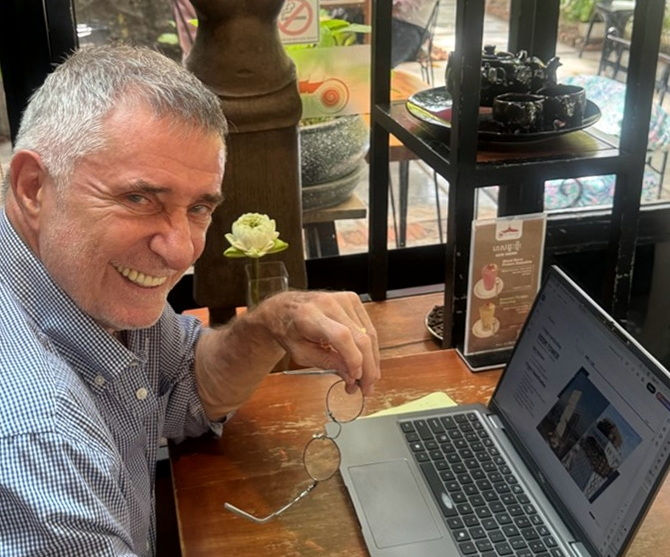
Finally, over the course of our conversation, Bruno D'Arcangues spoke to us of buildings, of project management, of his family, of his mistakes, of that survey that reflected back the image of an overly directive leader. Of a temperament that is sometimes too strong-willed. And of his determination, at 73, to keep evolving.
He smiles one last time.
“I'm trying to be kinder, I'm trying to be calmer, to be more polite.”
For more than fifty years, Bruno D'Arcangues has built buildings. He acknowledges having sometimes been harsh. Having learned. Changed. Passed things on.
Perhaps that is what makes him profoundly human. Not that he is a man without flaws. But a man who has never stopped building himself.


Comments