


Bernard and the wedding next door: in Cambodia, the noise is always someone else’s

Bernard has lived in Cambodia for eight years. When a wedding tent goes up under his window, he knows he is in for it and drafts his complaint at once. He doesn’t yet know who it will end up serving.
Friday night: a white tent in the alley
Friday, 5 pm. Walking home from the bar down his alley in Toul Tom Poung, Bernard comes across men stretching a big white canvas from one pavement to the other. The plastic Greek-temple columns are already up, and so are the satin-dressed chairs. A truck unloads two speakers the size of American fridges.
Bernard knows the drill. In eight years in Cambodia, he has seen dozens of these tents.
“Three days,” he tells the building guard. “Three days of karaoke at five in the morning.”
The guard smiles. He always smiles. Bernard takes it as solidarity.
Saturday, 4:58 am: the message to the landlord
Saturday, 4:58 am, the first note drops: a traditional song at stadium-concert volume, followed by the master of ceremonies testing his mic. “Muoy, pi, bei. Muoy, pi, bei.”
Bernard grabs his phone and writes to his landlord:
“Good morning Mr Dara. It is 5 am. I pay rent to sleep, not to attend a concert. Please do what is necessary. Very kind regards, Bernard.”
He is rather proud of the “very kind regards,” which is irony. He hits send. At 5:03, Mr Dara replies with a thumbs-up, and nothing else.
Noon: Bernard dresses for the wedding
At 7 am, on his way down for a coffee, Bernard waves away an auntie in a sampot who is beckoning him into the tent. He has principles.
At 11:30, the smell of beef lok lak and grilled chicken drifts up to the second floor. The principles last ten minutes.
One problem remains: you don’t go to a wedding in shorts. His white shirt, the one he arrived with in 2018, buttons up to the third button, after which the belly wins. Bernard rushes to Orussey Market on a moto-dop. The stallholder glances at his belly, works her way up the sizes to 3XL and finally calls her sister, who comes back from the far end of the aisle with a linen shirt in “American size.” It closes, as long as he doesn’t breathe too hard.
Shoe sizes at the market stop at 43, and Bernard is a 45. He leaves with brown loafers in a 44. “They will stretch,” the seller promises. They will not.
The Cambodian wedding buffet
By 1:10 pm, sunglasses pushed up on his head for elegance, he is seated at a round table between a cousin of the groom and an uncle pouring him his third Angkor. He doesn’t know the couple and nobody asks. When someone hands him an envelope, he understands he is meant to give and slips in 10 dollars. After a look at the buffet, he adds another 10, out of honesty. He fully intends to get his money’s worth.
“Chol muoy!” shouts the uncle, glass raised. Bernard answers “Chol muoy!” in a thick Auvergne accent, the table applauds, and he is now convinced he speaks Khmer.
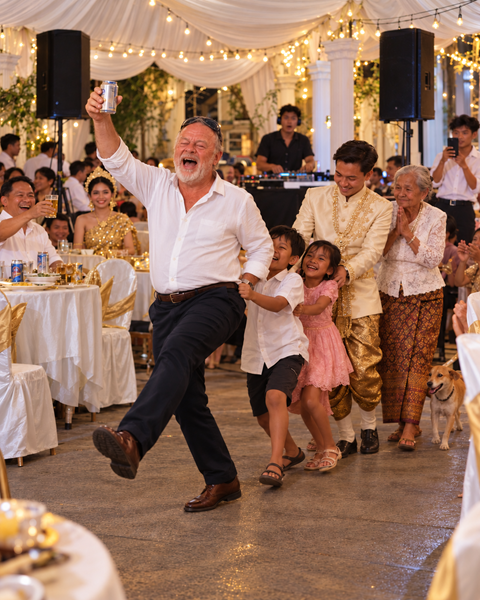
At 4 pm, he dances the romvong, a slow dance where you move in a circle while your hands trace flowers in the air. Bernard moves in a circle. What his hands are tracing, nobody knows. A little girl copies him, crying with laughter, and he thinks she admires him.
9 pm: the conga line hits Cambodia
At 9 pm, eleven Angkors in, Bernard has an idea.
He hands his phone to the DJ. On the screen is “La Chenille” by La Bande à Basile, the song that has closed every French office party and village fête since the 1980s. The DJ studies Bernard for a long moment before plugging it in.
Bernard grabs the mic. “Ladies and gentlemen, French culture!” Since nobody understands, he explains in English: hands on the shoulders of the person in front, walk in a line, kick your legs. In France it’s called la queue leu leu. The groom’s nephew translates, roughly. In his version, it is a fire evacuation drill.
A hesitant line forms. The young guests think it’s a game; a grandmother, sure it is a procession, presses her palms together. Two children hang on to Bernard’s new shirt and the groom follows, out of politeness. The bride, now on her fourth outfit change, declines with a flawless smile.
The conga line zigzags round the tables, brushes past the head table and goes by the buffet, where two cousins seize the chance to break off and help themselves to seconds. The waiters step aside with their trays without a word. They have seen worse.
By the second lap, only Bernard and the two children are left. By the third, only Bernard. The DJ switched back to Khmer music long ago. Bernard finishes alone in the middle of the tent, one leg in the air and his left loafer on fire, singing “à la queue leu leu” over a Sinn Sisamouth ballad. The uncle pours him another beer, out of pity or admiration, we will never know.
Sunday night: Bernard keeps the party going
Sunday night, the tent comes down and silence returns to the alley.
Except at Bernard’s, who has discovered something. Window wide open, he plugs his Bluetooth speaker into the playlist he has just made, “Cambodian Wedding”: La Chenille, the Birdie Song, Joe Dassin, and Patrick Sébastien on repeat. At 1 am, he tries to teach the conga to the guard. The guard smiles. He always smiles.
Monday, he does it again. Tuesday, he adds Michel Sardou.
Wednesday: the neighbours’ complaint
Wednesday, 8 am, a knock at the door. On the landing stand Mr Dara, the guard, the translating nephew and the grandmother from the procession, holding a sheet signed by twelve neighbours.
Mr Dara doesn’t read the sheet. He takes out his phone and reads a message.
“Good morning Mr Bernard. It is 1 am. People pay rent to sleep, not to attend a concert. Please do what is necessary. Very kind regards.”
Bernard recognises the punctuation, and even the “very kind regards.” Mr Dara has only changed the time.
The grandmother adds a few words, which the nephew translates: “She says the wedding was three days. You, it’s been four nights.”
Bernard now listens to La Chenille on headphones and does the conga alone in his living room, in his socks. The guard, for his part, still smiles.


Comments