


Anida Yoeu Ali: how an artist of the Cambodian diaspora turned exile, Islam and Khmer identity into creature, colour and performance

Born in Battambang, exiled as a child, she returned as an adult to inhabit memory — Anida Yoeu Ali transforms displacement into creature, performance, colour. A portrait of one of the most visible artists of the Cambodian diaspora today.
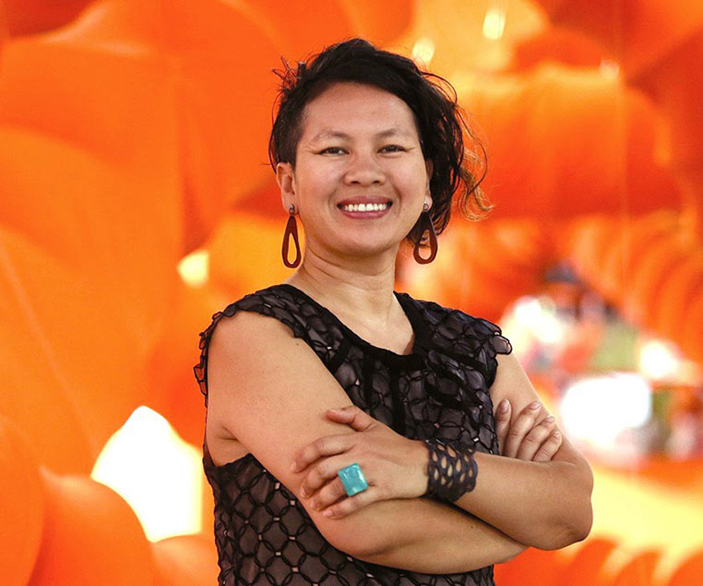
Anida Yoeu Ali was born in Battambang in 1974. She was five when her family fled the country after the Vietnamese invasion, passing through a refugee camp in Thailand and then Malaysia, before settling in Chicago. That's where she grew up, a first-generation American in a Muslim Khmer family, straddling Cham, Malay, Thai and Khmer heritage.
She didn't return to Cambodia until 2011, living in Phnom Penh for five years — deliberately, the same number of years she had spent in the country before the family's exile. That return produced her best-known work, The Buddhist Bug: a saffron-coloured, serpentine creature — part caterpillar, part monk's robe, part hijab — that Ali inhabits and photographs in motion, through classrooms, cinemas, rice fields, and Cambodian streets. The Bug has no fixed gender and no single religious identity; it is built to never settle into one thing. The series, made between 2009 and 2015, won her the Sovereign Asian Art Prize in 2015 and became one of the most internationally exhibited works of the Cambodian diaspora of the decade.
The Red Chador, or public space as stage
Her second major work, The Red Chador, pushes the confrontation further, and more literally into public space. Dressed in a sequined red chador, Ali walks in silence — sometimes for hours — through streets, beaches and transit stations around the world: a shimmering, impossible-to-ignore figure that forces every passer-by to confront their own reaction to a visibly Muslim woman.
In 2017, the original garment disappeared from her luggage after she was searched and detained by immigration officials on a trip between Ramallah and Tel Aviv. Rather than treat the loss as a mere incident, Ali staged a funeral ceremony for the missing work — a way of commenting on the disappearances and hostility Muslims face at borders. Two years later, during a residency at the Shangri La Museum in Honolulu, she "rebirthed" the work — not as a single chador, but as a sisterhood of seven, in rainbow colours, walking together.
Displacement as material, joy as method
What links both works is Ali's refusal to reduce displacement to tragedy alone. She claims humour, absurdity and joy as working tools — not despite the weight of refugee history and Islamophobia, but precisely because of it. "We need humour," she says. "We need joy and the ability to laugh at ourselves."
This aesthetic of spectacle hasn't won everyone over: some observers see a risk in it — that of turning subjects as grave as Islamophobia or forced exile into images that are primarily seductive, blunting the critical charge they carry.

Today, Ali splits her life between Washington State — she lives in Tacoma and holds a senior artist-in-residence post at the University of Washington Bothell — and a practice that regularly brings her back to Southeast Asia. Her work has been shown at the Palais de Tokyo, Haus der Kunst, the Smithsonian, and in a major retrospective at the Seattle Asian Art Museum in 2024. She co-founded Studio Revolt, an artist-run media lab, with her longtime collaborator Masahiro Sugano. She is currently working on The 99, the final chapter of the Red Chador series: a haute couture collection of 99 unique chadors, made from fabrics sourced in markets across Cambodia, Thailand, Indonesia, Malaysia and Vietnam.
For a publication rooted in Cambodian culture and told in both French and English, Anida Yoeu Ali is a natural subject: her entire body of work is about the impossibility of choosing a single language, religion, or country — and about making that impossibility visible, audible, and strangely joyful.
More on the artist: www.anidaali.com


Comments