


Tatai Bridge: Life Suspended Between Jungle and Mangrove

In the Cardamom Mountains, in Koh Kong province, a concrete bridge spans the Tatai River. Below it, motorized longtail boats, roadside vendors, and traveling musicians keep alive a riverine way of life that the road, and later the sand dredgers, nearly swept away.

Seen from the bridge deck, the landscape looks like a postcard: tea-colored water bordered by hills covered in dense forest that reaches right down to the water's edge, and, moored beneath the concrete piers, a whole flotilla of long boats painted green, red, and turquoise, capped with dark tarps against the sun. This is Tatai Bridge, in Phum Daung village, about twenty kilometers from Koh Kong town, in southwestern Cambodia. Here, National Road 48 crosses the river of the same name, at the edge of the Cardamom Mountains — one of the last great stretches of intact tropical forest left in Southeast Asia.
A River Born of the Cardamoms
The Tatai rises in the highlands of the Cardamom Mountains, a mountain range running along the Thai border that encloses one of the country's richest ecosystems: Asian elephants, clouded leopards, gibbons, and a considerable variety of birdlife find refuge there. The river winds through the jungle for some thirty kilometers before reaching the Gulf of Thailand, at times calm and twenty meters deep, at times rushing over cascades where the rocky riverbed suddenly drops away — this is where, upstream of the bridge, the Tatai waterfalls are found, reachable by longtail boat.
In 2016, part of this territory was designated the Tatai Wildlife Sanctuary, a protected area of more than 144,000 hectares placed under the authority of the Ministry of Environment — belated recognition of the ecological value of a mountain range still largely threatened by poaching, land grabbing, and illegal logging.
A Bridge, a Road, an Opening Up
For a long time, Koh Kong province remained one of the most isolated regions of Cambodia, wedged between the sea and an impenetrable mountain range, accessible only by boat or by long laterite tracks. The construction of National Road 48, which today links Sihanoukville to the border town of Koh Kong, changed all that: three major rivers cross this single drivable road, and each one has its own bridge, around which a small settlement has grown up. Tatai, the closest of these towns to Koh Kong, owes its very existence to this crossing — a waypoint village, built quite literally around and beneath its bridge.

This road has made Tatai an obligatory rest stop for truckers and buses traveling between Phnom Penh and the Thai border, as well as the tourist gateway to the Cardamom Mountains.
Life Beneath the Bridge
It is here, in the shade of the bridge deck, that the true heart of the village beats. Boat pilots, teenagers in flip-flops and bush hats, wait for tourists, laughing between two runs to the waterfalls or the lodges upriver.

Roadside vendors set up their makeshift tables: chicken skewers grilled over charcoal, boiled duck eggs stacked in a pyramid, candied fruit in plastic tubs, all within easy reach of drivers who stop just long enough for a meal.

A little farther on, beneath one of the bridge's pillars, traveling musicians — players of the tro, the traditional two-stringed Khmer fiddle, and percussion — settle onto a woven mat, surrounded by a circle of villagers who have come to listen, in a scene that could belong as much to a century ago as to today.

Further up the bank, an elderly woman is busy preparing dried fish wrapped in banana leaves, a gesture repeated so many times that her hands seem to work without her needing to look. It is these details, more than the bridge itself, that make Tatai a living place: an entire economy — fishing, roadside food, river transport, small crafts — organized around a simple crossing point.

A River Under Threat
This apparent tranquility masks a more troubled history. Between 2008 and 2012, the Tatai became, against its will, the symbol of one of Cambodia's most well-documented environmental conflicts: the industrial dredging of its sand, extracted by the tens of thousands of tons for export to Singapore, where it was used for land reclamation. According to a report by the NGO Global Witness, the operation reportedly earned several million dollars a year for the concession-holding company, while destroying the fish and crab habitats that hundreds of riverside families depended on. Fishermen from the Tatai ecotourism community reported a roughly 85 percent drop in their catch.
After years of petitions, international news coverage, and a personal intervention by Prime Minister Hun Sen, dredging on this stretch of the river was eventually suspended. The episode remains, for residents and environmental advocates alike, a reminder of how fragile the balance between development and preservation can be.
This fight does not belong only to the past. In January 2026, the Ministry of Environment suspended a new sand-extraction project in Koh Kong province — not on the Tatai itself, but on the neighboring Prek Kampong Som stream, in Sre Ambel district, near the Royal Turtle Sanctuary. Authorities ordered a halt to the operations, which had begun in November 2025, pending a full environmental impact assessment. While the ministry said an inspection found no evidence of confirmed damage, groups such as the Cambodian Youth Network Association welcomed the precautionary suspension, noting that sand extraction can weaken riverbanks, degrade water quality, and threaten the reproduction of the royal turtle, an endangered reptile of which only a few hundred mature individuals are believed to survive in the wild. The episode, unfolding just a few dozen kilometers from Tatai, shows that vigilance over the sand of Koh Kong's rivers remains, fifteen years after the first crisis, very much alive.
An Ecotourism Still Taking Shape
The river has since reclaimed part of its original role: that of a natural corridor between jungle and mangrove, now supporting a still-modest but organized community tourism scene. The green sign for the "Tatai Tourism Community," planted along the national road between a coconut palm and hand-painted boards advertising bungalows, kayaking, and hiking, sums up the ambition: channel visitors toward local operators rather than large outside businesses.

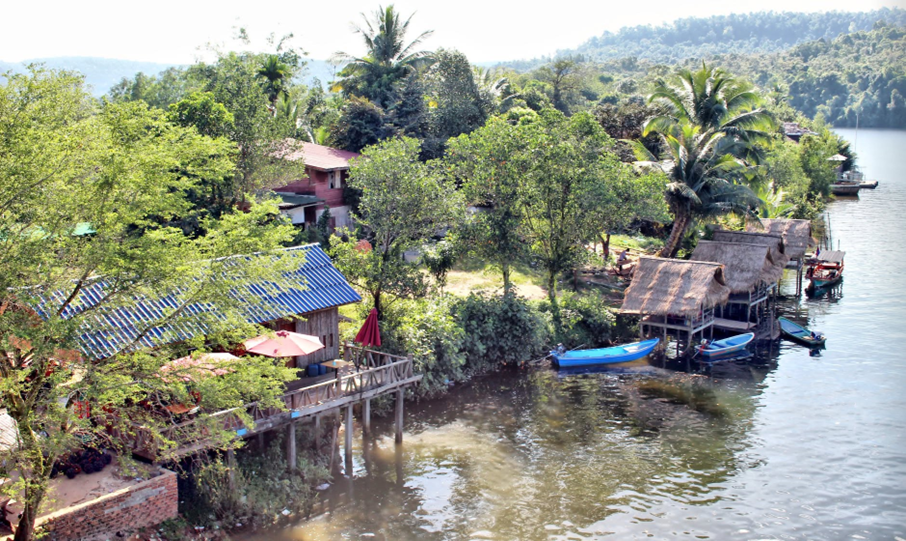
A handful of riverside lodges, built on stilts in traditional Khmer style — thatched roofs, wooden decks suspended above the brown water — offer overnight stays, kayak outings, and nighttime excursions in search of the fireflies that light up the mangrove after dark.
Upstream and downstream of the bridge, one can still spot these stilt houses where entire families live by the rhythm of the river, longtail boats tied to the dock, laundry drying beneath the thatched eaves — the ordinary, continuing river life that the road and tourism have not, for now, encroached upon too much.
How to Visit Tatai
The village of Tatai (Phum Daung) sits on National Road 48, about twenty kilometers east of Koh Kong town, on the route of buses connecting Phnom Penh or Sihanoukville to the Thai border. Most visitors stop here to catch a boat to the Tatai waterfalls, an hour upriver by longtail boat, or to reach one of the eco-lodges scattered along the river. There is no bank or ATM on site, so it's best to bring cash. Boat pilots, organized into a local community, offer their services directly at the foot of the bridge — a simple way to put money straight into the village economy rather than into tours booked from Koh Kong or Sihanoukville.


Comments