


Koh Samseb, the Secret Archipelago Where the Mekong Runs Wild Again

At the heart of the Sambo Wildlife Sanctuary in Kratie province, an archipelago of sand and flooded forest is attempting an unusual bet: turning tourism into a tool for conservation rather than a threat to biodiversity. A portrait of a Mekong that still looks like what it must have been before the dams.
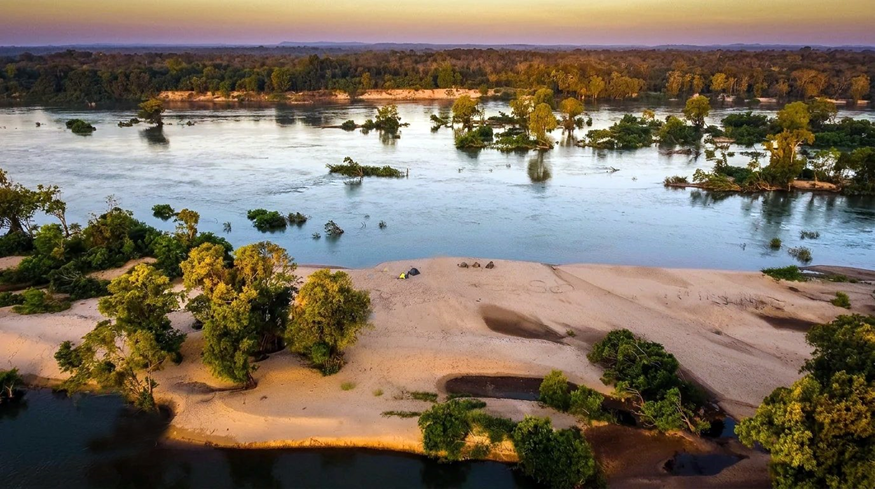
Its name literally means "thirty islands," but Koh Samseb actually has hundreds — a dense archipelago of sandbars, wooded islets, and flooded forest, scattered across one of the widest and wildest stretches of the Cambodian Mekong. Here, between Kratie and Stung Treng, the river hasn't yet been tamed: it spreads out, splits apart, redraws its banks with every season, and the forest that follows it floods and recedes with the rhythm of the flood pulse. This is a long way from the tidy rice paddies of central Cambodia — Koh Samseb looks like what the Mekong must have looked like before people began to channel it.
A Sanctuary Before It's a Destination
The archipelago sits entirely inside the Sambo Wildlife Sanctuary, a protected area of more than 50,000 hectares established by the Cambodian government in 2018 along the upper Mekong. It's one of the country's last refuges for endangered bird species — more than 200 species have been recorded here, including several rare raptors and wading birds — as well as for fish that retreat into the river's deep pools during the dry season.

It's in this context that the local community, with support from the regional NTFP-EP program (Non-Timber Forest Products – Exchange Programme) and the Provincial Department of Tourism, set up a community-based ecotourism project in 2018: Koh Samseb Community-Based Ecotourism. The idea is simple but rare in Cambodia: make biodiversity protection and local income move in the same direction instead of working against each other.
Three Villages, an Economy Built on the River
The community behind the project brings together three villages settled on the archipelago — Khsach Leav, Koh Khnaer, and Pun Chhean, in O'Krieng commune — largely populated by Bunong and Kuy families, two indigenous minorities from northeastern Cambodia. Daily life here still runs on the river: fishing, small-scale farming on the sandbars exposed during the dry season, river transport. It's a fragile way of life, dependent on the Mekong's natural cycles, and increasingly strained by economic pressure and a lack of infrastructure — the nearest high school is more than forty kilometers away, with no public transport, pushing some teenagers to drop out of school to work on tourist boats or in the fields instead.

It's precisely this tension that ecotourism is trying to ease. By training young villagers as guides, boatmen, or cooks for visiting travelers, the project aims to turn a subsistence activity into sustainable supplementary income, without repeating the extractive model that has often accompanied tourism elsewhere in the country.
Camping in the Middle of the River
Koh Samseb isn't a half-day visit. What the community offers is closer to a light expedition than an excursion: two or three days, sleeping in tents on one of the islands or staying with a family in one of the three villages. Days are built around swimming in the river's calm waters, boat trips to watch birds at dawn, short hikes of a few kilometers through dry deciduous forest in search of woodpeckers, raptors, and adjutant storks, and evenings by the campfire where locals tell local stories, translated as best they can by the guides.

Comfort stays deliberately basic — simple camping gear, no continuous electricity, an unfiltered immersion into the river's rhythm. That's exactly what draws the rare travelers who make the trip: not a photogenic, sanitized Mekong, but one that's still a little wild, where you sleep under the stars in the middle of the current.
A Still-Fragile Model, a Long-Term Bet
A five-year master plan, developed by the Kratie Department of Tourism in collaboration with NTFP-EP, now aims to better structure visitor reception across the archipelago without stripping it of its character. The stakes are real: elsewhere on the Mekong, similar projects — like Koh Prumacharey further south, supported by WWF — show it's possible to combine camping, community income, and light infrastructure like solar electricity without spoiling the site.
But nothing is guaranteed. Koh Samseb remains a little-known destination, off the main circuits, dependent on a visitor flow still too small to meaningfully change life in the three villages. That may be exactly what makes it a more interesting subject than an already "successful" destination: a bet still being placed, somewhere between conservation, tourism, and the economic survival of a minority that tourist-oriented Cambodia has almost never looked at.

Practical note: Koh Samseb can be reached from Kratie (about 95 km along National Road 7) or from Stung Treng (about 65 km), followed by a boat crossing to the archipelago. Visits are organized exclusively through the local community, either camping or staying with a family, ideally over two to three days. The dry season, from December to April, offers the best conditions for birdwatching and access to the sandbars; the rainy season transforms the landscape into a maze of flooded forest, less accessible but just as spectacular by pirogue.


Comments