


From Assembly Line to Economic Autonomy: Cambodia's #MadeInCambodia Strategy

The Cambodian Ministry of Commerce has launched a national #MadeInCambodia campaign, mobilizing over 300 supermarkets and convenience stores in a year-long effort to prioritize domestic products.

By securing high-traffic shelf spaces and dedicated display areas for local goods, the government aims to rebalance market dynamics in favor of national manufacturers and promote "Made in Cambodia" products on broader markets. The initiative goes far beyond a simple economic campaign—it is a national strategy driven by a confluence of internal and external forces.
External Catalysts: Border Conflict and Tariff Pressures
The outbreak of the Cambodia-Thailand border conflict in July 2025 marked a turning point. With Thailand's unilateral closure of border posts, the flow of Thai products—which held a dominant position in the Cambodian market—was abruptly halted, revealing the economy's vulnerability due to heavy reliance on imports from its neighbor. Yet, every crisis also offers an opportunity. Border tensions ignited a resurgence of nationalism. Boycotts of Thai products and support for local brands quickly turned into a popular movement, injecting strong public momentum into "Made in Cambodia." Meanwhile, the sudden halt in Thai supplies created a significant market gap for local products. The government responded swiftly, urging national producers to ramp up output to fill this void.
Hun Sen stated that Thailand's border closure had accelerated the growth of Cambodian products and would ultimately benefit the country's long-term economic development. Pressure also comes from the United States. As Cambodia's primary export market, the U.S. imports garments, footwear, and travel goods—the backbone of the country's industrial base. While a 19% tariff has only a limited short-term impact on domestic consumption, analysts, including the Asian Development Bank, warn of a potential long-term drag. More troubling than the tariff itself is the unpredictability of U.S. trade policy: shifting rates, uncertain timelines, and strategic ambiguity continue to fuel investor uncertainty. In response, Phnom Penh is acting decisively. Expanding national production, boosting local consumption, and reducing dependence on a single external market are no longer optional—they are essential for building economic resilience. What began as reactive damage control is now evolving into a proactive industrial strategy.
Internal Imperative: From Assembly Chains to Autonomous Economy
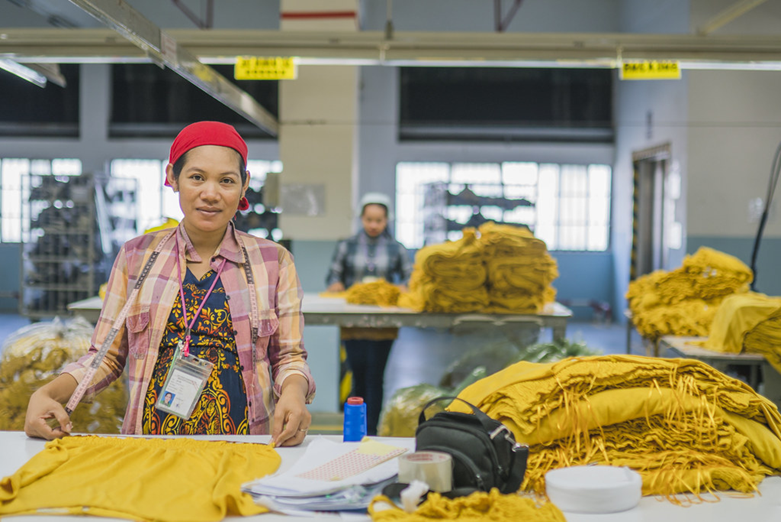
Cambodia's growth trajectory remains undeniable. In October 2025, the country had over 2.06 million registered factory workers, including more than 1.11 million in garments, footwear, and travel goods. This vast labor pool provides a foundation for industrial continuity. Yet, cracks are appearing. In 2024, industrial investments rose 10%, while industrial production fell 7%, according to the Ministry of Industry, Science, Technology, and Innovation.
This disparity signals deeper structural inefficiencies: capital is flowing in, but productivity and value creation are lagging. To achieve its ambitious goals of becoming an upper-middle-income country by 2030 and a high-income nation by 2050, Cambodia must act now to strengthen its industrial base. Cambodia faces a harsh reality: factories are filled with local workers performing basic tasks, while managerial expertise and advanced technical skills remain largely foreign. This "local labor, foreign management" model traps the country in assembly-dependent production. Technology does not take root locally, talent does not accumulate, and value chains remain superficial. Without national technical depth, "Made in Cambodia" risks staying at the bottom of the global manufacturing ladder.
The gap between "Khmer hands" and "Khmer minds" exposes Cambodia's position in the global value chain: a world's workshop confined to low-end assembly. This is not fate—it is a tipping point. Moving from hands to minds requires a three-pronged advance.
Business Environment: Rule of Law and Smart Governance
To reconnect Khmer hands with Khmer minds, fertile ground is essential—a transparent and stable legal framework paired with a business-friendly environment. Cambodia's 2021 Investment Law is a prime example, explicitly linking tax incentives to national strategic goals. Under this framework, industries and investment activities designated as Qualified Investment Projects (QIP)—including agriculture, agro-processing for domestic and export markets, and emerging high-value-added manufacturing sectors—can benefit from tax deductions of up to 150% on eligible expenditures, provided the projects are recognized by the government for their socio-economic development potential. This institutional design underscores Cambodia's commitment to using legal transparency as a catalyst for industrial transformation. Building on this foundation, Cambodia must ensure policy predictability—maintaining a consistent legal framework insulated from administrative fluctuations. It must also accelerate the development of implementing regulations that translate the Investment Law's general principles into operational rules, while pushing administrative reform beyond a one-stop shop toward a fully integrated one-stop service model.
Currently, the Council for the Development of Cambodia (CDC) serves as the central one-stop shop, processing investment applications in a unified manner. By law, projects not on the negative list must receive a registration certificate within 20 working days. The next step is to advance the "digital government" agenda—integrating the CDC's investment management system with tax, labor, and environmental platforms to create a unified business database and electronic certificate registry, enabling true "one-stop online government services."
Cambodia should also leverage established mechanisms, such as the Cambodia-China Public-Private Sector Dialogue (PPSD), to institutionalize regular policy communication between the government and foreign business communities. These periodic dialogue platforms help resolve operational bottlenecks, improve public-private engagement efficiency, and strengthen policy continuity and transparency—creating a more stable and predictable institutional environment for investors.
Industrial Modernization: The Path to High-Value, Diversified Growth
Bridging the gap between Khmer hands and Khmer minds requires climbing the value chain. Vice-Prime Minister Sun Chanthol emphasizes that Cambodia must move beyond its dependence on garments and textiles. Industrialization depends on diversification—of products, production bases, and export markets—driven by technical skills and high-value-added manufacturing. The automotive sector illustrates the challenge. Cambodia aims to position itself as a regional and global hub for automotive and electronic components, starting with simple parts and building a high-value qualified supplier ecosystem.
Global automakers, including Ford, Hyundai, Isuzu, Toyota, and BYD, have already established assembly plants in the country. Yet, leaping from assembly to large-scale manufacturing, and from imported kits to localized supply chains, remains daunting. While these international brands bring advanced production processes and management practices, true industrial modernization depends on localizing these technological advances: Can Cambodian engineers participate more in process optimization? Can local firms integrate into global supply chains? The answers will determine whether Cambodia can surpass low-cost assembly and emerge as a high-value contributor.
Skills Development: Building a Talent Base to Drive Transformation
Vice-Prime Minister and Minister of Economy and Finance Aun Pornmoniroth highlights the challenge: "For Cambodia, transitioning from labor-intensive industries to skills-driven industries is crucial." The question is whether the nation can trade scale for quality and redefine its competitive advantage. Skills training emerges as a key lever to break this cycle. Guided by a national strategy, momentum is building.
In 2023, Prime Minister Hun Manet officially launched Cambodia's first National Master Plan for Development—the "Pentagonal Strategy"—at his first Cabinet meeting. He identified technical skills training as a vital component, placing "improving workforce knowledge and skills" at the heart of the first-phase development plan to strengthen the nation's socio-economic foundations.
Under this strategy, a multi-stakeholder skills vocational training platform is taking shape. The Cambodia TVET Base, developed jointly by the government, research institutions, and businesses, has entered the implementation phase. The institute aligns with the key industries of the "Made in Cambodia" initiative, adopting an integrated model combining basic employability language training, professional skills development, and workforce placement. The program aims to build a robust talent pipeline to support "Made in Cambodia's" transition from a limited-capacity industry to one with solid foundations and market confidence.
Conclusion: From Assembly to Leadership
From assembly to full manufacturing, from following to leading, Cambodia has a long way to go. Border tensions will eventually ease, and tariff uncertainties will not persist indefinitely. Whether this moment is fleeting or Cambodia embraces true long-termism—the fate of "Made in Cambodia" rests entirely in the nation's hands.
By Song Shujun - Director of Khmer Times Chinese News Center

Comments