


Cambodia-Thailand Border Tensions: From Ceasefire to Standoff

Updated: Feb 26
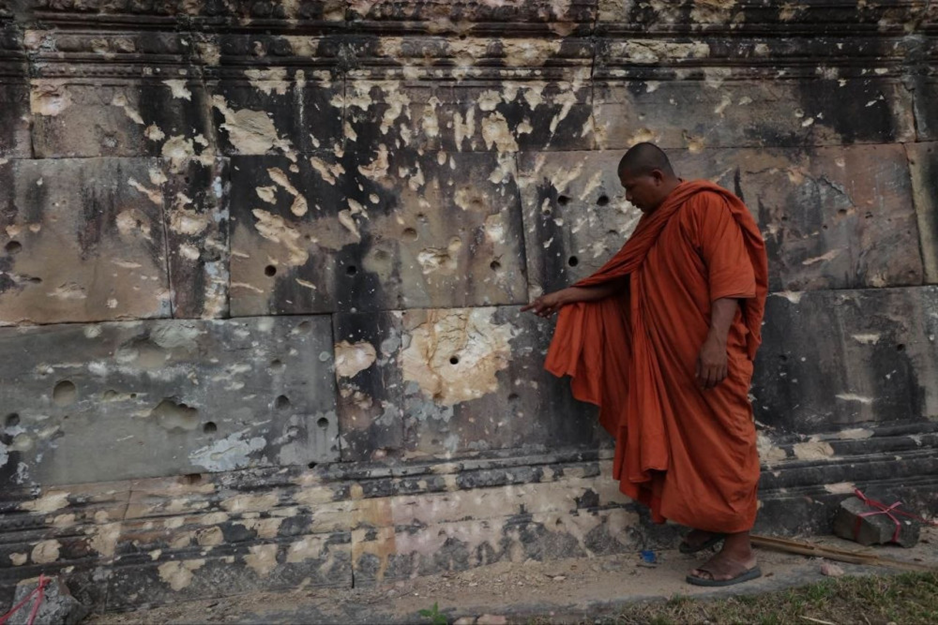
Since mid-February 2026, the Cambodia-Thailand border has been the scene of a simmering tension, crystallized on February 15 by the erection of Thai barbed wire and containers near Preah Vihear, blocking Cambodian farmers' access to their lands.

Phnom Penh denounces a "deliberate provocation," invoking the 1904 Franco-Siamese Treaty and ICJ rulings. Bangkok retorts with accusations of mutual violations, maintaining a military status quo.
Detailed Timeline: From Ceasefire to Escalation
The February 3 Regional Border Committee (RBC) meeting at Cham Yeam-Hat Lek, under ASEAN auspices, had sketched a de-escalation: document exchanges between Generals Mom Samedy and Kittiphon Kunsiripanyo, echoing the GBC declaration of December 27, 2025.
On February 4, Hun Manet activates "multiple diplomatic mechanisms," including complaints to ASEAN and internal consultations. But on February 15, the Preah Vihear incident reignites the embers of the 2025 crisis—December clashes (five dead, thousands displaced). On February 24, Cambodia proposes joint surveys and denies grenade fire alleged by Bangkok.
From February 1, Phnom Penh highlights recurrent Thai incursions: drone overflights, intrusive patrols, pasture blockages in Oddar Meanchey and Preah Vihear provinces. Cambodia cites a choked border trade—Doung, O’Smach, and Choam Sangke posts semi-closed—with estimated losses in the millions of dollars for Cambodian rice, livestock, and agricultural exports. The Cambodian government recalls the French cartographic heritage, key to potential arbitration, citing the 1907 maps held at the Paris National Archives.
Recent Observation Mission Results
Observation missions, intensified since February 20, confirm a relative but precarious calm. A team of 12 observers (5 Cambodians, 5 Thais, 2 Indonesians) deployed to Preah Vihear and Ta Moan from February 22 to 24 reports no major armed incidents, but notes "limited troop movements" on both sides and an accumulation of 2 km of Thai barbed wire along the ridgeline.
The February 24 report highlights that Cambodian civilians are still barred from 150 hectares of rice fields, while Bangkok denounces "Khmer patrols too close" (500 m).
These observations, transmitted to the ASEAN secretariat in Jakarta, recommend freezing fortifications and resuming joint surveys under neutral supervision.
The Phnom Penh Post quotes an Indonesian observer: "The situation is stable, but a minor incident could degenerate in 24 hours."
A Persistent Colonial Dispute
This 816 km border conflict traces its roots to the French protectorate over Cambodia (1863-1953). The 1904 Franco-Siamese Treaty, supplemented in 1907, draws a line along the watershed, but ambiguities persist around sacred sites like Preah Vihear—a 11th-century Khmer temple, UNESCO-listed in 2008. The ICJ, in 1962, awards the temple to Cambodia, but Bangkok contests adjacent areas. Sporadic clashes in 2008-2011 and the violent 2025 crisis mark a tragic recurrence.
Today, the stakes are as symbolic as material: control of fertile lands (rice fields, forests), water resources, and trade routes. Cambodia sees these incursions as a threat to its territorial integrity; Thailand views them as a challenge to its sovereignty against a neighbor perceived as unstable.
Nationalism and Regional Impotence
This dispute transcends borders: it questions sovereignty. Cambodia, entrenched on the ICJ (1962 ruling reaffirmed in 2013), deploys an internationalist rhetoric.
Thailand, favoring bilateralism, aligns Oplot tanks, helicopters, and revanchist nationalism, fueled by ultra-patriotic media like Thai Rath. ASEAN, undermined by its non-interference principle and unanimous consensus, stalls: the RBC is merely a bandage on a wound open since 2008.
"ASEAN must impose a deployment freeze, or risk a regional domino effect," estimates analyst Sok Touch, stressing the urgency of binding mediation like the 2011 Indian auspices.
Economically, Phnom Penh pays dearly: 40% drop in rice and livestock exports to Bangkok, rising food inflation in border provinces, affecting 200,000 rural dwellers. Bangkok fears a precedent for its disputes with Laos and Malaysia.
Geopolitically, Beijing quietly backs Phnom Penh; Washington reacts little. France, heir to the treaties, could play a pivotal role: "The 1907 French maps remain the key; mutual rejection of the past blocks everything," notes Thai historian Thongchai Winichakul, author of Siam Mapped.
The Cost of the Status Quo
Civilians pay the price: Khmer peasants barred from rice fields, Siamese herders blocked. In Oddar Meanchey, mixed families are separated; tourism to Preah Vihear collapses. Informal trade, a pillar of the provinces, dwindles: a report estimates monthly losses at $5 million. Socially, nationalist propaganda stokes tensions, making reconciliation difficult.
Arbitration or Spark?
Without ICJ referral or third-party arbitration (France, India), the risk of incident is high: fratricidal shot, drone accident, or clashes during harvests. Hun Manet advocates "proportionality."
For Sophie Boisseau du Rocher, sinologist at the International Research Center: "This arm-wrestling tests ASEAN resilience; escalation would isolate Bangkok against Beijing." On the Cambodian side, former diplomat Meas Ny: "Without accepted joint surveys, the border remains a powder keg."
A Test for Southeast Asia
This conflict undermines ASEAN cohesion, already fragile from Myanmar. It revives historical tensions and questions multilateralism against nationalisms. Phnom Penh bets on diplomacy and law; Bangkok on its security alliances.
This border is more than a cartographic quarrel: it embodies the fractures of a region seeking integration. For Khmer and Siamese peasants caught in the vise, total peace may remain a distant horizon, suspended on political will. French mediation, backed by irrefutable evidence and ASEAN observer data, could break the deadlock—provided history no longer trumps the future.


Comments