


Cambodia: Kaoh Anlong Chen, the Quiet Bassac at Phnom Penh's Doorstep

A short distance from the capital, on the calm banks of the Bassac River, the village of Kaoh Anlong Chen unfolds its papaya and jackfruit orchards, golden pagodas, and river life — almost sheltered from the urban sprawl that is nonetheless gaining ground.
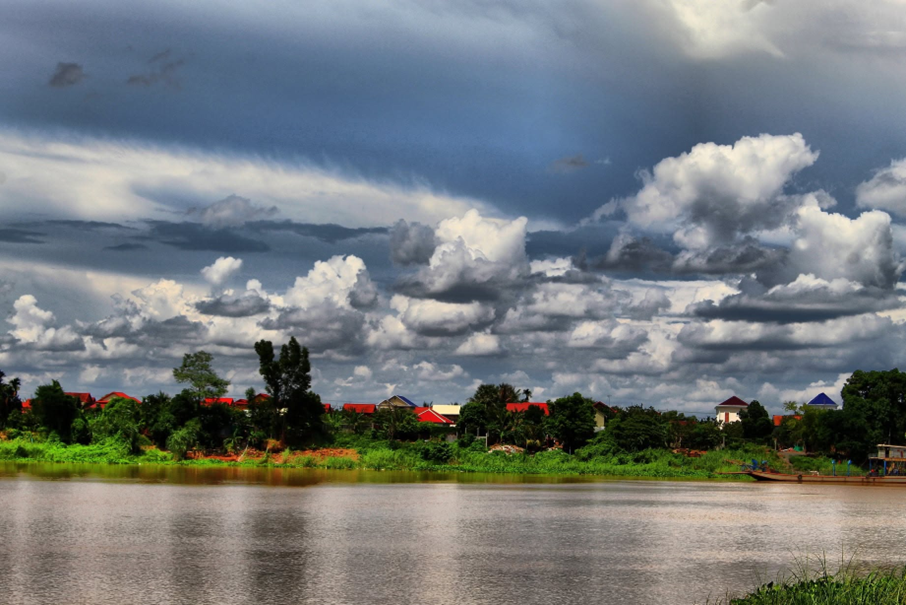
Heavy storm clouds roll over the Bassac, streaking the sky with dark blue and white, as the river, the color of packed earth, slides silently past the red rooftops of the village. On the far bank, a pagoda with golden gables pokes above the treetops. An elderly man, a checkered krama tied around his head and a cigarette between his lips, weaves his motorbike through the puddles of a rain-soaked laterite track. Further along, under the awning of a small shop, two young girls burst out laughing in front of the camera. This is Kaoh Anlong Chen, a small stretch of land along the Bassac, just south of Phnom Penh — a place few tourist maps mention, and yet one that lives, day after day, to the precise rhythm of this great arm of the Mekong.
The Bassac, a nourishing branch of the Mekong
The Bassac (ទន្លេបាសាក់, Tonlé Bassac) is born right in Phnom Penh, at the famous Chaktomuk confluence where the Mekong and the Tonlé Sap meet and split back into several branches. From there, it runs due south for about 190 kilometers, crosses Kandal province, then crosses into Vietnam near Chau Doc, where it takes the local name Sông Hậu.

The name "Bassac" itself is thought to come from the Khmer pa, a mark of respect or lineage, combined with sak (សក្តិ), borrowed from the Sanskrit sakti, meaning "power" or "honor" — a name that also echoes the old kingdom of Champasak, further up the Mekong, whose western capital bore a related name. Even today, the Bassac remains an active transportation corridor between Cambodia and Vietnam, plied by cargo barges, and crossed in Phnom Penh by the Monivong Bridge.
An island that isn't quite one anymore
The very name Kaoh Anlong Chen begins with kaoh, "island" in Khmer — a sign that this was originally a sandbank or stretch of riverbank shaped by the whims of the river, like so many others along the Bassac and the Mekong.

Administratively, Kaoh Anlong Chen is today a sangkat (commune) that for a long time belonged to S'ang District, before being transferred in 2019, by government sub-decree, to the municipality of Ta Khmau, the capital of Kandal province — an administrative shift that reflects the steady expansion of Phnom Penh's urban zone into its rural fringes. Ta Khmau itself lies only about twenty kilometers south of the capital, placing Kaoh Anlong Chen within that still-preserved but increasingly sought-after strip of countryside that separates Phnom Penh from the Mekong Delta.
Village life, in the shade of papaya trees
It's this contradictory closeness — almost urban in distance, still fully rural in way of life — that gives the village its character. The family gardens here are dense and generous: papaya trees bend under bunches of green, still-firm fruit.

A little further on, jackfruit trees let their spiky fruit dangle at head height, while banana groves are planted in tight rows in the shade of older, taller trees.


Une échoppe de quartier, chargée de bouteilles de sodas et de jouets en plastique suspendus en grappes, tient lieu d'épicerie et de lieu de passage obligé pour les habitants du coin.

On the water, wooden canoes moored along the muddy banks are a reminder that fishing and river transport remain part of daily life, even at this modest distance from the capital.

The village's children and teenagers, meanwhile, lead a life that is nothing extraordinary but keeps that particular charm of untouristed places: people smile easily at the camera here, get around by motorbike on dirt tracks still largely untouched by asphalt.


A place without a landmark, but not without character
Unlike other riverside towns in Cambodia, Kaoh Anlong Chen has no archaeological site, no colonial monument, no attraction listed in guidebooks. That's precisely what makes it a faithful snapshot of a Cambodian reality far more common than the postcards of Angkor or Phnom Penh: that of tens of thousands of ordinary, endearing riverside villages, where people farm, fish, raise children, and watch the seasons pass on the river, with no ambition beyond continuing to do so.
How to get there
Kaoh Anlong Chen lies within the municipality of Ta Khmau, the capital of Kandal province, a short half-hour's drive south of Phnom Penh. Since the area isn't set up for tourism, it's best visited by car or motorbike from the capital, taking the time to follow the Bassac's banks rather than rushing toward a specific destination — that unhurried pace, more than any listed site, is the real appeal of the place.


Comments